Bank Fraud Investigation Timeline: How Long Refund Decisions Take (2026)
Understand how bank fraud investigations work in 2026, including timelines for refunds, factors causing delays, and what victims can do to speed up decisions and recover funds.

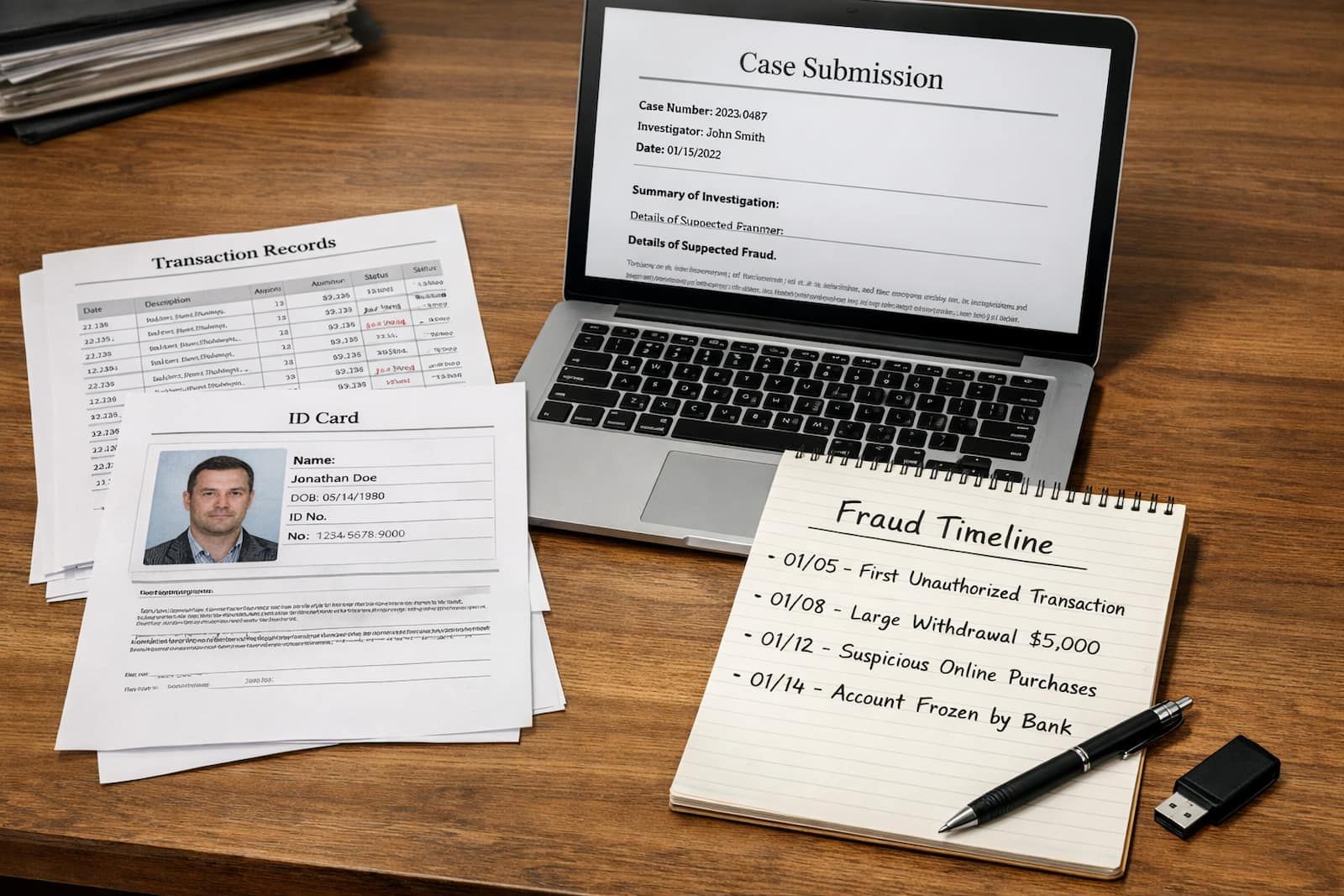
Bank fraud investigations are a queue plus an evidence test. Most delays come from missing documentation and slow interbank requests. This guide breaks the 2026 investigation timeline by stage, shows what triggers faster decisions, and gives scripts and escalation paths across the US, UK, Canada, Australia, and New Zealand.
A bank fraud investigation typically takes 10 to 45 business days to reach a refund decision, depending on the payment rail, how fast you report, and whether the bank needs interbank tracing. Faster outcomes usually require a complete evidence pack within 24 hours, clear dispute framing, and escalation to the correct complaint channel when deadlines slip.
Case File Opener: What “Under Investigation” Actually Means
A bank says “We are investigating” because it has two jobs.
First, stop more loss.
Second, decide liability. Who eats the loss. You, the bank, or another institution.
That decision does not happen by vibes. It happens by process steps, timestamps, and documentation. The scammer understands this. That is why the scam is built around speed. And why bank delays feel like watching paint dry on a burning house.
A bank fraud investigation is the bank’s internal review to verify what happened, whether the payment can be stopped or recalled, and whether policy or law requires a refund.
Refund rights and deadlines differ across the US, UK, Canada, Australia, and New Zealand, so treat timelines as typical ranges, not guaranteed clocks.
The Bank Fraud Investigation Timeline (2026): One-View Breakdown
Below is the reality map. Not the marketing map.
| Stage | What the bank is doing | Typical time range | What speeds it up |
|---|---|---|---|
| T+0 to T+24 hours | Freeze access, log case, triage the rail, attempt immediate recall | Same day to 1 day | Fast reporting and a complete evidence pack |
| Day 2 to Day 10 | Collect statements, device and login info, call notes, beneficiary data, request info from the other bank | 3 to 10 business days | Exact timestamps, screenshots, and a clean fraud narrative |
| Day 11 to Day 45 | Interbank responses, AML checks, decision review, refund approval or denial | 10 to 45 business days | Escalation to complaints when deadlines slip |
| Post-decision | Complaint review, ombudsman review, regulator complaint where appropriate | 2 weeks to several months | Policy framing and jurisdiction-correct escalation |
Scammers move in seconds. Banks move in committees.
DV Bank Reality Block: Why Timelines Stretch
Banks do not investigate in a straight line. They investigate in a queue.
They triage cases by:
- Amount lost
- Active account takeover risk
- Payment rail finality
- Whether another bank must respond
- Whether the facts look like unauthorized access or authorized payment
The stall points are boring and predictable:
- Missing evidence so the case becomes “pending customer documents”.
- Interbank dependency where one institution requests and the other institution delays.
- Internal handoffs between fraud ops, disputes, compliance, and complaints.
The “we are looking into it” script is a pillow. It is not a process.
Your job is to reduce ambiguity. Banks decide faster when the file reads like a timeline, not a rant.
The First 24 Hours: Your Timeline Starts Now (Not When the Bank Calls Back)
Timeline reality. The first day decides whether money can be stopped, and whether your claim looks credible.
Use this 24-hour plan.
T+0 to T+30 minutes
- Call the bank fraud line.
- Ask for a case or reference number.
- Ask what rail it was: transfer, wire, real-time payment, bill pay.
- Ask if a recall or trace has been sent.
T+30 minutes to T+2 hours
- Change passwords and enable MFA.
- Scan devices for remote access tools.
- Freeze your credit if identity theft is possible.
T+2 hours to T+24 hours
- Build your evidence pack.
- Submit it in one clean bundle.
A partial report creates a partial investigation.
DV Evidence Pack: The Documents That Change a Refund Decision
Screenshot artifact reality. Banks decide faster when the evidence is ready and consistent.
- [ ] Fraud timeline with exact timestamps
- [ ] Screenshots of texts, emails, social posts, and any in-app messages
- [ ] Recipient details shown in your banking app
- [ ] Call logs and voicemails
- [ ] Proof of impersonation if it was a fake bank or government caller
- [ ] Device evidence if remote access happened
- [ ] Any police report number if you filed one
One sentence that often helps: “This payment was induced by deception and coercion, and the beneficiary details were controlled by criminals.”
Scammers do not want secrecy. They want you to feel too embarrassed to document it.
Paperwork is the opposite of panic.
Two Micro-Scenarios With Numbers (What the Timeline Looks Like)
Process reality. Numbers below are illustrative. Use currency equivalents in your region.
Scenario 1: Consumer APP transfer scam
- Amount: $3,800
- Rail: real-time bank transfer
- Reported: 45 minutes after sending
- Evidence pack submitted: same day
What usually happens:
- Day 1: Bank attempts recall. Recipient bank may freeze if funds are still there.
- Day 2 to Day 7: Requests go out. Banks check beneficiary KYC data.
- Day 10 to Day 30: Decision review, refund yes or no.
Sending a real-time transfer and hoping for reversal is like dropping cash into a moving taxi and chasing it barefoot.
Speed wins or you chase ghosts.
Scenario 2: SMB invoice fraud
- Amount: $28,000
- Rail: wire transfer
- Reported: next morning
- Evidence: vendor emails, invoice, bank details change request, domain spoof proof
What usually happens:
- Day 1: Wire recall and SWIFT trace request.
- Day 3 to Day 15: Intermediary banks respond. Recipient bank checks account activity and holds if possible.
- Day 15 to Day 45: Decision and recovery probability assessment.
Invoice fraud is not clever. It is email plus audacity.
If the recipient account is in another country, timelines lengthen because interbank cooperation and legal processes can add weeks.
Every extra day is oxygen for criminals.
Decision Threshold Triggers (Snippet-Ready)
Policy reality.
If your bank has not confirmed a recall or trace within 24 hours, then escalate to the bank complaints channel and demand written confirmation of the actions taken and the date sent.
If you reported the fraud within 24 hours and provided a complete evidence pack, then ask for the bank’s expected decision deadline in writing.
If the bank requests documents you already provided, then resubmit the bundle and include the case number and original submission date.
Some delays are not investigation. They are amnesia with a headset.
Deadlines beat sympathy.
Escalation Ladder: Who You Escalate To, and When
Regulator reality. Escalation works only when you escalate to the correct place.
Use this ladder.
- Fraud operations team
- Goal: stop further loss, send recall, confirm rail type.
- Disputes or claims team
- Goal: decision timeline and evidence review.
- Formal complaints team
- Goal: written response, deadline commitments, policy citations.
- External escalation (jurisdiction correct, after complaint steps)
- United States: Consumer Financial Protection Bureau (CFPB) complaint.
- United Kingdom: Financial Ombudsman Service (FOS) after the firm’s final response.
- Canada: Bank complaint process, then the external complaints body relevant to the institution. FCAC for compliance concerns.
- Australia: Australian Financial Complaints Authority (AFCA).
- New Zealand: The bank’s dispute resolution scheme. Other agencies may apply depending on facts.
The “Bank Script” Translation (So You Stop Losing Weeks)
Fraud mechanic reality.
Script from bank: “We are still investigating.”
Translation: “We are waiting on information, your file is in a queue, or the case is not in the right team.”
Script from bank: “It looks like you authorized it.”
Translation: “This may be treated as an APP scam. We need a liability basis to refund.”
Script from bank: “We cannot disclose details.”
Translation: “We can disclose actions and dates. Push for those.”
The script is designed for call time, not for your outcome.
Ask for actions and dates. Not reassurance.
Scripts protect call metrics, not victims.
Cost Lens: What Delays Actually Cost (Simple Math)
Cost reality.
Fraud loss is not only the stolen amount. It is the damage around it.
Example math.
- Stolen amount: $5,000
- Overdraft fees and bounced payments: $120
- Missed bill late fees: $90
- Time spent: 8 hours
- Hour value (conservative): $30
Total extra cost: $120 + $90 + (8 × $30) = $450
Now SMB math.
- Fraud loss: $28,000
- Payroll delay penalties or emergency credit cost: 2 percent short-term cost
2 percent of $28,000 = $560
Delays are not neutral. They are a second invoice.
Time is money and delays burn both.
- If the money moved today, use the first-day checklist: First 24 hours fraud recovery steps
- If the recipient bank is overseas, reset expectations: Cross-border fraud investigation reality
FAQ: Bank Fraud Investigation Timelines (2026)
1) How long does a bank fraud investigation take?
Commonly 10 to 45 business days for a decision, depending on payment rail and interbank responses.
2) Why does the bank keep saying “under review”?
Usually missing documents, waiting on another bank, or your case is in a queue that is not prioritized.
3) Does reporting faster change the outcome?
It can. Faster reporting increases the odds of a recall, freeze, or trace before funds disappear.
4) What is the single best thing to submit?
A clean timeline with timestamps plus screenshots that match the timeline.
5) Should you file a police report?
It can help create an official record. It is not a magic refund switch.
6) What if the bank says you authorized the transfer?
That usually means APP scam framing. Your evidence must focus on deception, coercion, impersonation, and control of beneficiary details.
7) Can a bank reverse a wire transfer?
Sometimes. Wires are difficult. Success depends on timing and whether funds are still available.
8) What if the recipient account was opened with fake identity?
That becomes a KYC and AML failure question. Still submit evidence. Still escalate.
9) When should you escalate to an ombudsman?
When the bank gives a final response, or when complaint deadlines are missed, depending on jurisdiction.
10) Can you speed up the decision?
You can reduce delay by submitting a complete evidence pack early and escalating through the correct complaint channel.
Reviewed for accuracy: March 2026
Regulatory reference placeholders (source name only): CFPB, Financial Ombudsman Service, FCAC, AFCA, New Zealand dispute resolution schemes
Recovery depends on timing, documentation, and bank cooperation.
Disclaimer: This article is for education and general information. It is not legal advice. For urgent cases, contact your bank immediately and consider qualified legal or financial help for your situation.
If the bank stalls, your paperwork sprints.
Document everything and escalate on the deadline, not the mood.