Gold Courier Scams: How Imposter Scammers Convince Senior Victims to Liquidate Retirement Assets into Gold Bars
Gold courier scams convince seniors to liquidate retirement savings, buy gold bars, and hand them to fake couriers. Learn the warning signs, evidence to preserve, reporting steps, and realistic recovery options.

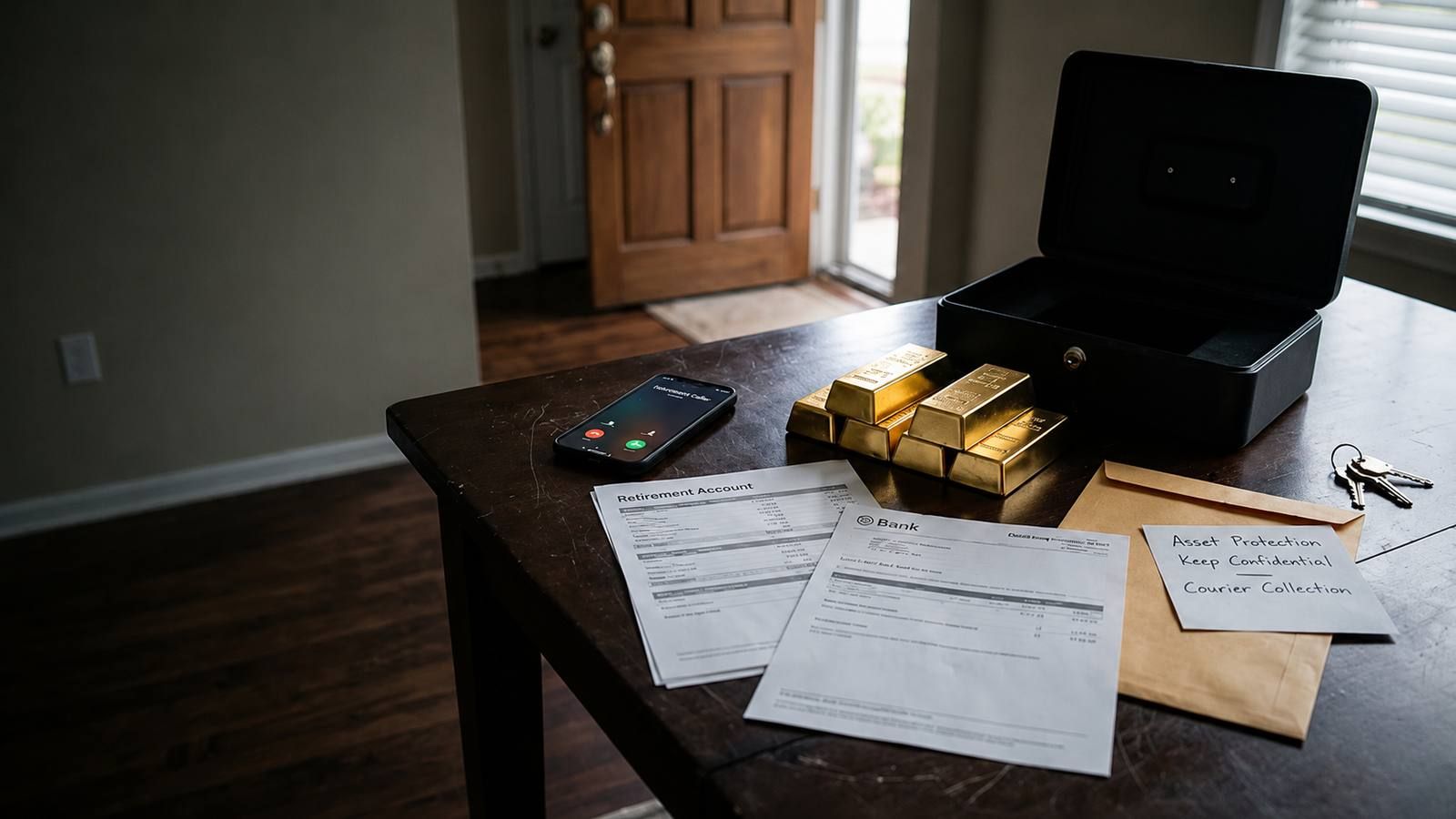
A real government agent does not tell your mother to buy gold bars, hide the purchase from the bank, and hand the metal to a stranger in a parking lot.
That is not “asset protection.”
That is a gold courier scam, and it is one of the nastier fraud models now targeting older Americans because it moves the crime scene out of the bank app and straight into the victim’s driveway. The scammer does not need a crypto wallet, a fake investment dashboard, or some ridiculous trading bot with a yacht logo. They need fear, secrecy, a fake badge, and a courier willing to collect stolen retirement savings in physical form.
According to the FBI’s 2025 Internet Crime Report, gold courier scams generated approximately 725 complaints and $311.8 million in reported losses. The FBI also warned in a January 2024 IC3 public service announcement that scammers were instructing victims, many of them senior citizens, to liquidate assets into cash or buy gold, silver, or other precious metals, then arranging in-person couriers to collect the assets. That is not small-time fraud. That is organized theft wearing a cheap government costume.
TL;DR
- A gold courier scam is a fraud where imposters convince victims to buy gold, cash out savings, or liquidate retirement assets, then hand the physical assets to a fake “courier.”
- The core danger is that physical gold and cash can disappear fast once collected, but the handoff may still leave evidence: dealer records, bank withdrawals, phone logs, vehicle details, surveillance footage, receipts, and location data.
- If this is happening now, stop the handoff, call local police immediately, contact the bank and gold dealer, preserve every message, and file an FBI IC3 complaint within the next fifteen minutes.
- This article focuses on the United States. Recovery, reporting, banking obligations, and legal options depend on state law, payment method, timing, evidence, and law enforcement action.
What A Gold Courier Scam Is
A gold courier scam is a physical asset retrieval fraud where criminals impersonate trusted authorities, such as tech support agents, bank investigators, federal officers, fraud department staff, or government officials, and tell the victim to “protect” money by converting it into gold, cash, or precious metals.
Then comes the punchline from the gutter: the victim is told to hand the assets to an “authorized courier.”
No legitimate FBI agent, bank investigator, Microsoft employee, Federal Reserve official, Social Security worker, or Treasury representative collects gold bars from civilians at home. That is not how investigations work. That is how thieves operate when they want the money off the digital rails and into a bag.
The scam often targets older adults because scammers believe seniors may have retirement savings, home equity, investment accounts, and a higher likelihood of trusting official-sounding callers. That does not make the victim foolish. It makes the criminal predatory. There is a difference, and the scammer would very much like everyone to forget it.
The Script: How Scammers Turn Retirement Savings Into Gold Bars
Gold courier scams usually follow a controlled sequence. The details vary, but the machinery is depressingly consistent.
1. The Fear Hook
The scam starts with a fake alert.
Common openings include:
- “Your computer has been hacked.”
- “Your bank account is compromised.”
- “Your Social Security number is involved in a crime.”
- “Your money is being targeted by foreign hackers.”
- “Your account is under federal investigation.”
- “We need to move your assets to protect them.”
Sometimes the first contact comes through a fake tech support pop-up. Sometimes it is a phone call. Sometimes the victim is passed from one fake department to another like the scammer is running a discount theater production called Federal Agency: The Musical.
The purpose is not to explain. The purpose is to panic.
2. The Authority Stack
The scammer may pretend to be:
- Tech support.
- A bank fraud investigator.
- A Federal Trade Commission official.
- An FBI agent.
- A U.S. Marshals Service officer.
- A Treasury or Federal Reserve employee.
- A local police detective.
- A “cybercrime unit” representative.
This layered impersonation is deliberate. The victim is made to believe multiple independent authorities are confirming the same emergency. In reality, it is the same criminal operation passing the phone around or using different aliases.
Fake authority is the scam’s engine. Without it, “buy gold and give it to my courier” sounds exactly as insane as it is.
3. The Secrecy Order
Then comes the gag order.
The victim may be told:
- Do not tell family.
- Do not speak to bank staff.
- Do not mention the investigation.
- Do not say the gold is for someone else.
- Do not call the police because “we are already the police.”
- Do not hang up.
- Keep the phone line open while going to the bank or dealer.
This is not confidentiality. This is isolation.
Real investigators do not require victims to lie to their banks, hide transactions from relatives, or remain on the phone while liquidating assets. Scammers do, because the whole scam collapses the second a skeptical family member, teller, compliance officer, or police dispatcher interrupts the script.
4. The Liquidation
The victim is instructed to move money out of safer, traceable, or harder-to-access places and into physical assets.
That can mean:
- Withdrawing large amounts of cash.
- Wiring funds to a precious metals dealer.
- Buying gold bars or coins.
- Selling investments.
- Closing certificates of deposit.
- Taking money from retirement accounts.
- Moving money from savings into checking before withdrawal.
- Purchasing precious metals in multiple transactions to avoid questions.
This stage creates an evidence trail. The scammer hates that. Good.
Bank records, wire confirmations, dealer invoices, cashier’s checks, withdrawal slips, account notes, teller interactions, and surveillance footage may all matter later.
If a bank employee questioned the transaction and the victim repeated a scammer-provided cover story, document that too. Do not sanitize the record. Investigations run on facts, not embarrassment management.
5. The Courier Pickup
The final stage is the physical handoff.
The courier may meet the victim:
- At the victim’s home.
- In a parking lot.
- Near a bank.
- Near a precious metals dealer.
- At a retail location.
- At a hotel lobby.
- Near a public landmark.
- In a vehicle with temporary plates, rideshare-style behavior, or no obvious identification.
The courier may claim to be from a “secure transport service,” “federal evidence unit,” “bank security team,” or “asset protection department.” Lovely little costume party. Still theft.
The victim may be instructed to package the gold or cash in a box, envelope, bag, or wrapped parcel. Sometimes scammers tell victims to photograph the package or read serial numbers. Sometimes they schedule multiple pickups.
If the courier has not arrived yet, call 911. Do not stage a confrontation. Do not play amateur detective. Do not “see what happens.” Physical pickups can involve organized criminal networks, and your job is to protect the victim, not audition for a surveillance thriller.
Why Gold Courier Scams Are So Profitable
Digital payments can be traced through bank rails, crypto ledgers, app records, device logs, and receiving accounts. Recovery is still difficult, but there is usually a transaction record.
Gold and cash create a different problem.
Once the victim hands physical assets to a courier, the trail becomes more dependent on:
- Timing.
- Location evidence.
- Surveillance footage.
- Vehicle information.
- Courier identification.
- Phone metadata.
- Dealer records.
- Bank withdrawal records.
- Witnesses.
- Law enforcement speed.
That is why scammers love this model. They move the money from regulated systems into a physical chain of custody they control. It is the fraud equivalent of dragging evidence into an alley and hoping no one brought a flashlight.
But “harder to trace” does not mean “impossible to investigate.” Families should not give up just because the asset was physical. The handoff may leave a messy trail. Messy trails are still trails.
The First Fifteen Minutes If A Handoff Is Happening Now
If your parent, spouse, grandparent, or relative is currently being told to buy gold or meet a courier, stop reading like this is a documentary. Act.
| Situation | What To Do Now | Why It Matters |
|---|---|---|
| Courier has not arrived | Call 911 and explain there is an active elder financial exploitation scam with a planned physical pickup | Police may be able to intercept or document the courier safely |
| Victim is at a bank or gold dealer | Call the branch or dealer if possible and ask for fraud intervention | Staff may pause the transaction before assets leave the building |
| Victim is on the phone with scammers | Get the victim off the call without arguing about pride or blame | The scammer’s control depends on uninterrupted pressure |
| Gold or cash was already purchased | Photograph receipts, packaging, serial numbers if available, and dealer documents | These details can support tracing and reporting |
| Handoff already occurred | Call local police, file an IC3 report, notify the bank and dealer, and preserve all evidence | Speed improves the chance of locating surveillance, vehicles, and suspects |
Do not start with a family debate about how the victim “could believe this.” That conversation is useless, cruel, and operationally stupid. The victim is under pressure. Break the scammer’s control first. Process emotions later.
For broader account containment after online banking compromise, use the first-day response steps in What To Do After Online Banking Fraud: Step-by-Step Guide. Keep this gold courier case focused on the physical pickup, but do not ignore account access if scammers touched devices, passwords, or banking apps.
Evidence That Matters In A Gold Courier Scam
A gold courier case needs a timeline, not a pile of panic screenshots dumped into a folder called “scam stuff.”
Build the file like this.
Communication Evidence
Save:
- Phone numbers used by the scammers.
- Voicemails.
- Text messages.
- Emails.
- Chat logs.
- Fake case numbers.
- Fake badge numbers.
- Names, titles, and agencies claimed.
- Any remote access app names.
- Screenshots of pop-ups or fake security alerts.
- Call logs showing dates, times, and durations.
Do not delete embarrassing messages. Scammers rely on shame as a cleanup crew.
Financial Evidence
Collect:
- Bank withdrawal receipts.
- Wire transfer confirmations.
- Cashier’s check records.
- Precious metals dealer invoices.
- Gold bar or coin descriptions.
- Serial numbers, if shown on receipts or packaging.
- Account statements showing liquidation.
- Retirement account withdrawal documents.
- Teller notes or branch interaction details, if available.
- Any warnings shown by the bank or dealer.
If a bank transfer funded the gold purchase, recovery may still depend on payment rail, timing, and whether funds remain reachable. For bank-transfer recovery mechanics, focus on speed: call your bank’s fraud department, request an immediate recall/trace, ask whether the receiving bank can be contacted, and document the exact transfer details (date/time, amount, recipient name, account/reference numbers). Do not assume a gold purchase makes the bank irrelevant. The money still moved through something before it became metal.
Courier Evidence
Write down immediately:
- Pickup date and time.
- Exact location.
- Vehicle make, model, color, and plate number.
- Direction of travel.
- Courier description.
- Clothing.
- Accent or speech details only if genuinely observed.
- Whether the courier used a rideshare, taxi, rental, or personal vehicle.
- Any doorbell camera, neighbor camera, business camera, or traffic camera nearby.
- Whether the courier showed a badge, ID, paperwork, or phone screen.
Surveillance footage disappears. Businesses overwrite video. Doorbell cameras may purge clips. Move fast. Polite delay is how evidence dies.
Can The FBI Or Police Trace Gold Courier Scams?
Sometimes, but nobody honest should promise recovery.
Law enforcement may investigate using:
- IC3 complaint data.
- Local police reports.
- Surveillance footage.
- Vehicle records.
- Phone records obtained through legal process.
- Dealer records.
- Bank transaction records.
- Package or pickup patterns.
- Courier identification.
- Links to other complaints in the same region.
- Coordination across agencies when patterns emerge.
The FBI’s Internet Crime Complaint Center is an intake and analysis hub. Filing with IC3 helps federal investigators identify patterns, connect complaints, and route information. It does not guarantee an agent will call you back tomorrow with dramatic background music and a recovered gold bar.
Local police matter because the handoff happened in a physical jurisdiction. They may be able to collect surveillance, document the scene, contact nearby businesses, and create a police report needed for banks, insurers, attorneys, or later proceedings.
If the victim is 60 or older and needs help filing an IC3 complaint, FBI warnings have pointed victims to local FBI field offices and the DOJ Elder Justice Hotline at 1-833-FRAUD-11 or 833-372-8311.
That hotline is not a magic refund wand. It is a real reporting and assistance route. Use it.
What Banks Actually See
Banks may see a customer withdrawing money, wiring funds, buying a cashier’s check, or moving assets. From the bank’s system view, some transactions may look authorized because the customer was present, authenticated, and gave instructions.
That is the ugly procedural problem.
The scammer manipulated the victim, but the transaction may still appear customer-authorized on the surface. This is where families often get furious and say, “The bank should have stopped it.”
Maybe. Maybe not. The answer depends on facts.
A stronger complaint may exist if evidence shows:
- Unusual withdrawals far outside the customer’s normal pattern.
- Repeated liquidation activity.
- Elder vulnerability indicators.
- Staff noticed red flags but failed to escalate.
- The victim gave inconsistent explanations.
- The transaction matched known scam typologies.
- The institution ignored its own procedures.
- Reporting happened quickly and the bank delayed action.
- A wire, check, or transfer recall could have been attempted sooner.
A weak complaint is just “they should have known.” That may be emotionally true and procedurally useless.
Evidence beats outrage. Outrage can be justified. Evidence moves the file.
For deeper dispute strategy after a bank denial, see Why Banks Reject Scam Refund Claims and What Evidence Actually Changes Their Minds.
The Red Flags Families Should Treat As A Siren
If any of these appear, assume fraud until proven otherwise:
- A caller says money must be converted into gold, silver, cash, or precious metals.
- The victim is told not to tell family.
- The victim is told to lie to the bank or gold dealer.
- A “government official” wants assets handed to a courier.
- A “bank investigator” says the bank itself is compromised and cannot be trusted.
- The caller keeps the victim on the phone during withdrawals or purchases.
- The victim is told to visit multiple banks or dealers.
- The victim suddenly becomes secretive about finances.
- Large withdrawals are framed as “protecting assets.”
- The caller uses fake case numbers, badge numbers, or “federal reserve” language.
- The victim is told the courier will “safeguard” assets in a protected account.
- The caller threatens arrest, account seizure, or family consequences.
- The scammer says the victim is helping an investigation.
The “helping an investigation” line deserves special contempt. Real investigators do not recruit scared grandparents into covert gold logistics. That is not public service. That is a heist with hold music.
What To Say To A Parent Who Is Under The Scammer’s Control
Do not lead with “You’re being scammed.”
That may trigger shame, defensiveness, or deeper compliance with the caller. Scammers often pre-load victims with warnings that family members will “interfere” or “ruin the investigation.”
Use calm interruption.
Try:
- “I believe you were trying to protect your money. We need to verify this through official numbers only.”
- “Real federal agents do not collect gold from homes. Let’s call the local police using 911 or the official non-emergency number.”
- “You are not in trouble. The person on the phone is trying to isolate you.”
- “Do not hand anything to anyone until police verify it in person.”
- “Let’s stop the transaction first. We can sort out the details after.”
Do not argue every detail. Break the chain of obedience.
The scammer’s strongest weapon is control. Your first job is to cut the leash.
Reporting Checklist For U.S. Victims
Use this sequence if the purchase or pickup already happened.
- Call local police immediately. Say: “This is an elder financial exploitation case involving a physical courier pickup of gold, cash, or precious metals.”
- File an FBI IC3 complaint at ic3.gov. Include the courier details, financial records, phone numbers, dealer information, and pickup location.
- Contact the bank fraud department. Ask for written confirmation of any recall, hold request, wire trace, or suspicious activity report handling where applicable.
- Contact the precious metals dealer. Request copies of invoices, payment records, product details, shipment or pickup records, and surveillance preservation if the purchase occurred in person.
- Preserve surveillance fast. Ask neighbors, businesses, building managers, and doorbell camera owners to save footage from the relevant time window.
- Secure devices and accounts. If tech support access was involved, disconnect the device from the internet and use a clean device to change passwords.
- Watch for recovery scammers. Anyone promising guaranteed recovery for an upfront fee is circling the wreckage looking for seconds.
If the case also involved identity information, new accounts, credit applications, or stolen personal documents, consider whether credit freezes or fraud alerts are needed. When in doubt, start with a freeze at all three credit bureaus (Equifax, Experian, and TransUnion), pull your credit reports to look for new accounts, and file an FTC IdentityTheft.gov report if personal data was misused.
What Recovery Really Looks Like
Recovery depends on where the loss occurred in the chain.
| Loss Stage | Possible Action | Reality Check |
|---|---|---|
| Money still in bank account | Freeze account, block withdrawal, cancel cashier’s check if possible | Best chance if caught before funds leave |
| Wire sent to dealer | Bank may attempt recall or trace | Success depends on timing, recipient cooperation, and whether funds remain |
| Gold purchased but not collected | Contact dealer, police, and bank immediately | Transaction may be stoppable if assets have not left custody |
| Gold handed to courier | Police investigation, surveillance recovery, vehicle tracing, IC3 pattern matching | Harder, but not automatically hopeless |
| Multiple pickups occurred | Build complete timeline and report every pickup | Patterns may help connect the case to a larger ring |
| Recovery company contacts victim | Do not pay upfront recovery fees | Recovery scammers love fresh victims because apparently one theft was not disgusting enough |
There is no universal refund rule for gold courier scams. The case may involve bank procedures, elder exploitation law, wire rules, dealer records, insurance questions, civil claims, criminal investigation, or family protective action. Anyone who says “guaranteed recovery” is either clueless or preparing scam number two.
Common Mistakes That Make The Case Worse
Avoid these.
Waiting Because The Victim Is Embarrassed
Embarrassment is understandable. Delay is expensive.
The courier’s vehicle, phone records, surveillance footage, and related evidence age badly. Move.
Letting The Scammer “Explain”
Do not keep talking to the scammer to gather more information unless law enforcement specifically advises it. Scammers use every extra minute to regain control.
Confronting The Courier
Do not physically confront the pickup person. Couriers may be low-level mules, organized crime participants, or people who do not care who gets hurt. Call police.
Cleaning Up The Victim’s Phone
Do not delete call logs, messages, remote access apps, or browser history before preserving evidence. The phone may look ugly. Evidence often does.
Paying A Recovery Expert
Real law enforcement does not demand upfront recovery fees. Real banks do not require gift cards, crypto, or “processing deposits” to release money. Fake recovery clowns show up after scams because the victim list is already warm.
FAQ
Is it normal for the FBI or a bank investigator to tell someone to buy gold?
No. Legitimate federal agents and bank investigators do not instruct civilians to buy gold bars, hide the purchase, and hand the assets to a courier. That is a scam signal, not a security procedure.
Can gold courier scam victims get their money back?
Sometimes recovery may be possible, but it is difficult and never guaranteed. The odds depend on timing, whether the gold was collected, whether surveillance or courier evidence exists, how the purchase was funded, and how quickly banks, dealers, police, and federal reporting channels are notified.
Should we call local police or only file with the FBI IC3?
Do both. Local police handle the physical incident location and may preserve local evidence. IC3 helps federal authorities analyze patterns and connect complaints. One report does not replace the other.
What if my parent willingly withdrew the money?
That does not mean the situation was legitimate. Many scam payments are “authorized” in the narrow banking sense but made under deception, impersonation, coercion, or manipulation. The distinction matters for recovery, but it does not make the victim responsible for the criminal’s lies.
What should I tell the gold dealer?
Tell the dealer the purchase may be linked to elder financial exploitation and a courier scam. Ask them to preserve transaction records, invoices, product details, payment records, staff notes, and surveillance footage. Keep the request factual. Drama does not preserve video. Specific requests do.
Can the courier be traced?
Possibly. Vehicle details, license plates, surveillance footage, phone records, pickup location, witness statements, and links to other complaints can help. But tracing depends heavily on speed and evidence quality.
What if the scammer says the victim will be arrested for talking?
That is a control tactic. Scammers use fake legal threats to isolate victims. If someone claims to be law enforcement but demands secrecy, gold, cash, or courier delivery, end contact and verify through official phone numbers.
Legal And Financial Disclaimer
This article is for general educational information only and is not legal, financial, or professional advice. Scam refund rules vary by country, state, payment method, bank policy, evidence, timing, and case details. If you need advice about your specific situation, contact a qualified legal, financial, or consumer-rights professional in your jurisdiction.
Cold Truth
Gold courier scams work because criminals understand something ugly: fear can make a smart person follow insane instructions if the voice on the phone sounds official enough.
So strip the costume off the scam.
No real agency protects retirement savings by sending a stranger to collect gold bars. No real bank secures an account by telling a senior to lie at the branch. No real investigator needs a frightened victim to become a private bullion transport service.
If someone says your money is only safe after you turn it into gold and hand it to a courier, the investigation is already over.
You found the thief.