Fake Bank Romance Scams in New Zealand: How to Verify a Financial Institution
Learn how fake bank romance scams steer New Zealand victims to sham financial institutions, harvest identity documents and demand release fees. Use FMA warnings and official registers to verify a bank, then act quickly if you shared money or personal data.

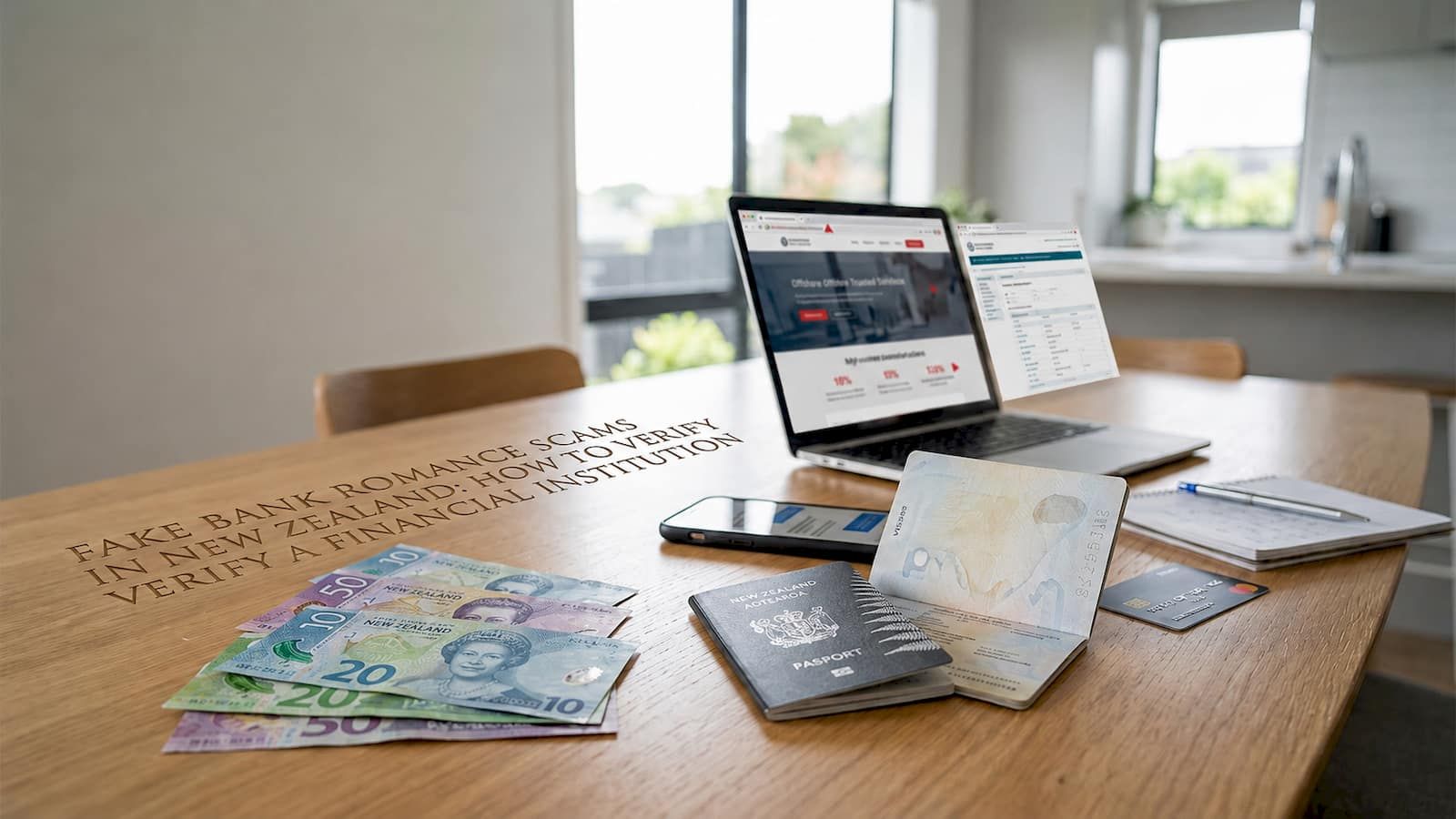
A bank website can display your name, a convincing account balance, and a polished transaction history without holding any real funds.
That is the method behind a fake bank romance scam: a fraudster builds an online romantic relationship, directs the victim to a fabricated or impersonated financial institution, and uses the fake banking portal to steal deposits, identity documents, login credentials, or financial information.
On 12 February 2026, New Zealand’s Financial Markets Authority (FMA) warned that scammers were posing as romantic partners and persuading victims to open accounts with fake banks. The FMA said scammers could manipulate the websites to show fictional payments before demanding “fees” or “taxes” to release money that did not exist.
The critical rule is simple: verify the institution independently before uploading identification, opening an account, or transferring money. A professional-looking website is not evidence of legitimacy. Evidence includes a verified legal identity, the correct regulatory status for the service offered, and contact details confirmed through an independent official source.
TL;DR
- A fake bank romance scam uses emotional trust to direct victims to a fraudulent banking website designed to steal money and personal information.
- A displayed account balance is not proof that funds exist. Scammers controlling the portal can manufacture balances, deposits, transfers, and withdrawal restrictions.
- Immediately check the exact institution through the Reserve Bank of New Zealand’s registered-bank list, the FMA’s licensed entities list, the Financial Service Providers Register, and the FMA’s warnings database.
- FSPR registration is not the same as an FMA licence, and neither a company listing nor a copied registration number proves that the website contacting you belongs to the registered entity.
- This guidance focuses on providers operating within New Zealand’s regulatory framework. Offshore institutions may be subject to different regulators, but their claims still require independent verification.
What Is a Fake Bank Romance Scam?
A fake bank romance scam is a form of romance fraud in which a supposed romantic partner persuades the victim to use a fabricated or impersonated financial institution. The fake bank collects identity documents, credentials, or deposits and may display fictional account balances before demanding additional payments.
The “bank” may be entirely invented. In other cases, scammers may borrow the name, address, or registration details of a real business while directing victims to a website, phone number, or messaging account controlled by criminals.
This creates two separate layers of deception:
- The relationship supplies trust.
- The fake banking website supplies false financial credibility.
The romantic partner may claim to need help receiving wages, moving an inheritance, completing an international transfer, or accessing money from an overseas employer. The victim is then asked to open an account at a particular institution.
At this point, emotional trust is converted into financial access, and the supposed bank becomes a vehicle for credential theft, identity theft, and payment fraud.
How the Scam Progresses From Online Romance to a Fake Bank
The FMA’s February 2026 warning describes a clear progression.
1. The Scammer Establishes Contact
The approach may begin through:
- A dating application
- Social media
- A private message
- A wrong-number conversation
- An online community
The profile may appear stable, successful, and emotionally available. That image is part of the deception.
2. The Relationship Develops Over Time
The FMA warned that scammers may spend months or even years developing a relationship.
The person may claim to work somewhere remote, such as an oil rig or military base. This explanation is used to justify why in-person meetings are impossible and video calls are unreliable.
One failed video call proves little. A persistent pattern of excuses for avoiding live verification is a serious warning sign.
3. A Financial Problem Appears
After establishing emotional trust, the supposed partner claims to need assistance. For example, the person may say they need help receiving wages from an employer.
The victim is instructed to open an account with a particular “bank,” often an unfamiliar offshore institution.
4. The Fake Bank Requests Personal Information
The account-opening process may demand:
- Passport photographs
- Driver’s licence images
- Proof of address
- Bank statements
- Selfies or identity-verification videos
- Phone numbers and email addresses
- Existing bank-account details
- Passwords or security information
A genuine institution may conduct customer identification checks. That does not make every document request genuine. The institution, domain, and regulatory status must be verified before anything is uploaded.
5. The Portal Displays Fictional Money
Because the scammers control the website, they can make an account appear to have received a large deposit.
That balance is not independently settled money. It is a number entered into a criminal’s database.
The portal may also show professional-looking:
- Account numbers
- Transaction histories
- SWIFT references
- Compliance notices
- Currency conversions
- Pending transfers
- Tax calculations
- Withdrawal reviews
Interface design is not evidence of regulation. A polished dashboard can be produced cheaply and manipulated completely by its operator.
6. The Withdrawal Trap Begins
The victim is told that the displayed funds cannot be withdrawn until another payment is made.
The demand may be labelled as:
- Tax
- Account activation
- Anti-money-laundering verification
- Cross-border clearance
- Transfer insurance
- Currency conversion
- Compliance certification
- Security deposit
- Withdrawal release fee
The FMA warned that paying these charges does not release the fictional money. It simply gives the scammers another payment.
Why a Professional-Looking Banking Portal Proves Nothing
A website proves that someone created a website.
It does not prove that the operator:
- Has the registration or licence legally required for the service offered
- Is the legal entity named on the page
- Controls the address displayed
- Has custody of the shown funds
- Can settle withdrawals
- Is supervised by the FMA or another regulator
- Owns the registration number it displays
- Has any physical presence in the country it claims
Scammers can copy regulatory language, legal disclaimers, staff photographs, branch addresses, and privacy policies. They can also create fake support chats and manipulate every balance visible inside the account.
The correct question is not, “Does this look like a bank?”
It is: “Can I connect this exact website and its contact details to an appropriately authorised legal entity using information obtained independently?”
If the answer is no, do not send money or documents.
Warning Signs the Romantic Partner May Be a Scammer
A single unusual detail does not automatically prove fraud. A pattern of emotional pressure, financial requests, and resistance to verification should be treated as a serious warning.
Watch for a romantic interest who:
- Introduces an unfamiliar offshore bank
- Pushes the relationship into love, commitment, or financial trust unusually quickly
- Cannot meet in person and always has a new reason to avoid live video verification
- Claims to work in a remote location with unreliable communications
- Asks you to receive wages, inheritance money, or business funds
- Wants an account opened in your name
- Provides the bank link rather than encouraging independent research
- Insists that you keep the relationship or transaction secret
- Discourages you from speaking to family, friends, your bank, or a regulator
- Coaches you on what to tell your bank
- Becomes angry, distressed, or threatening when asked for evidence
- Treats reasonable verification as proof that you “do not trust” them
- Promises a financial reward for helping
- Moves the conversation to WhatsApp, Telegram, or another private channel
Emotional pressure is not financial verification. If reasonable due diligence is treated as a threat to the relationship, the relationship may be the control mechanism.
Warning Signs the Supposed Bank Is Fake
Stop before depositing money if the institution:
- Communicates only through WhatsApp, Telegram, or private messages
- Uses an email address unrelated to its claimed official domain
- Has no verifiable licence or regulatory information
- Claims registration but provides no searchable legal name or FSP number
- Uses a registration number belonging to another entity
- Has website details that do not match official records
- Demands a deposit before activating the account
- Accepts payment only through unrelated bank accounts, money mules, or cryptocurrency
- Asks you to send funds to an individual rather than the institution
- Shows a balance that cannot be confirmed outside its own portal
- Requires “tax,” “verification,” or “release” payments before withdrawal
- Refuses to provide written terms explaining fees and legal jurisdiction
- Claims a regulator has approved, guaranteed, or endorsed the transaction
- Requests excessive identity documents before its own identity can be verified
- Has no independently confirmed telephone number or physical address
- Pressures you to act before a supposed transfer expires
Also check the domain carefully. Misspellings, extra words, and unfamiliar domain endings matter, but a clean-looking domain is not proof of legitimacy. A correctly spelled domain can still be fraudulent.
How to Verify a Financial Institution in New Zealand
Verification should begin outside the website supplied by the romantic partner.
Do not use the portal’s support number, live chat, or “regulator verification” link. Those channels may be controlled by the same criminal group.
1. Record the Institution’s Exact Claims
Before searching, write down:
- Exact legal name
- Trading name
- FSP or licence number
- Website domain
- Physical address
- Email domain
- Telephone number
- Claimed regulator
- Financial services offered
- Name of the person contacting you
- Payment destination and recipient name
Small mismatches matter. “Global Capital Bank Limited” and “Global Capital Banking Ltd” are not automatically the same entity.
2. Check the Reserve Bank of New Zealand’s Registered-Bank List
If the institution claims to be a bank operating in New Zealand, search the Reserve Bank of New Zealand’s registered-bank list.
The Reserve Bank states that all banks operating in New Zealand must be registered with it. Confirm the exact legal name and follow the official record to the bank’s disclosure statements and recognised website. An FSPR entry or an FMA licence for another financial service does not, by itself, establish that an entity is a registered bank.
3. Check the FMA’s Licensed and Reporting Entities List
Search the FMA’s licensed and reporting entities list using the claimed legal name.
The FMA states that businesses and people on this list have been granted a licence or authorised by the FMA. Check:
- The exact entity name
- Its FSP number
- The licence category
- The services covered
- Whether the claimed activity matches that licence
A licence for one regulated service does not authorise unrelated financial activities. Confirm that the licence category covers the service being offered.
4. Search the Financial Service Providers Register
The Financial Service Providers Register is maintained by the New Zealand Companies Office, which is part of the Ministry of Business, Innovation and Employment.
The FSPR can show:
- Current and former names
- FSP number
- Registration status
- Business address
- Financial services listed
- Licensed or certified services, where applicable
- Relevant licensing authority
- Dispute-resolution scheme information, where required
Use the register’s exact-match and advanced-search options when possible. Check whether the provider is registered, suspended, or deregistered and whether the listed services match what is being offered.
5. Search the FMA’s Warnings and Alerts
Check the FMA warnings and alerts database for:
- The institution’s legal name
- Trading names
- Website domain
- Phone numbers
- Email addresses
- Similar names or impersonation warnings
The absence of a warning does not prove safety. A newly created fraudulent domain may not have been reported. Treat the warnings database as one verification step, not as approval of an entity.
6. Compare Every Material Detail
A name match alone is insufficient. Compare:
| Detail | What must match |
|---|---|
| Legal identity | Exact legal or recognised trading name |
| Registration | FSP number and current status |
| Licence | Correct authority, category, and covered service |
| Website | Domain connected to the genuine provider |
| Address | Official business address |
| Contact details | Phone and email from an independent official source |
| Service offered | Activity consistent with the registered or licensed service |
| Payment details | Recipient identity consistent with the verified institution |
If the register lists a real entity but does not connect it to the suspicious website, do not assume the website is genuine. Contact the entity using details obtained from the official listing and ask whether it owns the domain and employs or authorises the named representative.
7. Verify the Relevant Overseas Regulator When Necessary
Not every offshore financial institution must be registered in New Zealand. Requirements depend on what the institution does, where it operates, and whether it provides regulated services in or into New Zealand.
If the institution claims to be regulated overseas:
- Identify the relevant banking or financial regulator for that jurisdiction.
- Find the regulator through an official government source.
- Search for the exact legal entity and licence category.
- Compare the approved website and contact details.
- Contact the regulator or institution independently if details conflict.
Do not rely on a certificate supplied by the romantic partner. Certificates can be forged or altered. Verify every claim through the regulator’s official register.
FMA Licensing and FSPR Registration Are Not the Same
The FSPR is a register, while an FMA licence is regulatory authorisation for a specified licensed service.
The New Zealand Companies Office explains that the FSPR is a searchable register containing information about financial service providers. It may show the services for which an entity is registered and, where applicable, the authority responsible for a licensed service.
FSPR registration alone does not mean:
- The FMA endorses the provider
- Every product is licensed
- Every website using the entity’s name is genuine
- An investment or deposit is government-approved
- The entity is necessarily licensed by the FMA
- A deposit or product is protected by New Zealand’s Depositor Compensation Scheme
- A person contacting you actually represents the registered entity
Similarly, appearing on the Companies Register proves only that a company record exists. It does not authenticate an unrelated website or financial offer.
For deposits in New Zealand, separately check the Reserve Bank’s list of deposit takers offering DCS-protected deposits. The Depositor Compensation Scheme generally protects eligible deposits up to NZ$100,000 per depositor, per covered deposit taker; it does not protect money sent to an impostor or fake website.
Scammers may impersonate a genuine registered business. Always match the exact legal name, domain, address, contact information, licence category, and service offered.
What to Check Before Sharing Identity Documents or Depositing Money
Do not upload a passport, driver’s licence, bank statement, or selfie until all of these questions have satisfactory answers:
- Did you find the institution independently?
- Is the exact legal entity identifiable?
- Is its status current?
- Does its regulatory authority cover the service being offered?
- Does the official record connect the entity to the website?
- Do the address and contact details match?
- Have you contacted the institution through an independently sourced number?
- Can it confirm the employee, account, and transaction?
- Is there a clear privacy notice explaining how identity data will be handled?
- Are the payment recipient and institution logically connected?
- Can your own bank verify or assess the destination?
- Have you discussed the situation with someone outside the relationship?
If the romantic partner is rushing you, stop the process. A legitimate institution and transaction will withstand independent verification.
What to Do if You Already Submitted Personal or Banking Information
Act on the assumption that the information may be misused.
- Stop communicating through the fake bank. Do not upload further documents or complete additional “verification.”
- Save evidence first. Capture the domain, account pages, document requests, messages, profile details, and dates.
- Contact your real bank immediately. Explain what information was exposed and ask what account protections are appropriate.
- Change compromised passwords. Use a trusted device and create unique passwords, especially for email and financial accounts.
- Enable strong multi-factor authentication. Secure the email account first because password-reset messages often pass through it.
- Review account activity. Look for new payees, password resets, unexpected applications, or unfamiliar transactions.
- Contact the document issuer. Ask what protective or replacement steps are available if a passport or driver’s licence image was exposed.
- Contact IDCARE. The FMA recommends IDCARE for guidance on identity theft and information security. Its published New Zealand contact number is 0800 121 068.
- Warn your contacts if impersonation is possible. Scammers may use stolen identity material to target other people.
Do not delete the conversations out of anger. They may be evidence.
What to Do if Money Has Already Been Transferred
Contact the bank, card provider, payment service, or other financial institution used for the transfer immediately.
Provide:
- Date and time
- Amount
- Payment method
- Recipient name
- Destination account
- Transaction reference
- Fake bank domain
- Messages that induced the payment
- Any later demands for fees or taxes
Ask whether the payment can be stopped, recalled, traced, or reported to the receiving institution. The available response depends on the payment method, timing, destination, remaining funds, and cooperation between institutions.
Do not assume that recovery is possible. Cross-border recovery may be difficult, limited, or unavailable.
Do not send another payment to “unlock” the first one. A withdrawal fee demanded by a suspicious bank is often the next theft, not the solution to the previous theft.
For a broader evidence-focused explanation, see why banks reject scam refund claims and what evidence can affect the outcome.
If cryptocurrency was involved, use a crypto-specific response process. Dollar Vigil’s cryptocurrency and pig-butchering scam recovery guide explains transaction-hash preservation, exchange reporting, and the risk of fraudulent recovery operators.
How New Zealand Victims Should Report the Scam
Reporting does not guarantee recovery, but it creates an official record and may help connect the website, recipient account, or romantic profile to other complaints.
Contact Your Financial Institution
Report the payment and any exposed banking credentials first. Ask for a reference number and written confirmation of the report.
Report to New Zealand Police
Use the New Zealand Police Fraud/Scam/Cyber reporting service or call 105 for a non-emergency report.
Include bank statements, messages, social media profiles, website details, and transaction records. Call 111 only if there is an immediate threat to safety.
Contact Netsafe
Netsafe provides confidential, non-judgemental online-safety support. Call 0508 638 723 or use the reporting options on the Netsafe website.
Notify the FMA
Report suspicious financial activity and check the FMA’s scam information and warnings. Include the exact entity name, domain, claimed licence details, and payment instructions.
Contact IDCARE After Identity Exposure
If identity documents or extensive personal information were submitted, contact IDCARE on 0800 121 068 for identity-theft response guidance.
Preserve an Evidence File
Keep:
- Full chat exports
- Dating or social media profile URLs
- Usernames and phone numbers
- Email headers
- Fake bank URLs
- Screenshots of balances and withdrawal demands
- Copies of uploaded-document requests
- Transaction receipts
- Recipient account details
- Regulatory claims and certificates
- Reports and reference numbers
- A dated timeline
A well-organised evidence file cannot guarantee a refund, but it can prevent important dates, records, and transaction details from being lost or misunderstood.
Frequently Asked Questions
How Can I Tell Whether an Online Bank Is Real?
Verify the exact legal entity through official registers, confirm that its licence covers the service offered, and match its website, address, and contact details. Contact the institution using a number obtained independently—not the number supplied by the romantic partner or suspicious website.
Can a Bank Appear Registered and Still Be Fraudulent?
Yes. A scammer may impersonate a registered company, copy an FSP number, or use a similar legal name. FSPR or company registration does not authenticate every website, representative, or financial offer using that information.
What Should I Do if a Romantic Partner Asks Me to Open a Bank Account?
Pause and verify the institution independently before providing information. Do not receive, hold, or forward money for the person. If the request involves secrecy, third-party funds, or transferring money onward, contact your bank and seek independent advice.
Where Can I Verify a Financial Institution in New Zealand?
If the entity claims to be a bank, first check the Reserve Bank of New Zealand’s registered-bank list. Also check the FMA’s licensed and reporting entities list, the Financial Service Providers Register maintained by the New Zealand Companies Office, and the FMA’s warnings and alerts. Compare the exact identity, website, address, regulatory status, licence category, and services offered.
What Should I Do if I Deposited Money Into a Fake Bank?
Stop all payments and contact the institution used to send the money immediately. Ask whether it can stop, recall, or trace the transaction. Save evidence and report the fraud to New Zealand Police, Netsafe, and the FMA. Recovery is possible in some cases but cannot be guaranteed.
Should I Pay a Fee to Withdraw Money From an Online Bank?
Not when the institution or balance cannot be independently verified. Demands for taxes, activation payments, compliance deposits, or release fees are common extraction tactics. Contact the institution through officially verified details before paying anything.
Is Every Offshore Bank Required to Appear on the FSPR?
No. Registration and licensing obligations depend on the provider’s services, location, and activities involving New Zealand. An offshore provider may be regulated elsewhere. Verify it with the appropriate official overseas regulator and confirm that the regulator’s record matches the exact website and service.
Key Takeaway
A fake bank does not need a vault. It needs a domain, a controllable dashboard, and a victim who has been manipulated into trusting the person behind it.
The relationship creates pressure, the portal creates false credibility, and the withdrawal fee extracts further money.
Verify the institution before sending any document or money. If the supposed relationship cannot withstand an official-register search and an independent call to the institution, stop all financial activity and treat the situation as potentially fraudulent.
DISCLAIMER
This article provides general educational information only and does not constitute legal, financial, regulatory, or professional advice. It does not create a professional-client relationship or guarantee recovery, reimbursement, regulatory action, or any other outcome. Laws, regulatory requirements, reporting channels, compensation schemes, bank policies, and recovery options may change and vary by jurisdiction, provider, payment method, evidence, timing, and individual circumstances. Verify current information with the relevant official authority. For advice about a specific situation, consult an appropriately qualified professional in the applicable jurisdiction.