What To Do After Online Banking Fraud: Step-by-Step Guide
A practical step-by-step guide explaining what victims should do immediately after online banking fraud, including reporting the incident, securing accounts, documenting evidence, and navigating bank investigations.

TL;DR
Online banking fraud is a timing game. Cut access, preserve evidence, and force written confirmation from your bank. Use a 24-hour plan, escalation triggers, and basic cost math. Recovery depends on timing, documentation, and bank cooperation.
After online banking fraud, lock the account, shut down all access paths, and preserve evidence before anything is changed or wiped. Then contact your bank fraud team, obtain a case ID, and request immediate recall or return actions if a transfer was sent. File a police report, submit a complete evidence pack, and escalate quickly if the bank stalls. Recovery depends on timing, documentation, and bank cooperation.
What to do after online banking fraud starts with one rule
If scammers got into the account, they want two wins.
The first win is the money.
The second win is time.
Time lets the transfer settle, the mule withdraw cash, and the bank say, “It is complicated.” Scammers love “complicated.” It sounds official while your balance bleeds.
We do not give them that.
This guide covers five regions: United States, United Kingdom, Canada, Australia, and New Zealand. The mechanics are similar. Refund rules and complaint pathways differ. We will flag limits where they matter.
Definition: Online banking fraud is unauthorized access to a bank account or banking session that leads to unauthorized payments, changes to account details, or data theft. It often involves account takeover, stolen credentials, SIM swap, malware, or social engineering, followed by transfers to mule accounts.
24-hour rapid action plan (priority ranked)
Use this when you have seconds, not serenity.
- Cut access paths: Lock the account, block cards, disable online banking, and remove trusted devices.
- Preserve evidence: Screenshots, logs, call records, emails, and transfer details.
- Contact the bank fraud team: Request recall, return request, or investigation. Obtain a case ID.
- File the report: Police report or incident number. In some cases, also file a cyber report.
- Escalate if stalling starts: Supervisor, executive complaint channel, then external complaint pathway.
- Contain repeat loss: Credit freeze, device check, SIM swap protection, and new credentials.
Scammers do not sleep. Neither should your paperwork.
Step 2: Preserve evidence before it disappears
Banks decide outcomes using what can be verified. Screenshots beat feelings. Timestamps beat stories.
DV Evidence Pack (copy this list)
Capture in one folder. Keep originals.
- Screenshots of unauthorized transactions with dates, times, and amounts.
- Payee details: name, account number, sort code, routing, IBAN, SWIFT.
- Confirmation screens and reference numbers.
- Login history, device list, “new device” emails, password reset emails.
- Messages in the banking inbox.
- Phone call logs with the bank and carrier.
- Emails or texts from the scammer. Include headers if possible.
- If malware is suspected, do not wipe the device yet. Photograph the screen and keep the device powered off.
Structured list suitable for extraction:
- Transaction proof
- Access proof
- Communication proof
- Device proof
- Identity proof
“I remember” is not evidence. It is a bedtime story.
If you later need to complain, external reviewers respond to a clean timeline plus attachments. Chaos emails get ignored.
Step 3: Call the bank and force precision
The bank must be told the correct incident type. “Fraud” is not one thing. The remedy depends on whether it was unauthorized access, authorized under deception, card-based, or transfer-based.
Step 3: Call the bank and force precision
The bank must be told the correct incident type. “Fraud” is not one thing. The remedy depends on whether it was unauthorized access, authorized under deception, card-based, or transfer-based.
Use this script (verbatim)
“I am reporting online banking fraud and I need the fraud team. Please lock my account and confirm in writing what actions you took. I need a case reference number. I need confirmation of the payment rail used. I need confirmation of whether this is being treated as unauthorized access, authorized push payment scam, or both. If a transfer was sent, I need an immediate recall or return request and the beneficiary bank contact process.”
Ask for:
- Case ID
- Fraud team email or secure message confirmation
- Exact transaction classification
- Whether recall, reversal, or return request has been initiated
- The deadline for providing documents
Criminals push urgency so you delay documentation. Banks often move slowly by default. The scammer pace beats the bank pace unless you impose structure.
Fraudsters sprint. Institutions schedule a meeting about sprinting.
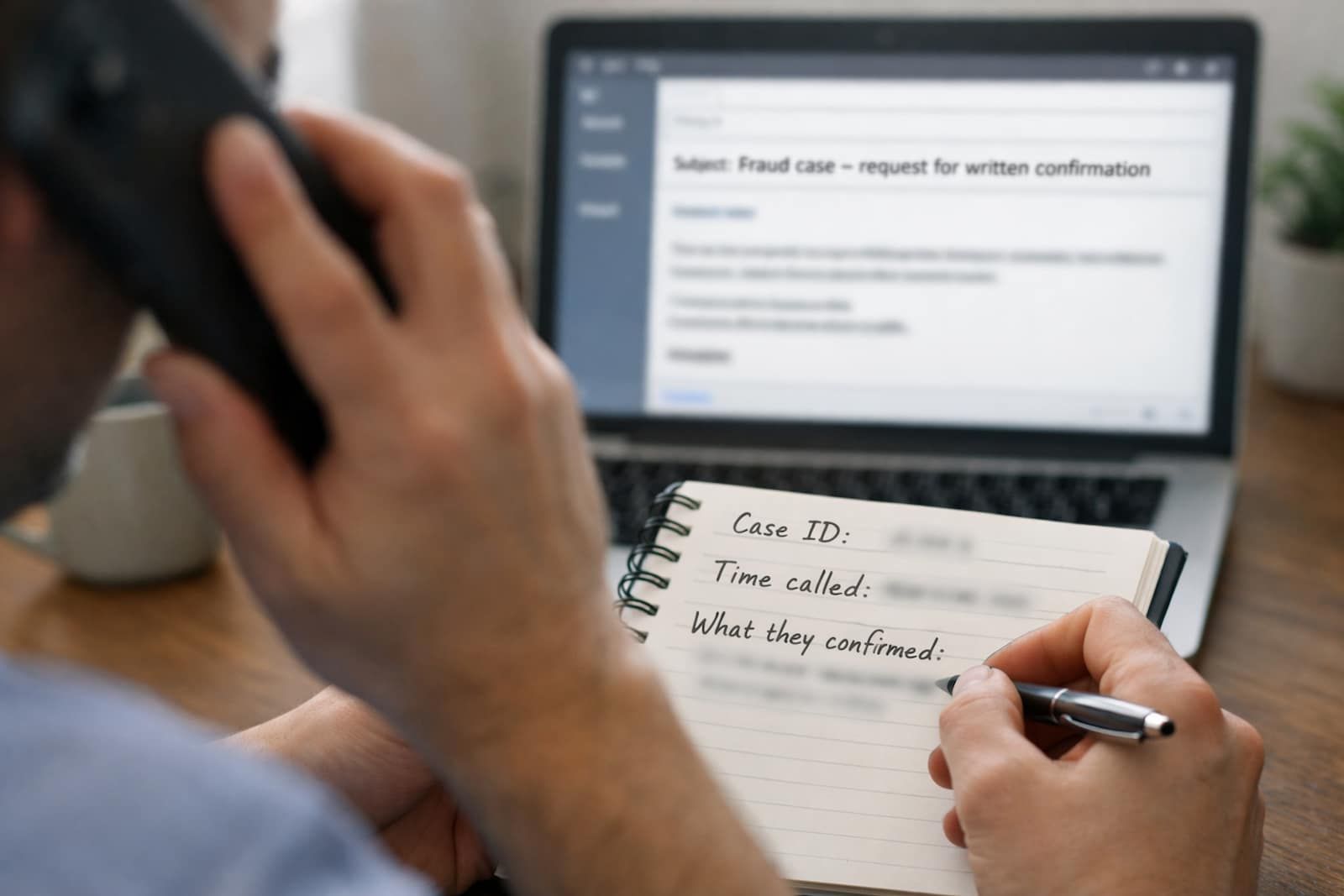
Write down the name, team, time, and summary of every call.
Step 4: Branch by what happened (unauthorized vs deceived)
The refund decision often turns on one ugly question. Did the bank treat the payment as authorized.
| Case type | What it usually means | What to ask for | Evidence that matters most |
|---|---|---|---|
| Unauthorized access (account takeover) | Login or control without consent | Investigation, reimbursement pathway, device audit | Login alerts, device list, reset history |
| Authorized under deception (APP or impersonation) | You sent it because you were manipulated | APP scam process, vulnerability flags, complaint escalation | Scammer messages, impersonation proof, call logs |
| Card or wallet fraud | Card credentials used | Chargeback or card fraud process | Merchant descriptors, device fingerprints, delivery proof |
Scammers sell lies. Systems sell categories.
If the bank says “you authorized it,” shift to an APP or deception complaint path and submit the evidence pack in one message.
Step 5: Confirm the payment rail and act on the clock
Evidence statement: Some payment rails are reversible in practice only within hours. Others become effectively final after settlement. This is infrastructure, not fairness.
Rail reality
- Wire transfers: Sometimes recallable before settlement. After settlement, recovery often depends on recipient bank cooperation and whether funds remain.
- ACH or bank transfers: Return options can exist, but timelines and rules vary by country, bank policy, and classification.
- Instant payments (UK Faster Payments, AU NPP, and similar): Often fast to leave, fast to cash out. Recovery becomes a race plus evidence.
Fast payments are excellent for commerce and fantastic for criminals.
Ask the bank to confirm the rail and confirm, in writing, whether the bank has contacted the beneficiary bank.
Step 6: Cost math that explains why speed matters
Cost Shock: Delay is not only “less chance of recovery.” It is measurable.
Use your local currency. The math is the point.
Micro-scenario 1 (consumer, USD example):
- Unauthorized transfers: $4,800 total
- You wait 48 hours to report
- Expected recovery probability drops from 35% to 15% (illustrative, bank dependent)
- Expected recoverable value change: $4,800 × (0.35 − 0.15) = $960
Micro-scenario 2 (SMB payroll drain, USD example):
- Fraudster changes payee details
- Outbound payroll: $22,000
- Containment delay creates second-wave risk at 20%
- Expected second-wave loss: $22,000 × 0.20 = $4,400
Criminals do not need genius. They need your delay.
Use the numbers when escalating. It signals seriousness.
Step 7: Escalation ladder (when the bank stalls)
Banks respond to structured complaints. “Please help” is a request. “Here is the case file and timeline” is an operational risk they must manage.
Decision Threshold Triggers (DV)
Escalate when any of these happen:
- No written confirmation of actions within 24 hours.
- The bank refuses to classify the case type.
- The bank says “wait” without a deadline.
- The bank blames you without addressing account takeover evidence.
- You receive new fraud attempts after the bank claims the account is secured.
Escalation path by region (high level)
- United States: Bank executive complaint channel, then regulator complaint pathway. Placeholder sources: Consumer Financial Protection Bureau (CFPB), Federal Trade Commission (FTC).
- United Kingdom: Follow the bank complaint process, then escalate to the Financial Ombudsman Service (FOS) if unresolved. Placeholder sources: Financial Conduct Authority (FCA), FOS.
- Canada: Escalate through the bank ombuds process and external complaints body as applicable. Placeholder sources: Financial Consumer Agency of Canada (FCAC).
- Australia: Bank complaints then Australian Financial Complaints Authority (AFCA). Placeholder sources: Australian Securities and Investments Commission (ASIC), AFCA.
- New Zealand: Use the bank complaints process and the approved dispute resolution scheme. Placeholder sources: Financial Markets Authority (FMA).
Jurisdiction clarification: Complaint pathways and refund obligations differ by country, by bank, and by how the payment is classified.
“We are looking into it” is not a timeline. It is a stall.
Step 8: Complaint letter skeleton
Use this format in a secure message or email.
Subject: Online banking fraud case [case ID] request for confirmation and recovery actions
Body:
- Date and time discovered
- Date and time reported
- Summary of unauthorized activity
- Transaction list with amounts and references
- Evidence pack attached
- Actions requested: lock confirmation, rail confirmation, recall or return request confirmation, investigation timeline, written decision criteria
- Impact: dollar value, business impact if applicable
Read This Twice: Ask for a written list of what the bank did, not what the bank “intends” to do.
Step 9: Contain identity risk and repeat attacks
Once criminals have credentials, they reuse them across services. A bank fix does not erase exposure.
Actions:
- Place a credit freeze or equivalent where available.
- Add a fraud alert if a freeze is not available or not appropriate.
- Change email password and enable multi-factor authentication.
- For phone accounts, add a port-out or SIM swap PIN.
- Check for email forwarding rules and new recovery emails.
Scammers do not retire. They recycle.
The bank incident is one part. Account takeover often starts in email.
Step 10: Prevention changes for individuals vs SMBs
Evidence statement: SMB fraud repeats because one compromised inbox can approve payments. Personal fraud repeats because identity data gets resold.
Individuals
- Separate banking email from public email use.
- Use authenticator apps where possible.
- Keep transaction alerts on.
SMBs
- Dual approval for new payees and high-value transfers.
- Payment limits and out-of-band verification for changes.
- Incident response runbook and evidence retention.
This is where tools may be justified. Not because tools are magic. Because controls are cheaper than losses.
Screenshot checklist (what the bank will ask for)
- Unauthorized transaction list
- Payee or beneficiary details
- Device list and login history
- Alerts and emails from the bank
- Chat logs or messages from the scammer
- Proof of who you contacted and when
Litigation and legal exposure (what we can say safely)
Most cases resolve through bank processes, ombuds pathways, and complaint escalation. Litigation is a separate track and depends on facts, contracts, and jurisdiction.
If the loss is high, if the bank refuses to document decisions, or if negligence is alleged, consult a qualified attorney in your jurisdiction. Do not threaten legal action as a performance. Use it when you have evidence and objectives.
A bluff is entertainment. Evidence is leverage.
FAQ
Can the bank reverse an online bank transfer after fraud
Sometimes. It depends on the payment rail, settlement status, and whether funds remain. Ask for written confirmation of recall or return request actions.
Should we file a police report for online banking fraud
Yes. It creates an incident number, supports the bank investigation, and helps escalation. It does not guarantee recovery.
How long does a bank fraud investigation take
It varies by bank and case type. Ask for a timeline in writing. Escalate if the bank will not provide deadlines.
What if the bank says the transfer was authorized
Shift to a deception or APP complaint path and submit the evidence pack. Challenge the classification with timelines and impersonation proof.
Should we wipe the infected device
Not immediately. Preserve evidence first. If malware is suspected, isolate the device and seek professional help before wiping.
What if new fraud happens after the bank “secured” the account
Treat it as containment failure. Demand a full reset of credentials, new account details, and a review of trusted devices and payees.
Can identity monitoring help after online banking fraud
It can reduce downstream identity theft harm. It will not reverse transfers. Use it as containment, not as recovery.
What should an SMB do if payroll was redirected
Stop payments, lock access, notify the bank fraud team, and document approvals and change requests. Implement dual controls before resuming.
Reviewed for accuracy
Reviewed for accuracy on: 8 March 2026
Regulatory citation placeholders: CFPB, FTC, FCA, Financial Ombudsman Service, FCAC, ASIC, AFCA, FMA
Disclaimer
This article is educational information, not legal advice. Processes and refund outcomes vary by bank, payment type, and jurisdiction. Do not delay reporting. Recovery depends on timing, documentation, and bank cooperation.
Scammers love silence. Send paperwork.
Report fast and document everything.
Related Fraud Guides
If you want to understand how financial fraud investigations and recovery processes work, these guides explain what victims should know.
• Can Banks Reverse Wire Transfer Scams? Recovery Rules 2026
https://dollarvigil.com/can-banks-reverse-wire-transfer-scams-recovery-rules-2026/
• Cross-Border Payment Fraud Rules 2026 Guide
https://dollarvigil.com/cross-border-payment-fraud-rules-2026-guide/