APP Scam Refund Rejected? What Evidence Banks Look For Before Reimbursing
A detailed guide explaining why banks reject app scam refund claims and the evidence they review before reimbursement. Learn how screenshots, transaction records, scam reports, and communication history can strengthen your fraud recovery case.

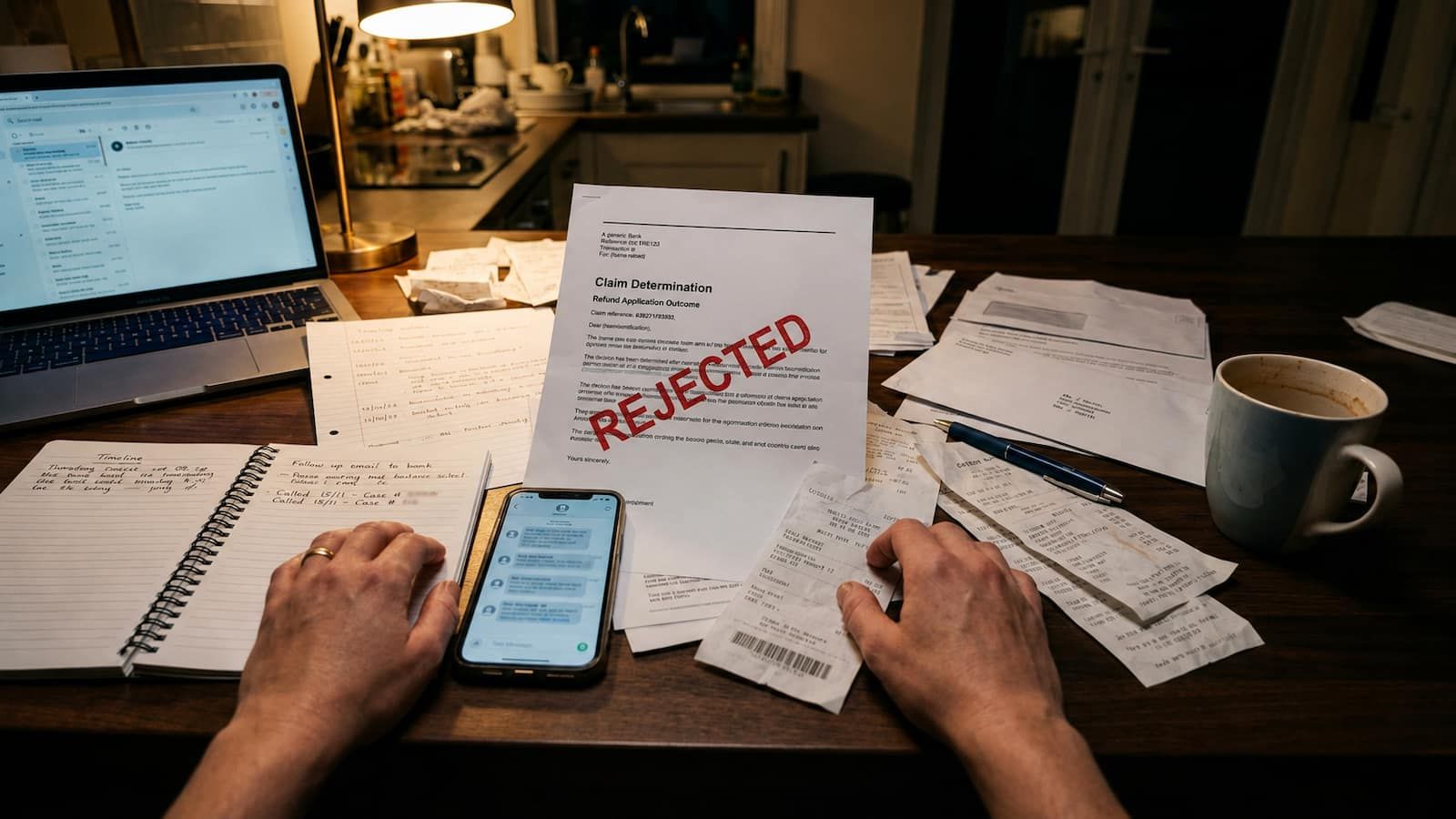
You did the right thing by reporting it. You handed your bank the truth. And the bank responded with a denial letter written in the ancient corporate dialect of “not our problem, but we hope you are having a wonderful day.”
Here is what is really happening: an APP scam (Authorised Push Payment scam) is not a “card fraud” event. It is you being manipulated into sending a real payment. In bank systems, that is treated like you walked into a branch, smiled, and handed cash to a stranger wearing confidence as a costume.
So when a refund gets rejected, it usually is not because the bank “does not care.” It is because the bank is running an internal evidentiary test that quietly asks:
- Were you tricked, or were you reckless
- Was this impersonation, or was this a bad decision
- Can we prove deception, or can we blame customer authorization
- If we reimburse, will a regulator punish us less than our finance team will
Let us get surgical.
TL;DR
- If your APP scam refund was rejected, it usually means the bank thinks the payment looked “authorized” and your evidence did not clearly prove deception, impersonation, or coercion.
- Banks look for proof of manipulation: impersonation signals, urgency scripting, credential compromise, remote access traces, and a clean timeline that shows you were engineered, not casually buying nonsense.
- Next 15 minutes: pull screenshots of chats, call logs, payment confirmations, the payee details, and any “security check” messages, then write a one-page timeline while memory is fresh.
- Jurisdiction matters: processes differ across the United States, United Kingdom, Canada, Australia, and New Zealand. Do not assume one country’s protections apply in another.
- Prevention: lock down call spoofing habits, disable remote access tools, and set a personal rule that no “bank” request is real until you call back using the number on the back of your card.
Dominant archetype: Prosecutorial Cross-Examiner
I am not here to soothe the bank. I am here to build the case file the bank wishes you would never assemble.
What “APP scam refund rejected” actually translates to
When a bank rejects your APP scam refund request, the denial usually means one of these:
- They classified it as “authorized” with no clear deception evidence
- They think you ignored warnings (in-app warnings, confirmation steps, payee warnings)
- They think you had control of your device and login (no compromise, no malware, no takeover)
- They think it resembles a civil dispute (you paid a person, now you regret it)
- They think you cannot identify the scammer or the destination clearly enough
- They think you moved too slowly and recovery rails closed
- They think you are not telling the full story because the timeline is messy, contradictory, or missing primary proof
A rejection is not always final. But it is a message: bring receipts. Real ones.
The bank is not judging your pain. The bank is judging your evidence.
Victims expect the bank to focus on harm. Banks focus on liability.
Their internal logic is closer to:
- What rule forces us to reimburse
- What regulator will care
- What evidence would beat our denial template
- Can we show we warned the customer
- Can we show the customer “authorized” it anyway
This is why vague statements like “I got scammed” do not work.
You have to show how the scam worked, in a way a bored disputes analyst can verify in 90 seconds.
What evidence banks look for before reimbursing (the real checklist)
Banks do not publish the internal checklist cleanly. So let us reverse engineer it.
1) Proof it was deception, not “you willingly paid”
Banks want evidence of false identity and false purpose.
Strong evidence:
- Screenshots where the scammer claims to be your bank, police, regulator, employer, delivery service, crypto exchange, government agency, or a known brand
- Spoofed email headers or SMS sender IDs
- Fake websites with lookalike domains
- Messages referencing internal-sounding case numbers, “fraud team,” “secure account,” “recovery wallet,” “compliance check”
- Any threat language: arrest, account closure, legal action, frozen funds, urgent security risk
Weak evidence:
- “They promised returns” with no impersonation
- “They said it was urgent” without screenshots
- “They sounded legit” (banks do not refund vibes)
The bank is not allergic to your story. The bank is allergic to an unprovable story.
2) Proof of coercion, urgency, or manipulation scripting
APP scams succeed by collapsing your time horizon.
Banks look for:
- Time pressure scripts: “do it now,” “within 10 minutes,” “you are at risk,” “keep this confidential”
- Isolation tactics: “do not tell branch staff,” “do not speak to anyone,” “fraud team only”
- Authority intimidation: “police report,” “warrant,” “investigation”
- Emotional triggers: fear, shame, greed, romance, rescue
Screenshot it. Quote it. Timestamp it.
3) Proof the payee was abnormal or recently created
Banks love to argue: “You set up a new payee and confirmed it, so you intended it.”
You need to show why the payee was set up:
- Scam instructions that told you what name to enter
- “Safe account” narrative
- “Temporary holding account” narrative
- “Wallet verification” narrative
Evidence that helps:
- The first time you ever paid that payee
- A sequence of new payees in a short period
- The scammer changing payee details mid-conversation
- Payments split into multiple transfers (classic mule funnel behavior)
4) Proof you did not benefit and did not control the destination
Banks want to exclude:
- A legitimate purchase you regret
- You paying a friend
- You paying yourself
- You participating in something shady and losing money
Provide:
- Proof of no product delivered (if purchase scam)
- Proof of no legitimate account relationship (if investment scam)
- Proof you never received funds back (watch for “refund bait” scams where scammers send small returns)
If it is crypto: banks get extra allergic. They see “customer chose crypto” and stop thinking. You must show the fraud mechanics, not the asset class.
5) Evidence of device compromise or remote access (when relevant)
If the scam involved AnyDesk, TeamViewer, remote banking help, “fraud technician,” or malware, that is critical.
Banks look for:
- Proof remote access tool was installed
- Session times
- Permission prompts
- Evidence your banking app was controlled while you were manipulated
If you claim “my phone was hacked” with no evidence, banks often treat it as a convenient storyline. You need specifics: app names, timestamps, what was installed, what permissions were granted, what you saw.
6) A clean timeline that matches bank logs
Banks run on logs. If your story timeline conflicts, they default to denial.
Your timeline should include:
- First contact time
- Channel (SMS, WhatsApp, phone call, email, social)
- What they claimed
- What you did next and why
- When you made each payment
- When you realised
- When you called the bank
- When you filed police report
- When you contacted the receiving bank or platform (if applicable)
You are building a prosecutable narrative. Not writing a diary entry.
7) Proof you acted quickly after discovery
Banks care about speed because recovery options decay fast.
Evidence:
- Call logs to your bank
- Chat logs with support
- Confirmation emails for fraud reports
- Reference numbers from bank and police
- Any receiving bank details you have
If you waited days because you were ashamed, that is human. But banks will not reward human. Banks reward timestamps.
8) Proof you followed bank warnings, or proof warnings were inadequate
Banks love to say “We warned you.”
You need:
- What exactly the warning said (screenshots if possible)
- Why it did not apply, or why it was too generic
- Whether the bank flagged it as unusual, and what happened next
If the warning was something like “Do not be scammed,” that is not meaningful. If it specifically mentioned impersonation or safe account scams and you clicked through, that makes your case harder but not impossible. You then pivot to deception sophistication, coercion, and vulnerability factors.
9) Evidence the bank failed to apply reasonable safeguards (quietly, without melodrama)
This is where your escalation case gets teeth.
Examples of safeguard failures:
- No effective confirmation of payee warnings (where applicable)
- No friction despite unusual payment patterns
- Allowed high-value transfer to a new payee immediately
- Ignored unusual account behavior after contact with known scam patterns
- Failed to respond promptly to recall request
Do not scream “negligence” unless you can point to a process failure. Be specific. Banks fear specifics.
The three APP scam categories banks treat very differently
Banks pretend all APP scams are the same. They are not.
Category A: Impersonation scams (bank, police, government, employer)
These are often strongest for reimbursement because deception is clear.
What to prove:
- Spoofed numbers or fake domains
- “Secure account” language
- Authority and urgency scripting
- Instructions to keep it secret
Category B: Investment scams (crypto, forex, fake trading apps)
Banks are more resistant because they see “customer chose.”
What to prove:
- Fake platform identity
- Fabricated returns dashboards
- Withdrawal blocks
- “Tax to release funds” payments
- Coordination and grooming behavior
- Evidence the receiving account is a mule funnel
Category C: Romance and relationship coercion scams
Banks get uncomfortable here and victims feel shame. Do not let that sabotage the evidence pack.
What to prove:
- Grooming timeline
- Requests for secrecy
- Escalating financial asks
- Fake emergencies
- Identity inconsistencies
- Reused scripts or stolen photos
You are not stupid. You were targeted. That is the point.
Operational reality: what banks can and cannot do (and when)
Let us stop the fantasy that banks can press a button and reverse everything.
Faster Payments / bank transfer rails
- Recalls are possible but depend on speed and cooperation.
- If the funds hit a mule account and move again, recovery becomes a chase, not a reversal.
- Banks can contact receiving banks. Receiving banks may freeze if funds remain and fraud is clear.
Cards
APP scam is not a card chargeback. If you paid by card, chargeback rules may apply, but that is a different topic.
Crypto
If money moved from bank to exchange to wallet:
- Banks often say it was your choice, end of story.
- Exchanges might freeze if you provide a police report and wallet details quickly.
- If it hit a private wallet, recovery becomes difficult and often requires law enforcement action and time.
Reality: speed matters. Documentation matters. Jurisdiction matters.
Jurisdiction notes (do not assume global protections)
This section is guidance only, not legal advice.
United Kingdom
If you are UK-based, focus on the bank’s handling process, whether warnings and safeguards were appropriate, and escalation via complaint and then the Financial Ombudsman Service (FOS).
Australia
If you are Australia-based, focus on internal dispute resolution, external dispute resolution (AFCA), and evidence of scam typology plus bank safeguard gaps.
Canada
If you are Canada-based, focus on a clean evidence pack, formal complaint escalation ladder, and ombudsman pathways depending on bank and product.
New Zealand
If you are New Zealand-based, focus on the bank complaint process, external resolution pathways, and documented evidence plus timelines.
United States
If you are US-based, outcomes vary heavily by payment rail and institution. Escalation often involves bank complaint channels and consumer regulator complaints where relevant.
The point: you must align your complaint to your country’s dispute pathways. A generic “banks must refund” argument is not strategy. It is hope wearing a suit.
The Evidence Pack: what to submit so the bank cannot play dumb
If your claim was rejected, you do not resubmit feelings. You resubmit a file.
Build a one-page “Case Summary”
Include:
- Scam type: impersonation / investment / romance / purchase / job / delivery
- Total amount and number of payments
- Dates and times
- Payment method and payee details
- How contact started
- Key manipulation tactics used
- When you reported to bank
- What you are requesting: reimbursement, recall, investigation, written rationale, escalation
Attachments banks actually use
- Screenshots of chats, SMS, emails (with timestamps)
- Call log screenshots (showing spoofed numbers if possible)
- Payment confirmations and payee details
- Any remote access evidence (screenshots of installed apps, permissions)
- Police report reference number
- Any receiving bank details you have
- Any platform reports (exchange ticket numbers, marketplace reports)
- Proof of identity impersonation (lookalike domain, fake website, fake documents)
Keep files readable. Name them clearly.
The escalation ladder (what to do after rejection)
You want a controlled escalation. Not an angry email that gets filtered into the “customer is emotional” bin.
Step 1: Demand the rejection rationale in writing
You want:
- Which policy or rule they relied on
- Which facts they believe are true
- What evidence they say is missing
- Whether a recall was attempted and when
- Whether the receiving bank was contacted
Step 2: Submit a structured rebuttal
Your rebuttal should match their rationale line-by-line.
Step 3: Use the bank’s formal complaint process
Not frontline support. Formal complaint.
Keep it clinical. Focus on process failures, evidence, outcomes requested, and timelines.
Step 4: External dispute resolution or ombudsman escalation
Depending on your jurisdiction, this is where banks become more attentive.
Step 5: Regulator complaint (where appropriate)
Regulators do not always resolve individual cases quickly, but complaints create pressure and patterns.
Common mistakes that quietly kill reimbursement chances
- Submitting a story without screenshots
- Contradicting your own timeline because shame makes people simplify details
- Calling it “hacked” with no proof when it was social engineering
- Leaving out remote access detail because it is embarrassing
- Not naming the scam type (banks categorize everything)
- Not listing payee details (you need payee name, bank, reference, sort code or account where relevant)
- Overloading the bank with emotion while missing core facts
- Waiting too long to report and then acting surprised rails closed
None of this makes you stupid. It makes you human. Scammers build systems around human behavior. Banks build denial systems around paperwork gaps.
FAQ
Can a bank refund an APP scam if I authorized the payment?
Sometimes, yes. The bank will look at whether you authorized the payment under deception, impersonation, coercion, or a compromised device situation. If your evidence shows you were engineered using false identity and urgent pressure tactics, reimbursement becomes more plausible. If it looks like you chose to pay a stranger for an “investment,” banks tend to resist.
What evidence is strongest after an APP scam refund is rejected?
Primary proof beats summaries. The strongest evidence is screenshots of scam messages, call logs, payment confirmations with payee details, proof of impersonation (spoofing, fake domains), and a clean timeline. If remote access was involved, proof of the tool and session timing helps.
How fast do I need to report an APP scam to have any chance?
Immediately. Minutes matter. The longer you wait, the more likely the money has moved through mule accounts and off ramps. Reporting quickly also supports your credibility and shows you took reasonable steps once you realised something was wrong.
If I paid a scammer through a crypto exchange, can my bank still reimburse me?
It is harder. Banks often treat bank-to-exchange transfers as customer choice. Your best angle is proving deception and manipulation, plus showing you acted quickly and requested recalls. Separately, the exchange may freeze funds if you provide a police report and wallet details fast enough.
What does “you ignored warnings” mean in a rejection letter?
It usually means the bank thinks it displayed warnings during payee setup or payment confirmation and you proceeded anyway. To counter it, you need to show the warning was generic, did not match the scam type, or you were under coercive manipulation that impaired judgement. You still need evidence.
Who do I escalate to if the bank refuses to reopen the case?
Start with the bank’s formal complaints process, then escalate to the relevant external dispute resolution or ombudsman for your country. The correct body depends on jurisdiction: United Kingdom, Australia, Canada, New Zealand, and United States pathways differ. Do not copy-paste another country’s scheme into your complaint.
What to do in the next 15 minutes (tactical)
- Screenshot everything: chat threads, SMS, emails, call logs, payment confirmations.
- Write a timeline while memory is fresh. Exact times if possible.
- Gather payee details and transaction references.
- If remote access was involved, capture installed apps and permissions.
- File or obtain a police report reference number.
- Send a written request to the bank: confirm recall attempt status, receiving bank contact, and written denial rationale.
The cold truth banks do not say
An APP scam refund rejection is not always a final verdict on truth. It is a verdict on what you proved.
Banks reimburse when deception is clear, documentation is clean, timelines are fast, and liability risk is higher than denial comfort.
Scammers run psychology at scale. Banks run paperwork at scale. Victims get crushed in the middle.
Your job now is to stop being the person telling a sad story and become the person submitting a prosecutable file.
Disclaimer
This article is for general educational purposes only. It is not legal advice, financial advice, or a guarantee of reimbursement. Outcomes in APP scam cases depend on factors like timing, the evidence available, the payment rail used, your bank’s policies, the receiving institution’s cooperation, and your jurisdiction’s rules and dispute pathways.
If you need advice tailored to your situation, speak with a qualified professional in your country (for example, a lawyer or consumer dispute adviser) and follow your bank’s formal complaints process and any applicable external dispute resolution/ombudsman route.
Anyone promising “guaranteed recovery” is selling hope on a subscription plan — and the first renewal charge is your wallet.