How to Spot and Report Deepfake Investment Scams in 2026
Deepfake investment scams are becoming more convincing in 2026. Learn how criminals use AI-generated videos and voices to steal money, recognize the warning signs, report fraud quickly, and protect yourself before it's too late.

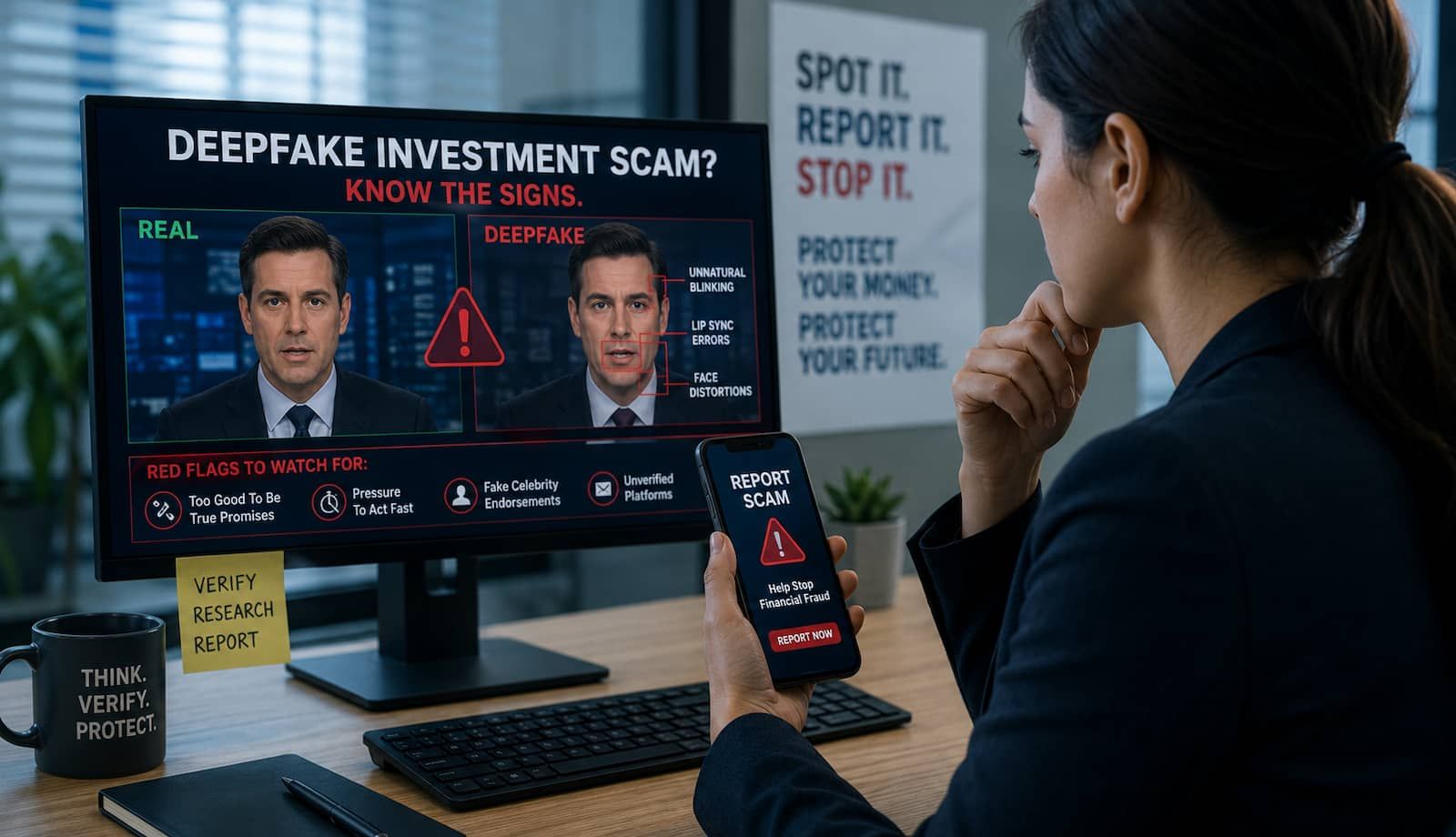
Deepfake investment fraud does not begin with a financial product. It begins with stolen authority.
A familiar face appears in a video. A politician. A billionaire. A television host. A respected business leader. The voice sounds right. The mouth moves well enough. The message is simple: a new trading platform, crypto opportunity, automated investment system, or “exclusive” wealth program is changing ordinary lives.
That is the bait.
The actual product is not investing. It is extraction.
In 2025, the FBI’s Internet Crime Complaint Center reported major losses connected to AI-facilitated cybercrime, including hundreds of millions tied to AI-enabled investment scams. Regulators such as New Zealand’s Financial Markets Authority have also warned about deepfake videos impersonating public figures to push fraudulent investment platforms. The scam industry has discovered something ugly and efficient: a fake endorsement can now be manufactured faster than a victim can verify it.
TL;DR
- A deepfake investment scam uses manipulated video, cloned audio, fake news pages, social media ads, or impersonated public figures to push fraudulent trading, crypto, or investment platforms.
- The core risk is authority laundering: scammers borrow the face or voice of someone trusted, then move victims into private chats, fake dashboards, and irreversible payment rails.
- Within fifteen minutes, search the investment platform on your country’s official financial regulator register before sending money or identity documents.
- Reporting rules differ across the US, NZ, UK, AU, and CA, so use your local regulator, cybercrime reporting portal, bank, and police channels rather than assuming one country’s process applies everywhere.
- If you already paid, stop sending funds, preserve evidence, contact your bank or payment provider immediately, and report the platform before a “recovery expert” arrives to perform the second robbery.
What Is A Deepfake Investment Scam?
A deepfake investment scam is a fraud scheme where criminals use synthetic or manipulated media to make a fake investment opportunity look legitimate.
The fake media may include:
- A video of a politician supposedly endorsing a trading platform.
- A cloned celebrity voice promoting a crypto app.
- A fake interview on a copied news website.
- A manipulated social media ad showing a public figure discussing “secret wealth software.”
- A fake livestream where comments are staged and urgency is manufactured like cheap theater.
- A chatbot or private-message account pretending to be a broker, analyst, celebrity assistant, or “investment manager.”
The investment usually does not exist in any meaningful, regulated sense. The platform may show fake balances, fake profits, fake withdrawal approvals, and fake compliance checks. The dashboard is a stage prop with numbers on it. The scammer’s job is to make you believe you are watching your money grow while they are moving it out the back door.
Deepfake fraud is not magic. It is old investment fraud wearing a better mask.
The classic script is still there:
- Borrow credibility.
- Create curiosity.
- Move the victim off-platform.
- Show fake profits.
- Demand more deposits.
- Block withdrawals.
- Invent taxes, fees, or verification charges.
- Disappear or hand the victim to a fake recovery scammer.
The mask changed. The machinery did not.
How The Scam Works
Most deepfake investment scams follow a predictable operational chain. Once you know the sequence, the trick loses some of its shine. Not all of it, because criminals are good at pressure and timing, but enough to stop the wallet from opening.
1. The Hook: A Fake Authority Figure
The scam usually starts with a video ad, social post, fake article, or sponsored clip.
The face is the weapon.
Scammers may impersonate:
- Politicians.
- Central bank figures.
- Financial commentators.
- Business leaders.
- Celebrities.
- Technology founders.
- News anchors.
- Local public figures with regional trust.
The video claims the person has discovered, backed, tested, or “accidentally revealed” a powerful investment method.
The scammer does not need the deepfake to be perfect. It only needs to survive the first few seconds while your brain says, “I know that person.” That tiny window is where the fraud crawls in.
2. The Fake News Page
After the ad, victims are often sent to a fake article.
It may imitate:
- A major broadcaster.
- A financial newspaper.
- A government-style notice.
- A business magazine.
- A local news site.
These pages often include fake quotes, fake screenshots, fake comments, and fake urgency. The page exists to make the lie feel socially confirmed. It is not journalism. It is a costume party for theft.
3. The Registration Form
The page asks for basic details:
- Name.
- Phone number.
- Email address.
- Country.
- Initial investment amount.
Once submitted, the victim is moved from public advertising into direct contact. This is the handoff from marketing fraud to extraction fraud.
Expect a call, WhatsApp message, Telegram invite, email, or SMS. The “broker” may sound polished. Some are scripted. Some are aggressive. Some pretend to be patient professionals. Different costume, same cash register.
4. The Fake Trading Platform
The victim is shown a platform that appears to track trades, profits, crypto balances, or forex activity.
Common dashboard tricks include:
- Instant “profits” after the first deposit.
- A graph that only seems to go up.
- Fake account managers congratulating the victim.
- Fake risk warnings to create professional theater.
- Withdrawal buttons that work only until real money is requested.
- “Compliance” checks that appear only when the victim tries to leave.
This is where many victims lower their guard. They can see numbers. They can log in. They can watch the balance grow.
But a fake dashboard is not proof of investment. It is proof someone knows how to build a web page.
5. The Deposit Escalation
Once the victim believes the account is profitable, the scammer pushes for larger deposits.
The pressure may sound like:
- “You need to upgrade your account.”
- “Your profits are locked until tax is paid.”
- “The regulator requires verification.”
- “The withdrawal wallet needs activation.”
- “Your account will be closed if you do not act today.”
- “The celebrity-backed launch window is closing.”
There it is. Urgency wearing a necktie.
Legitimate regulated financial firms do not need a stranger on WhatsApp to bully you into sending crypto to unlock your own money.
6. The Withdrawal Trap
When the victim tries to withdraw, the platform invents barriers.
Typical excuses include:
- Tax clearance fees.
- Anti-money laundering checks.
- Wallet verification payments.
- Account upgrade charges.
- Minimum trading volume requirements.
- Cross-border transfer fees.
- Frozen funds requiring a “release deposit.”
A real institution may require identity verification. A real bank may conduct compliance checks. But a demand to send more money before you can retrieve existing money is a red flag so large it should come with its own weather warning.
Why Deepfake Investment Scams Work
Victims are not stupid. That lazy explanation belongs in the trash with the fake trading dashboard.
These scams work because they exploit normal human trust systems.
Familiar Faces Lower Suspicion
A known face creates borrowed credibility. The victim may not fully believe the ad, but the presence of a familiar person creates enough curiosity to click. Scammers do not need total belief at the start. They need a small opening.
Social Media Ads Look Approved
People often assume paid ads have been checked by the platform. That assumption is dangerous.
Ad approval is not the same as financial due diligence. A scam ad can pass through weak screening, hijacked accounts, cloaked landing pages, or rapid campaign rotation. By the time enforcement catches one ad, another is already grinning in the feed with a different stolen face.
Fake Profits Create Commitment
Once the fake dashboard shows gains, the victim is emotionally invested.
The scammer then uses:
- Hope.
- Embarrassment.
- Sunk cost pressure.
- Fear of missing out.
- Fear of losing existing “profits.”
- Shame about reporting too late.
This is psychological engineering, not ordinary persuasion.
Private Messaging Removes Friction
Public ads get the victim’s attention. Private channels do the damage.
Once moved to WhatsApp, Telegram, Signal, direct calls, or email, the scammer controls the environment. There are fewer warnings, fewer moderators, and more pressure. That is not an accident. It is the fraud equivalent of moving the conversation into a windowless room.
Red Flags Of A Deepfake Investment Scam
A single red flag may not prove fraud. Several together should stop the transaction cold.
| Red Flag | What It Usually Means |
|---|---|
| A celebrity, politician, or public figure appears to endorse a trading platform in a social ad | The endorsement may be fabricated or manipulated |
| The platform is introduced through a fake news article | The scam is laundering credibility through counterfeit media |
| You are pushed into WhatsApp, Telegram, or direct calls | The scammer wants pressure without oversight |
| The broker is not listed on your official regulator register | You may be dealing with an unlicensed or cloned operation |
| The platform guarantees profits or low-risk crypto returns | Real investing carries risk, and guaranteed returns are bait |
| You must pay fees, taxes, or deposits to withdraw | This is a classic advance-fee extraction tactic |
| The company name resembles a real regulated firm | It may be a clone scam using stolen identity |
| You are discouraged from contacting your bank, family, or regulator | Isolation is part of the control system |
| The website was recently created or has hidden ownership | Many scam platforms are disposable |
| The “account manager” becomes hostile when questioned | Pressure is replacing proof |
If the investment came from a social media ad featuring a famous person, treat it as suspicious until verified through an official regulator portal. Not through the ad. Not through the platform’s footer. Not through the “broker” sending you a certificate that looks like it was assembled in a hurry by someone with a PDF editor and a guilty conscience.
How To Verify An Investment Platform Before Sending Money
Verification must happen outside the scammer’s ecosystem.
Do not use links sent by the promoter. Do not rely on screenshots. Do not trust badges on the website. Fraud sites love regulatory logos because logos are easier to steal than licenses.
Use the official register for your jurisdiction.
United States
Check:
- SEC Investment Adviser Public Disclosure database.
- FINRA BrokerCheck.
- CFTC registration and enforcement resources for commodity, forex, and derivatives activity.
- FBI IC3 for cybercrime reporting if you were targeted or paid.
The US has multiple regulators because financial regulation is a layered machine with too many doors and not enough plain English. Use the register that matches the product being promoted.
New Zealand
Check:
- Financial Markets Authority warnings and licensed provider registers.
- Companies Office details where relevant.
- Report scams to the FMA and CERT NZ where appropriate.
The FMA has specifically warned about deepfake video scams impersonating New Zealand public figures. That matters because local authority figures can make a scam feel more credible to local victims.
United Kingdom
Check:
- Financial Conduct Authority Financial Services Register.
- FCA warning list.
- Action Fraud for reporting fraud and cybercrime.
If a firm claims to be FCA-authorised, search the FCA register yourself. Clone firms often copy the name, address, or registration number of a real company while changing phone numbers, websites, and email addresses.
Australia
Check:
- ASIC professional registers.
- Moneysmart investor alert list.
- ReportCyber for cybercrime reporting.
For investment scams, also consider whether the product involves crypto, managed investments, derivatives, or financial advice. Different products may trigger different regulatory issues.
Canada
Check:
- Canadian Securities Administrators National Registration Search.
- Provincial or territorial securities regulator warnings.
- Canadian Anti-Fraud Centre for reporting fraud.
Canada is not one single neat reporting box. Securities oversight is provincial and territorial, which scammers exploit by sounding official while staying vague.
The Fifteen-Minute Verification Drill
Before sending money, do this. No exceptions for famous faces. Especially not for famous faces.
- Search the exact platform name plus “scam,” “warning,” and “regulator.”
- This is not perfect, but it may reveal warnings, victim reports, or copied site names.
- Check the official regulator register in your country.
- Type the regulator’s website into your browser yourself.
- Do not follow links from the ad or “broker.”
- Compare contact details.
- If the register shows a different domain, phone number, or email, stop.
- Clone scams depend on victims not comparing boring details. Boring details often save money.
- Search the website domain age.
- A newly created domain promoting an elite investment system should make your suspicion sit upright.
- Test the withdrawal claim before increasing funds.
- If you already deposited a small amount, do not add more because the dashboard shows profits.
- Fake platforms often allow a tiny withdrawal first to build trust, then block larger withdrawals later.
- Ask one blunt question: “Which regulator licenses you, and what is your registration number?”
- Then verify independently.
- If they send pressure instead of proof, you have your answer.
For related prevention patterns across payment apps and fast-moving fraud channels, see Mobile Payment Scam Trends 2026: Loss Prevention Tips. The same operational weakness appears again and again: speed helps criminals, while verification feels slow. The criminal economy depends on you hating the slow part.
What To Do If You Already Sent Money
First: stop sending money.
Do not pay withdrawal fees. Do not pay tax clearance fees. Do not pay a “recovery agent.” Do not let embarrassment make the next decision for you. Shame is one of the scammer’s favorite tools because it keeps victims quiet while the funds move.
Step 1: Preserve Evidence
Save everything:
- The ad or video URL.
- Screenshots of the deepfake video or fake endorsement.
- The website URL.
- Account dashboard screenshots.
- Deposit instructions.
- Wallet addresses.
- Bank account details.
- Email headers if available.
- Chat logs.
- Call logs.
- Names used by the broker.
- Transaction receipts.
- Any refusal or withdrawal messages.
- Copies of identity documents you submitted.
Do not clean up the evidence to make it look organized. Preserve the original material first. Investigators prefer messy truth over polished gaps.
Step 2: Contact Your Bank Or Payment Provider Immediately
Tell the bank this is suspected investment fraud involving a fake platform and manipulated endorsement.
Ask about:
- Card chargeback rights.
- Bank transfer recall options.
- Wire recall procedures.
- Crypto transaction tracing limitations.
- Fraud report reference numbers.
- Account security steps.
- Whether your account needs monitoring for further unauthorized activity.
Be precise. “I regret an investment” is weaker than “I was induced by a suspected fraudulent platform using a deepfake endorsement and now withdrawals are blocked.”
Banks respond to evidence and category. Give them both.
Step 3: Report To The Correct Authority
Use the correct reporting channels for your country.
| Jurisdiction | Where To Report |
|---|---|
| US | FBI IC3, FTC ReportFraud, SEC or CFTC where relevant, local police |
| NZ | FMA, CERT NZ, local police |
| UK | Action Fraud, FCA, local police where appropriate |
| AU | ReportCyber, Scamwatch, ASIC where relevant |
| CA | Canadian Anti-Fraud Centre, local police, provincial or territorial securities regulator |
Reporting does not guarantee recovery. It creates an official record, supports enforcement intelligence, and may help your bank or payment provider assess the case.
Step 4: Secure Your Identity
If you uploaded identity documents, assume they may be misused.
Consider:
- Changing passwords.
- Enabling multi-factor authentication.
- Monitoring bank accounts.
- Placing fraud alerts where available.
- Checking credit reports.
- Freezing credit where the option exists in your jurisdiction.
- Watching for new account fraud and loan applications.
Deepfake investment scams often become identity theft cases after the money is gone. The scammer already has the wallet. Do not hand over the filing cabinet too.
Step 5: Watch For Recovery Scams
After an investment scam, victims are often targeted again.
The second scammer may claim to be:
- A blockchain recovery expert.
- A government-linked investigator.
- A law firm.
- A chargeback specialist.
- A crypto tracing agency.
- A hacker who can “reverse” the transaction.
- An insider who found the stolen funds.
Some recovery services are legitimate in narrow contexts. Many are parasites with better stationery.
Red flags include:
- Guaranteed recovery.
- Upfront fees.
- Claims of special regulator access.
- Requests for wallet seed phrases.
- Pressure to keep the process secret.
- Fake court orders.
- Fake fund-freezing certificates.
- Demands for “tax” before release.
If someone guarantees recovery from a crypto or investment scam, ask for verifiable licensing, written terms, jurisdiction, fee structure, and evidence. Watch how quickly the confidence costume starts falling apart.
Can You Get Your Money Back?
Sometimes. Often not. That is the ugly answer, and it is more useful than comfort theater.
Recovery depends on:
- How you paid.
- How quickly you reported.
- Whether funds remain in the receiving account.
- Whether the recipient account was domestic or overseas.
- Whether crypto was involved.
- Whether the bank or payment provider can identify a recoverable transaction path.
- Whether the merchant was real, fake, or merely a payment front.
- Whether your jurisdiction gives you dispute rights for that payment type.
Card Payments
Card payments may offer chargeback rights, depending on the card network rules, merchant category, timing, evidence, and jurisdiction. A chargeback is not a magic refund button. It is a dispute process with rules, deadlines, and documentation requirements.
Useful evidence includes:
- Misrepresentation by the merchant.
- Blocked withdrawals.
- Fake licensing claims.
- Proof the service was not delivered.
- Screenshots of the platform and communications.
- Regulator warnings if available.
Bank Transfers And Wires
Bank transfers and wires are harder.
A wire recall may be attempted, but success usually depends on speed and whether funds remain available. Once funds are withdrawn, transferred onward, or moved internationally, the trail becomes harder and the recovery window gets colder by the hour.
This is where banks often produce their finest denial-letter ballet: sympathetic language, procedural paragraphs, and a conclusion that lands like a locked door. That does not mean you should skip reporting. It means you should document aggressively and escalate properly.
Crypto Payments
Crypto recovery is difficult.
Blockchain transactions may be traceable, but tracing is not the same as recovery. If funds move through mixers, cross-chain bridges, mule wallets, offshore exchanges, or uncooperative platforms, recovery becomes complex. Law enforcement or regulated exchanges may be able to act in some cases, but victims should not assume funds can be reversed.
Crypto has no chargeback department. That is exactly why scammers love it.
Evidence That Actually Matters
The strongest complaints are not emotional essays. They are evidence packages.
Use this structure:
| Evidence Type | Why It Matters |
|---|---|
| Payment records | Shows amount, date, recipient, and payment rail |
| Platform screenshots | Shows fake balances, withdrawal blocks, and account claims |
| Communications | Shows representations, pressure tactics, and instructions |
| Advertisements | Links the scam to deepfake endorsements or fake public figure claims |
| Regulator checks | Shows whether the firm was licensed, cloned, or warned against |
| Website details | Helps identify domains, hosting clues, and impersonation |
| Wallet addresses or bank accounts | Supports tracing, bank action, and intelligence reporting |
| Identity documents submitted | Helps assess identity theft risk |
Do not wait until your evidence package is beautiful before reporting. Report quickly, then supplement. Fraud money does not sit politely while you design a folder system.
Myth Versus Reality
| Myth | Reality |
|---|---|
| “The video looked real, so the endorsement must be real.” | Deepfake and manipulated media can imitate trusted people well enough to deceive viewers, especially in short ads. |
| “The platform showed profits, so trades happened.” | Fake dashboards can display invented profits with no real trading behind them. |
| “I just need to pay the withdrawal fee.” | Extra fees are often the next stage of extraction, not a path to recovery. |
| “The broker has a certificate.” | Fake certificates, stolen license numbers, and cloned firm details are common. Verify through official regulator registers. |
| “A recovery expert can definitely get it back.” | Guaranteed recovery claims are a major red flag. Real recovery depends on payment method, timing, evidence, and jurisdiction. |
| “If a social media platform allowed the ad, it must be legitimate.” | Ad approval is not financial regulation. Scam ads can and do appear on major platforms. |
How To Report Deepfake Ads And Fake Endorsements
Reporting the investment platform is only half the job. Report the ad and impersonation too.
Report The Social Media Ad
Use the platform’s reporting tools and select categories such as:
- Scam.
- Fraud.
- Impersonation.
- Misleading financial product.
- Fake endorsement.
- Manipulated media where available.
Take screenshots before reporting. Some ads vanish after complaints, and vanished evidence is annoying evidence.
Report The Impersonation
If the scam uses a politician, celebrity, company executive, or news brand, report it to:
- The social platform.
- The impersonated organization if it has a fraud or brand abuse contact.
- The relevant regulator if the endorsement promotes financial services.
- Cybercrime reporting portals in your country.
Do not message the fake page asking if it is fake. That is like asking a burglar for locksmith recommendations.
Report The Financial Platform
Submit details to your financial regulator or cybercrime portal, including:
- Platform name.
- Website domain.
- Contact details.
- Payment instructions.
- Public figure impersonated.
- Screenshots of the ad or video.
- Amount lost if any.
- Timeline of contact and payments.
The goal is to create a trail that regulators, banks, and investigators can use. A single report may not bring the empire down. Multiple reports can map the machinery.
Common Mistakes That Make The Damage Worse
Sending More Money To “Unlock” Withdrawals
This is the most expensive mistake.
If the platform blocks withdrawal and demands another payment, assume the payment is part of the fraud unless independently verified by a regulated institution. Scammers are not holding your profits in a neat little vault. They are testing how many times the same wound can be reopened.
Trusting Screenshots From The Broker
Screenshots are not verification. They are pixels.
A scammer can send fake licenses, fake bank letters, fake blockchain confirmations, fake tax notices, and fake regulator messages. Verify through official channels only.
Waiting Too Long To Contact The Bank
Speed matters.
Payment recalls, fraud reviews, and chargeback windows are time-sensitive. Waiting because you feel embarrassed helps the scammer, not you.
Deleting Chats
Do not delete conversations out of shame or anger. Screenshots are useful, but exported chat logs and original messages may carry details screenshots miss.
Hiring The First Recovery Person Who Messages You
Recovery scammers monitor victim spaces. Some even pretend to be previous victims who “found someone who helped.” Lovely little sewer network they have there.
Verify anyone offering recovery help. Never share wallet seed phrases, remote access, banking passwords, or identity documents with strangers promising miracles.
FAQ
What is the first thing I should do if I clicked a deepfake investment ad?
Do not deposit money. Save the ad, website, and messages, then verify the platform through your country’s official financial regulator register. If you entered passwords or identity details, secure your accounts and monitor for identity misuse.
Can I get my money back from a deepfake investment scam?
Possibly, but recovery is never guaranteed. Card payments may have dispute options. Bank transfers and wires are harder. Crypto transactions are especially difficult because they usually cannot be reversed. Timing, evidence, payment method, and jurisdiction matter.
Should I file a police report?
Yes, especially if you lost money or submitted identity documents. Also report to your national cybercrime portal and financial regulator. A police report may help support bank disputes, insurance claims, identity theft records, or future investigations.
What evidence does my bank need?
Provide payment records, recipient details, communications, screenshots of the platform, proof withdrawals were blocked, the ad or video that induced payment, and any regulator warning or license check results. Banks need facts they can categorize, not just a description of regret.
How long does recovery take?
It varies. Card disputes may take weeks or longer. Wire recalls can move quickly but often fail if funds have left the receiving account. Crypto-related cases may take much longer and may not result in recovery. Anyone giving a guaranteed timeline is selling confidence, not reality.
Can scam funds be frozen?
Sometimes, but it depends on where the funds are, how quickly the report is made, whether a financial institution or exchange can identify the account, and whether law enforcement or compliance teams can act. Funds moved through crypto wallets, mule accounts, or overseas channels become harder to freeze.
Are all celebrity investment ads scams?
No, but any celebrity or political endorsement in an investment ad should be treated as unverified until proven through official sources. Scammers routinely fabricate endorsements. A familiar face is not due diligence.
How do I know if a firm is a clone?
Compare the website, phone number, email address, and domain against the official regulator register. Clone scams often copy the name or license number of a real firm but use different contact details. If the details do not match, stop.
Cold Truth
Deepfake investment scams don’t win by being sophisticated. They win by being fast.
A familiar face buys a few seconds of belief. A clean-looking dashboard buys a few days of hope. Then the scam tightens the loop: move you into private chat, show you “profits,” and turn every withdrawal attempt into a new payment request.
If you remember only one test, make it this: no legitimate investment requires you to send more money to access your own money.
Slow the process down. Verify licensing through official regulator registers you find yourself. If you already paid, treat it like an emergency: preserve evidence, call your bank or payment provider, and report through the right channels before the trail goes cold.
The moment you stop trusting the stolen authority and start demanding verifiable details, the scam’s story usually falls apart.
Disclaimer
This content is provided for educational purposes only. It is not legal advice, financial advice, or a guarantee that money will be recovered. Outcomes depend on timing, documentation, the payment rail used, institutional cooperation, and jurisdiction. If you need legal guidance, consult a qualified professional in your country, not a comment section, a fraud coach, or someone selling confidence in a thread.