How to Recover Money From a Bank Transfer Scam (2026 Guide)
Step by step guide explaining how victims can recover money after a bank transfer scam, including immediate actions, bank fraud investigation timelines, refund rules, and evidence collection strategies used in real fraud recovery cases.

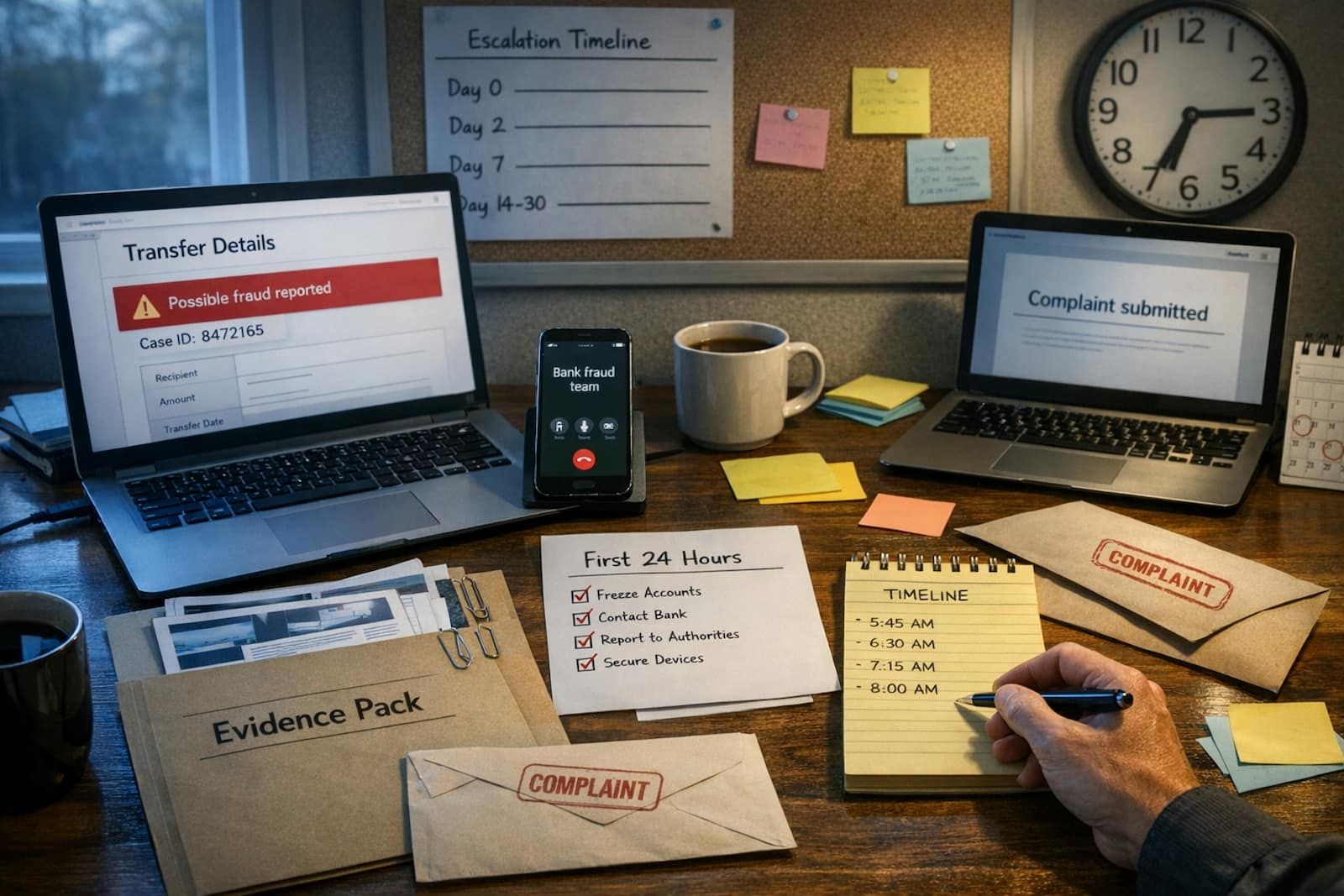
TL;DR
If you sent a bank transfer to a scammer, treat it like an active incident. Freeze access, report immediately, build an evidence pack, and escalate in writing. Recovery depends on timing, documentation, and bank cooperation.
To recover money from a bank transfer scam in 2026, report the transfer to your bank within minutes, request a recall and beneficiary freeze, file a written fraud claim, and preserve full evidence. If the bank refuses, escalate to the relevant regulator and ombudsman. Recovery depends on timing, documentation, and bank cooperation.
The incident brief
A bank transfer scam is not magic. It is speed, pressure, and a payment rail built to be final.
You can still fight it.
The winning approach is simple.
Shrink the scammer’s time window. Expand your evidence. Force accountability.
Hard truth: Every hour you wait improves the scammer’s exit.
This guide is written for five regions:
- United States
- United Kingdom
- Canada
- Australia
- New Zealand
Jurisdiction note: Rules and complaint bodies differ by country and by bank. Use the path for your location.
Cross-border limitation: If the beneficiary bank is in another country, recovery rates usually drop. Freezes and recalls rely on cooperation and local law.
Definition
A bank transfer scam is when money is sent from your bank to another bank account under deception. The transfer is real. It is authorized in the app, online banking, or a branch. Once received, it is often difficult to reverse.
Bank reality block
Banks do not “push a refund button.” They run a process:
- Confirm what was sent and when.
- Contact the receiving bank.
- Request a hold or freeze on remaining funds.
- Request a recall or return.
- Decide whether the loss sits with the customer or the bank.
Scammers understand this process. They race you to withdraw, move, or launder the funds.
Your job is to make the bank’s job easy. Make it fast. Make it documented.
The first 24 hours plan (control-first)
Compliance warning: Do not negotiate with the scammer. Do not “test send.” Do not pay anyone to “unlock” a refund.
0 to 30 minutes
- Call your bank fraud team. Use the emergency number on the back of your card or inside the app.
- Say this sentence: “I sent a bank transfer under deception. I need an immediate recall request and a beneficiary freeze request.”
- Ask for a case number.
- Ask for the timestamp and payment reference.
Secure your access:
- Change your banking password.
- Turn on multi-factor authentication.
- Remove unknown payees.
30 to 120 minutes
- File a written fraud report with the bank. Use email or secure message.
- Submit your DV Evidence Pack. Do not drip-feed evidence over days.
- File a police report if your region uses it as a standard escalation input.
2 to 24 hours
- Escalate to the bank’s complaints channel in writing.
- If the bank does not confirm a recall request and contact with the receiving bank, escalate again.
Read this twice: Your job is not to be polite. Your job is to be documented.
DV Evidence Pack (what banks actually need)
Screenshot checklist.
- Payment confirmation screen.
- Beneficiary details entered.
- All chat logs, emails, SMS, and call logs.
- Any “safe account” or “bank security” scripts used.
- Proof of impersonation:
- The spoofed domain.
- The fake number.
- The fake invoice.
- Timeline notes with exact times.
- Any warnings the scammer told you to ignore.
Evidence-weight model:
- High weight: spoofed domain, altered invoice, recorded call, written “move money now” instructions.
- Medium weight: screenshots of messages, call logs, payment reference.
- Low weight: verbal memory with no artifacts.
If you remember only one thing: Bring receipts, not rage.
Can a bank transfer be reversed?
Sometimes.
A transfer can be recovered if unspent funds remain in the receiving account and the receiving bank cooperates with a freeze and return.
Once the money is withdrawn or moved onward, the bank can still pursue it. At that point it becomes a multi-bank, sometimes multi-jurisdiction process. That is slow.
Scammers are fast.
In one line: Scammers love delays. Delays love excuses.
The escalation timeline with decision thresholds
Use this timeline to apply pressure without losing credibility.
Day 0
- Bank fraud report filed.
- Recall requested.
- Receiving bank contacted.
Decision threshold: If your bank does not confirm contact with the receiving bank within 24 hours, escalate to a formal complaint.
Day 2
Ask for written confirmation of:
- Recall request status.
- Receiving bank response.
- Any freeze or hold action.
Decision threshold: If there is no written update, file a regulator or ombudsman complaint.
Day 7
- Request the bank’s final position in writing.
- Request a copy of the bank’s internal decision criteria used for your case, if available.
Decision threshold: If the bank blames “authorized transfer” without addressing deception evidence, escalate again and attach the evidence pack.
Day 14 to 30
- Push for reconsideration.
- Consider civil recovery only after you have the bank’s written response.
Comparison table: recovery approaches and when they work
| Approach | When it can work | When it usually fails | What you must provide |
|---|---|---|---|
| Bank recall and beneficiary freeze | Funds still in receiving account, fast report | Scammer cashes out quickly, cross-border friction | Payment reference, timeline, beneficiary details |
| Formal bank complaint | Bank process errors, weak first response | Purely verbal story, no documentation | Written statement, evidence pack, case number |
| Regulator or ombudsman escalation | Bank ignores evidence, delays, inconsistent handling | No clear bank decision yet, incomplete complaint | Complaint timeline, copies of bank responses |
| Civil recovery attempt | Identified beneficiary, local enforceable route | Unknown recipient, mule network, overseas account | Recipient details, bank records, legal guidance |
Operational cost table (real math, not vibes)
This is why speed matters.
Assume a scam bank transfer loss of $4,800. Also assume you spend time chasing it.
| Cost line | Example math | What it means |
|---|---|---|
| Direct loss | $4,800 | The money that left |
| Time cost | 10 hours × $35 per hour = $350 | Calls, forms, follow-ups |
| Short-term cash impact | Overdraft fees or interest = $60 | Secondary financial bleed |
| Identity exposure risk | 1 year of monitoring = $120 | Scams often include data theft |
| Total incident cost | $4,800 + $350 + $60 + $120 = $5,330 | Recovery is not just the transfer |
For small businesses, add a second layer. Invoice fraud often hits vendors, payroll, and customer trust. A single incident becomes a reputational tax.
Micro-scenario 1: the fake bank security call
- Loss: $2,300 transfer to a “safe account.”
- Timeline: transfer sent at 10:12. Fraud report at 10:28.
Outcome logic:
- A recall request can land before the mule empties the account.
- Your evidence pack should include the spoofed number, the script, and the exact words used.
If-then rule: If the scam used a fake bank alert script, treat it as impersonation and escalate with proof of spoofing.
Micro-scenario 2: invoice redirection for an SMB
- Loss: £9,750 supplier payment to a changed bank account.
- Timeline: invoice received Monday, paid Tuesday, fraud discovered Friday.
Outcome logic:
- Delayed discovery lowers recovery odds.
- Preserve email headers and invoice version history.
Business note: Fraud is not only theft. It is operational disruption.
Region-specific escalation map (clinical, not dramatic)
Banks respond to scrutiny. These are escalation routes, not refund guarantees. Names and steps vary by bank.
United States
- Complaint paths: CFPB complaint portal for bank conduct, FTC for scam reporting themes.
- Expect the bank to focus on authorization versus deception.
United Kingdom
- Complaint paths: bank complaints process, then the Financial Ombudsman Service.
- The FCA sets conduct expectations that influence complaint handling.
Canada
- Complaint paths: bank complaint process, then the bank’s external complaints body.
- OSFI sets governance expectations, even when it does not adjudicate individual refunds.
Australia
- Complaint paths: bank complaints process, then AFCA.
- ASIC enforcement posture shapes how institutions describe scam controls.
New Zealand
- Complaint paths: internal complaints, then your bank’s dispute resolution scheme.
- The Financial Markets Authority influences conduct norms and disclosures.
Litigation exposure and why documentation matters
Some cases move beyond a bank dispute.
If the recipient account is identifiable, civil recovery can be possible. If the recipient is a mule network, costs can rise quickly.
Save every bank message. Save every response time.
If a bank delays a recall request, that delay creates a paper trail. That paper trail matters.
Psychology neutralization: how scammers steer transfers
Scammers run a predictable script:
- Urgency.
- Authority.
- Isolation.
- Reversal:
- “We will arrest you.”
- “You will lose your account.”
- “This is confidential.”
Neutralization rule:
- Slow the moment.
- Verify the channel.
- Confirm the beneficiary independently.
When a scam involves impersonation and pressure, victims often blame themselves. Do not.
Blame the playbook. Then break it.
Prevention difference: individual versus SMB
Individuals
- Most losses are personal transfers, fake bank calls, or marketplace payments.
- Prevention is identity hygiene and payment verification.
Small businesses
- Most losses are invoice fraud, payroll diversion, and supplier impersonation.
- Prevention is process:
- Dual approval for new payees.
- Callback verification using known numbers.
- Email security controls.
FAQ
How long do I have to report a bank transfer scam?
Report immediately. Hours matter more than days because holds and recalls depend on unspent funds.
Will my bank refund me if I approved the transfer?
Sometimes. Many banks treat authorized transfers as customer responsibility, even when deception is clear. Strong evidence and fast reporting improve outcomes.
Should I pay a “recovery service” that promises to get the money back?
No. Many are secondary scams. No legitimate party can guarantee recovery.
Does filing a police report get the money back?
A police report can support a bank claim and escalation. It rarely triggers instant reimbursement by itself.
What if the recipient account belongs to a mule, not the real scammer?
That is common. Banks may still recover unspent funds. The mule layer is why timing and freezes matter.
What if the transfer was international?
Cross-border transfers add delays and legal friction. Recovery can still happen, but expectations must be realistic.
What should we say to the bank in one line?
“I sent a bank transfer under deception. I request an immediate recall and beneficiary freeze, and I am submitting a complete evidence pack today.”
Disclaimer
This article is educational information, not legal advice. Bank transfer scam recovery outcomes vary by timing, documentation, bank policy, and jurisdiction. No guide can guarantee a refund. If you believe you are at risk of harm or significant financial loss, seek professional advice from a qualified legal or financial professional in your region.
Scammers want speed. You want receipts.
Report fast and document everything before the story changes.