Task-Driven Job Scams: How Fake Remote Work Dashboards Trap Crypto and Cash
Task-driven job scams disguise themselves as legitimate remote work opportunities, using fake dashboards, commissions, and account balances to convince victims to deposit crypto or cash. Learn how these scams work, the warning signs, and how to avoid losing money.

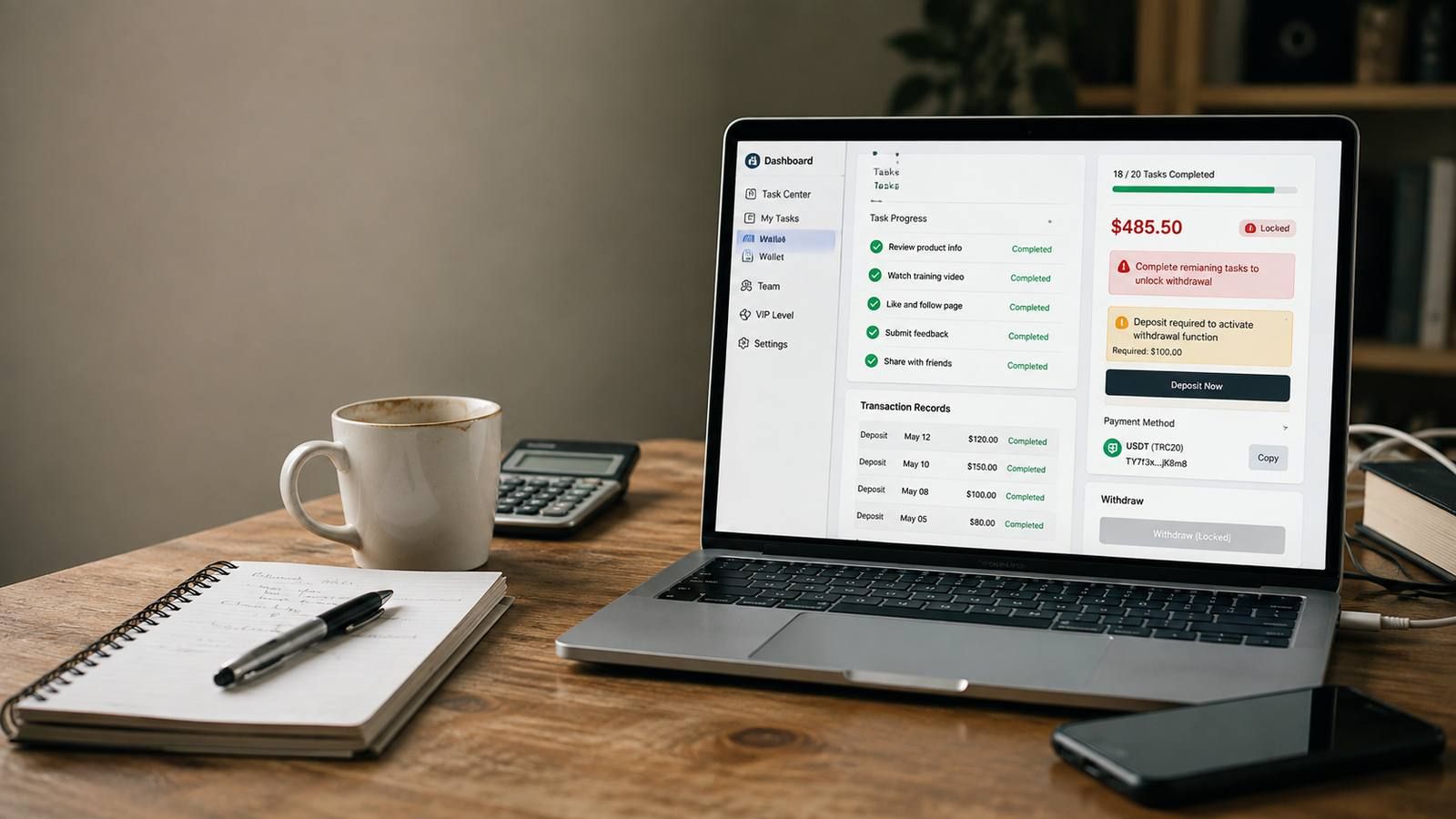
The job was never a job.
It was a deposit machine wearing a fake dashboard, a fake recruiter, and a fake “customer service” script. The tasks were bait. The commission was theater. The negative balance was the trap door.
A task-driven job scam is a fake remote work scheme. Scammers offer easy online work such as “optimizing” products, rating vacation packages, boosting apps, or completing dashboard tasks. Then they require you to deposit money—USDT, USDC, or other crypto—to unlock more tasks, clear a negative balance, or withdraw fake profits.
That is not employment.
That is a scammer putting a cash register in your pocket and calling it career development.
The Canadian Anti-Fraud Centre has warned about rising crypto job frauds. Victims are offered freelance work to “boost” products, apps, or videos using scammer-created software. They may get a small payment first to make the job look real. Then they are pushed into depositing funds to continue tasks or access earnings. The FBI describes similar cryptocurrency job scams where criminals pose as employees of legitimate companies, offer click-based work, require deposits, promise higher commissions for larger deposits, and route victims through fake customer service groups.
If you are staring at a task dashboard with a negative balance and someone is telling you to add crypto before you can withdraw, stop feeding the machine.
It is already chewing.
TL;DR
- A task-driven job scam is a fake remote work scheme where “optimizer,” “rating,” or “task completion” jobs require you to deposit money or crypto before you can withdraw fake commissions.
- The core risk is not just the money you already sent. It is also wallet exposure, repeated deposits, identity document misuse, and recovery scammers circling the wreckage like flies in suits.
- In the next fifteen minutes, stop all deposits, disconnect the wallet, revoke token approvals where applicable, screenshot everything, copy transaction hashes, and contact your bank or crypto platform if fiat or exchange transfers were involved.
- Canada-based victims should report to the Canadian Anti-Fraud Centre and local police. U.S. victims can report crypto job scams to the FBI’s IC3. Rules and recovery options vary by country, payment method, timing, and evidence.
- Do not pay “tax,” “verification,” “unlock,” “anti-money laundering,” “channel repair,” or “final withdrawal” fees. That is the scam asking for dessert.
What Is a Task-Driven Job Scam?
A task-driven job scam is a fake employment scheme built around repetitive online tasks.
The job title changes. The scam does not.
You may see roles such as:
- Product optimizer
- App booster
- Hotel or vacation package rater
- Marketplace data assistant
- Remote task evaluator
- Commission-based reviewer
- Search engine optimizer
- Order processor
- Digital marketing assistant
- Web3 platform tester
The fake company tells you the work is simple. Click tasks. Rate products. Submit reviews. Improve rankings. Complete sets. Earn commission.
Then the dashboard shows a balance.
Then the balance grows.
Then the platform says you need to maintain a minimum account balance, deposit USDC, top up USDT, or clear a “negative task” before withdrawal.
Congratulations. The “job” has turned into a pay-to-withdraw clown parade.
Real employers pay workers.
Fake task platforms make workers pay the employer, then call the hostage money a “balance.”
How The Scam Works: The Dashboard Autopsy
This scam is not random. It has a machine-like sequence.
Here is the usual operating pattern.
| Stage | What The Scammer Shows You | What Is Actually Happening |
|---|---|---|
| Recruitment | A remote job offer through WhatsApp, Telegram, text, social media, job boards, or a fake recruiter | The scammer is filtering for people who need flexible income |
| Legitimacy bait | A real company name, fake HR profile, polished website, training group, or “mentor” | Brand theft with a smiley face |
| First tasks | Easy clicks, ratings, product boosts, or vacation package reviews | No real work is being performed |
| Small payout | A tiny commission or withdrawal succeeds | The scammer buys your trust with your future loss |
| Deposit request | You must add money or crypto to unlock more tasks | The platform is switching from bait to extraction |
| Negative balance | A “combo task,” “lucky order,” or “premium task” makes your balance negative | The dashboard is fake math wearing a lab coat |
| Withdrawal block | You must pay tax, fees, AML verification, wallet sync cost, or another deposit | The scam is stretching the loss |
| Cutoff | Support delays, threatens account closure, or disappears | The extraction phase is over unless you keep paying |
The important thing to understand is this:
The dashboard is not a bank account.
It is not a payroll system.
It is not a regulated trading account.
It is not proof of earnings.
It is a screen controlled by criminals.
They can make the balance say $80, $800, $8,000, or “negative 1,200 USDC” because the number is not money. It is bait with digits.
The Negative Balance Trick Is Psychological Warfare
The negative balance is the scam’s nastiest little gadget.
It works because it flips the victim from “I am earning” to “I need to fix this.”
Scammers may call it:
- A combined task
- A premium task
- A data packet
- A lucky order
- A high-commission task
- A merchant requirement
- A platform balance rule
- A frozen withdrawal
- A system repair
- A channel verification
Different names. Same garbage.
The scammer claims your account has gone negative because the task value exceeded your current balance. To continue, you must deposit more.
This is not how legitimate work works.
A real employer does not say:
“Great news, your job generated a surprise negative balance. Please send stablecoins to unlock your salary.”
That sentence belongs in a fraud museum, next to fake inheritance emails and “kindly send gift cards” nonsense.
The negative balance trick exploits three pressures:
- Loss aversion
You already deposited money, so you feel forced to keep going. - Completion pressure
The platform says you are close to finishing a task set. Scammers love progress bars because humans hate leaving things unfinished. - Fake authority
“Customer service” explains the rule calmly, as if the scam has a compliance department and not a criminal with a headset script.
Do not argue with the dashboard.
Preserve it as evidence.
Then stop paying.
Why USDT and USDC Are Perfect Scam Fuel
Task scams increasingly use stablecoins such as USDT and USDC because they are fast, global, and easier for scammers to move across wallets, chains, exchanges, and laundering routes.
Stablecoins are designed to track a currency value, often the U.S. dollar. They are easier to understand than volatile crypto. “Send 100 USDC” feels cleaner than “send 0.038 random mystery coin.”
That is the point.
The scammer wants crypto that feels like cash but behaves like a difficult-to-reverse digital transfer.
Common crypto mechanics in these scams include:
- Sending USDT or USDC to a wallet address controlled by the scammer
- Buying crypto through an exchange after being coached by the “job mentor”
- Moving funds from a bank account to an exchange, then to the fake platform
- Connecting a wallet to a suspicious Web3 site
- Approving token permissions that may expose funds in the wallet
- Being told to use a specific network such as TRC-20, ERC-20, or another chain
If you connected a wallet to the task platform, treat that wallet like a contaminated crime scene.
Do not keep using it casually.
Do not store new funds there.
Do not assume disconnecting the website is enough.
If token approvals were granted, the platform may have permission to move certain tokens. That does not mean every wallet is drained automatically, but it does mean you need to check approvals and isolate risk fast.
For broader crypto fraud recovery realities, Dollar Vigil’s cryptocurrency pig butchering scam recovery guide explains why blockchain tracing can help build evidence but does not magically yank coins back from criminals. Anyone promising guaranteed recovery is selling fairy dust with transaction fees.
What To Do In The First Fifteen Minutes
This is not the moment for embarrassment.
This is the moment for containment.
Do these steps now.
1. Stop All Payments
Do not send another deposit.
Not for:
- Negative balance clearance
- Tax
- Withdrawal verification
- AML review
- Account activation
- Wallet synchronization
- Channel repair
- Merchant release
- Final task completion
- Commission unlock
- Customer service escalation
The next payment is not the rescue rope.
It is another hook.
2. Disconnect The Wallet
If you connected a wallet to the fake task dashboard:
- Disconnect the site from your wallet app.
- Check connected sites inside the wallet settings.
- Remove the suspicious connection.
- Do not approve any new prompts.
- Do not sign any “refund,” “verification,” or “withdrawal” transaction.
Scam sites may disguise dangerous wallet prompts as harmless login or verification steps. If you do not understand exactly what a signature or approval does, do not sign it.
3. Revoke Token Approvals
If you approved USDT, USDC, or another token, use a reputable token approval checker for the chain involved.
Common examples include blockchain explorers or established approval tools for Ethereum-compatible chains. Use caution. Do not use random links sent by the scammer, a Telegram “helper,” or a recovery expert with a profile photo that looks like a motivational speaker trapped in a stock image factory.
When in doubt, move remaining assets to a new clean wallet using a safe device and verified wallet software. Do not move funds through the scam platform.
4. Screenshot Everything
Capture:
- Job posting
- Recruiter profile
- Phone numbers
- WhatsApp or Telegram chats
- Training instructions
- Dashboard balance
- Negative balance screen
- Deposit instructions
- Wallet addresses
- Transaction IDs
- Withdrawal rejection messages
- “Customer service” conversations
- Website URL
- Company name used
- Any fake contract or employment letter
Do not rely on the platform staying online. Scam websites vanish when the heat arrives.
Screenshots are boring until they are the only thing left.
5. Copy Transaction Hashes
For crypto transfers, collect:
- Transaction hash or transaction ID
- Sending wallet address
- Receiving wallet address
- Date and time
- Blockchain network
- Token type and amount
- Exchange account used, if any
- Screenshots from the exchange withdrawal page
- Any memo, tag, or reference number
A transaction hash is not just a receipt. It is the breadcrumb investigators, exchanges, and blockchain analytics teams may use to follow movement.
6. Contact Your Bank Or Crypto Exchange
If you funded the scam through a bank card, bank transfer, wire, Interac e-Transfer, ACH, debit card, credit card, or exchange purchase, contact the relevant institution immediately.
Be precise.
Say:
“I was defrauded through a fake remote task job scam. I need to report the transaction, preserve evidence, and ask whether any recall, dispute, freeze, chargeback, or fraud escalation option is available.”
Do not say only “I changed my mind” or “I want a refund.”
That makes the file look like a merchant dispute. This is fraud.
If the payment involved a bank transfer, link to your bank’s fraud-reporting page, or use a neutral public resource like the CFPB’s fraud guidance: https://www.consumerfinance.gov/consumer-tools/fraud/.
Recovery is not guaranteed, but delay is the scammer’s favorite employee.
Evidence That Actually Matters
Evidence beats panic.
Panic is understandable. Evidence moves the file.
Use this checklist.
| Evidence Type | Why It Matters |
|---|---|
| Recruiter messages | Shows how you were approached and manipulated |
| Job description | Proves the employment framing |
| Fake company name and website | Helps identify impersonation or cloned branding |
| Dashboard screenshots | Shows fake balances, locked funds, and negative balance demands |
| Wallet addresses | Enables blockchain tracing and exchange reporting |
| Transaction hashes | Creates a verifiable payment trail |
| Bank or exchange receipts | Connects fiat funding to crypto movement |
| Withdrawal denial messages | Shows the platform blocked funds and demanded more money |
| ID documents submitted | Helps assess identity theft risk |
| Timeline | Helps banks, police, CAFC, IC3, and complaint bodies understand sequence |
Build a clean timeline.
Use this format:
- Date and time recruited
- Platform where contact started
- Name and contact details used by recruiter
- Website or app used
- First deposit amount and method
- Any successful small withdrawal
- Later deposits
- Negative balance demand
- Withdrawal attempt
- Support response
- Date you stopped contact
- Reports filed
Do not “clean up” the story to make it sound less embarrassing.
The messy details are often the mechanism. Investigators need the mechanism.
Reporting Channels For Canada And Global Victims
If you are in Canada, report the scam to:
- The Canadian Anti-Fraud Centre
- The Report Cybercrime and Fraud portal
- Your local police service
- Your bank, credit union, card issuer, or payment provider
- Your crypto exchange, if one was used
- The impersonated company, if scammers used a real company’s name
The CAFC says it collects information on fraud and identity theft and provides information on current and past frauds affecting Canadians. The federal reporting portal also states that reporting helps the RCMP, the National Cybercrime Coordination Centre, and CAFC learn more about incidents.
If you are in the United States, report crypto job scams to:
- FBI IC3
- Local law enforcement
- Your bank or card issuer
- Your crypto exchange
- The impersonated company
The FBI specifically warns that cryptocurrency job scams often involve criminals posing as employees of legitimate companies, offering routine click-based tasks, requiring deposits, promising higher commissions for larger deposits, and using fake customer service groups.
If you are outside Canada or the U.S., use your national cybercrime reporting body, local police, bank, payment provider, and exchange. Do not assume Canadian or U.S. rules apply to your case. Jurisdiction matters. Payment rail matters. The scammer, naturally, would prefer you understand none of that.
Can You Recover Money From A Task Job Scam?
Maybe.
Not guaranteed.
Anyone telling you otherwise is either guessing, selling, or lying with confidence.
Recovery depends on:
- Whether the payment was crypto, card, bank transfer, wire, e-transfer, or another method
- How quickly you reported it
- Whether funds are still at an exchange or reachable account
- Whether the receiving wallet connects to a regulated exchange
- Whether your bank or exchange can freeze, recall, dispute, or investigate
- Whether the transaction was authorized, unauthorized, or induced by fraud
- Your country’s consumer protection rules
- The quality of your evidence
- Whether law enforcement can connect your case to a larger wallet cluster or operation
Crypto transfers are usually difficult to reverse once confirmed. That is the ugly plumbing. Blockchain records can support tracing and reporting, but tracing is not the same as recovery.
Bank-funded crypto purchases create a more complicated file. Your bank may say you authorized the transfer. That may be true at the transaction level. But the broader complaint may still involve fraud, manipulation, ignored warnings, account compromise, vulnerability, or poor handling depending on the facts.
Some denials are valid.
Some are lazy.
Your job is to build the file well enough to tell the difference.
For evidence-based escalation after a bank rejection, read Dollar Vigil’s breakdown of why banks reject scam refund claims and what evidence can change the outcome. Outrage may be justified. Evidence is still the crowbar.
What Not To Do Next
The second scam often arrives while the first one is still smoking.
Avoid these mistakes.
Do Not Pay A Recovery Agent
Fake recovery experts love job scam victims.
They will say:
- “We traced your crypto.”
- “Your funds are frozen.”
- “We can retrieve it.”
- “Pay a small legal fee.”
- “Buy this software.”
- “Send gas fees.”
- “Deposit to activate the refund wallet.”
- “We work with blockchain authorities.”
Translation:
They found your wound and brought a straw.
Legitimate blockchain analysis firms do not guarantee recovery through Instagram DMs, Telegram strangers, or WhatsApp “agents.” Law enforcement and regulated institutions do not require victims to pay crypto fees to unlock stolen funds.
Do Not Keep Negotiating With Customer Service
The fake support agent is not support.
They are the cash extraction clerk.
Once they know you are scared, they will rotate scripts:
- sympathy
- pressure
- fake compliance
- deadline
- threat
- “manager approval”
- final fee
- account closure warning
Do not debate the rules of a fake platform.
Document. Stop. Report.
Do Not Delete Chats
Victims often delete messages because they feel ashamed.
Do not.
Shame is exactly what scammers rely on after the theft. Evidence is how you punch back without sending another dollar into the furnace.
Do Not Reuse The Same Wallet For New Funds
If you connected a wallet, approved tokens, or interacted with a suspicious Web3 site, treat the wallet as unsafe until checked.
Move remaining assets carefully to a new wallet if needed. Use verified wallet software. Avoid links sent by anyone involved in the scam.
Do Not Assume Your Identity Is Safe
If you submitted ID documents, selfies, bank statements, tax numbers, Social Insurance Number, passport, driver’s licence, or proof of address, the scam may now include identity theft risk.
Monitor accounts. Watch for new account openings, loan applications, SIM swap attempts, suspicious emails, and new messages from “recruiters.”
For identity-monitoring choices, consider starting with free options (fraud alerts/credit freezes where available) and only paying for a service if it clearly covers a risk you actually have.
Red Flags Of A Fake Task Dashboard Job
Here is the scammer’s uniform.
| Red Flag | Why It Is Dangerous |
|---|---|
| You are contacted out of nowhere for easy remote work | Real hiring rarely starts with instant commissions from strangers |
| The recruiter uses WhatsApp, Telegram, or text as the main channel | Scammers prefer disposable communication |
| The company name resembles a real brand | Impersonation gives the scam borrowed credibility |
| No interview, references, tax paperwork, or real employment process | They are not hiring. They are harvesting |
| You must deposit money to work | Real jobs pay you. They do not invoice you for the privilege of clicking buttons |
| You must keep a minimum USDC or USDT balance | Payroll does not run on hostage deposits |
| A small withdrawal succeeds early | That is bait, not proof |
| Your balance suddenly turns negative | Fake math used to force more payment |
| Support says withdrawal requires tax or fees | Real tax authorities do not collect through scam dashboards |
| They promise higher commissions if you deposit more | That is not compensation. That is extraction |
| You are told not to tell your bank the full story | Huge red flag. Scammers hate accurate reporting |
| Recovery agents contact you afterward | The victim list may be circulating |
If your “job” contains three or more of these, stop treating it like employment.
Treat it like evidence.
The Recovery Decision Tree
Use this as a blunt triage map.
If You Sent Crypto Directly From Your Wallet
Do this:
- Stop all contact.
- Disconnect the wallet.
- Revoke approvals.
- Move remaining assets to a clean wallet if needed.
- Record transaction hashes.
- Report wallet addresses to the exchange, CAFC or IC3, local police, and relevant blockchain abuse reporting channels.
- Watch for recovery scams.
Recovery outlook: difficult unless funds hit a regulated exchange or law enforcement connects the wallet to an active investigation.
If You Bought Crypto Through An Exchange
Do this:
- Contact the exchange immediately.
- Report the recipient wallet address and transaction hash.
- Ask whether the receiving address is linked to any platform account or suspicious activity.
- Request preservation of records.
- File reports with law enforcement and fraud reporting bodies.
Recovery outlook: possible only in limited situations, usually when funds remain within a reachable exchange environment or investigators can act quickly.
If You Paid by Bank Transfer or E-Transfer
Do this:
- Contact your bank immediately.
- Ask for fraud escalation and recall options.
- Provide recipient name, account details, transaction time, amount, and scam evidence.
- Ask for written confirmation of actions taken.
- File CAFC and police reports.
Recovery outlook: depends heavily on speed, receiving institution cooperation, payment rail rules, and whether funds remain available.
If You Paid by Credit or Debit Card
Do this:
- Contact the card issuer.
- Explain it was a fraudulent fake employment platform.
- Ask about chargeback or dispute rights.
- Provide screenshots showing fake job claims, withdrawal blocks, and fee demands.
Recovery outlook: stronger than pure crypto in some cases, but not automatic. Card networks have rules, deadlines, and evidence requirements.
If You Shared ID Documents
Do this:
- Monitor credit and banking activity.
- Contact relevant credit bureaus or identity protection services available in your country.
- Consider fraud alerts or credit freezes where available.
- Watch for SIM swap signs and account takeover attempts.
- Report identity document misuse if suspicious activity appears.
Recovery outlook: this is about preventing second-stage harm, not recovering the first payment.
Myth Versus Reality
| Myth | Reality |
|---|---|
| “The dashboard shows profits, so the money exists.” | The dashboard is controlled by scammers. The number is not proof of funds. |
| “If I pay the negative balance, I can withdraw everything.” | The next fee usually creates the next excuse. The staircase has no top floor. |
| “Customer service sounds professional, so it might be real.” | Professional scripts are cheap. So are fake badges and stolen logos. |
| “USDC is stable, so it must be safer.” | Stable value does not mean reversible payment. |
| “A recovery expert can get it back for a fee.” | Most unsolicited recovery offers are follow-up scams. |
| “My bank must refund me because I was tricked.” | Maybe, maybe not. It depends on country, payment method, authorization, timing, evidence, and handling. |
| “Deleting the wallet app removes the risk.” | It does not revoke token approvals or erase blockchain transactions. |
| “Reporting is pointless.” | Reporting may not guarantee recovery, but it creates a record, supports investigations, and may help connect cases. |
Sample Report Summary You Can Use
Use this when reporting to your bank, exchange, CAFC, police, or IC3. Keep it factual. No speeches. No guessing.
I was contacted about a remote task or optimizer job. The recruiter said I would earn commission by completing online tasks such as rating, boosting, or optimizing products or services. I was directed to a website or dashboard that displayed task earnings and later required deposits in fiat or cryptocurrency to continue tasks, clear a negative balance, or withdraw funds. I made payments after being told they were required for the job. The platform then blocked withdrawal and demanded additional payments. I believe this was a fake employment and cryptocurrency task scam. I am requesting fraud reporting, transaction review, preservation of records, and any available recall, dispute, freeze, or investigative action.
Attach:
- Timeline
- Screenshots
- Transaction IDs
- Wallet addresses
- Bank or exchange receipts
- Recruiter contact details
- Website URL
- Police or CAFC report number if already filed
Evidence does not need to be emotional.
It needs to be usable.
FAQ
Is an “optimizer” remote job a scam?
Not every legitimate job title is fake, but an “optimizer” job is highly suspicious if it involves easy dashboard tasks, crypto deposits, minimum balances, negative task balances, or withdrawal fees. If you must pay money to receive wages, the job has already failed the smell test.
Can I get my deposit back from a task job scam?
Possibly, but recovery is not guaranteed. Crypto transfers are usually hard to reverse. Bank transfers, card payments, and exchange-funded purchases may have dispute, recall, or investigation options depending on timing, payment method, country, evidence, and institutional cooperation.
What should I do first if my task dashboard balance is negative?
Stop paying immediately. Screenshot the negative balance, copy all wallet addresses and transaction hashes, disconnect your wallet, revoke token approvals if applicable, and report the scam to your bank, exchange, CAFC or local equivalent, and police.
Should I pay the withdrawal fee or tax to unlock my money?
No. Fake withdrawal fees, tax payments, AML fees, verification charges, and account unlock deposits are common second-stage extraction tactics. Real tax authorities and legitimate employers do not collect withdrawal taxes through random crypto wallets on fake task dashboards.
Did I compromise my bank account?
Maybe, depending on what you shared and how you paid. If you only sent a bank transfer, your account may not be directly compromised, but you should still notify your bank. If you shared login details, remote access, card information, ID documents, one-time codes, or installed software, treat it as a higher-risk compromise and act fast.
Can police freeze scam crypto?
Sometimes, but only in specific circumstances. Crypto may be traceable on-chain, but freezing usually depends on whether funds reach a cooperative regulated exchange, whether law enforcement acts quickly, and whether the exchange or jurisdiction can intervene. Blockchain visibility is not the same as control.
Why did they let me withdraw a small amount first?
Because it worked. A small payout is bait designed to make the platform look real. Scammers spend a little to extract much more later. It is not proof of legitimacy. It is the cheapest trust-building trick in the fraud toolbox.
Should I confront the scammer?
No. Do not threaten, negotiate, or reveal your reporting strategy. Preserve evidence, stop payments, secure your accounts and wallets, and report through official channels. The scammer’s job is to keep you emotionally engaged until you pay again.
Legal And Financial Note
This article is for general educational information only and is not legal, financial, or professional advice. Scam refund rules vary by country, payment method, bank policy, evidence, timing, and case details. If you need advice about your specific situation, contact a qualified legal, financial, or consumer-rights professional in your jurisdiction.
Cold Truth
A task-driven job scam is not a broken job platform.
It is a fake workplace built around one business model: make victims pay to chase wages that never existed.
The dashboard is theater.
The recruiter is bait.
The negative balance is a leash.
The withdrawal fee is the next bite.
Your job now is not to finish the tasks.
Your job is to stop the bleeding, preserve the evidence, secure the wallet, report the trail, and refuse to let the same dirty machine invoice you for your own escape.