AI Voice Cloning & Imposter Scams 2026: How to Verify Family Emergencies
AI voice cloning scams can make fake family emergencies sound frighteningly real. Learn how to verify a loved one, use a family safe word, recognize imposter scam red flags, and respond quickly if money has already been sent.

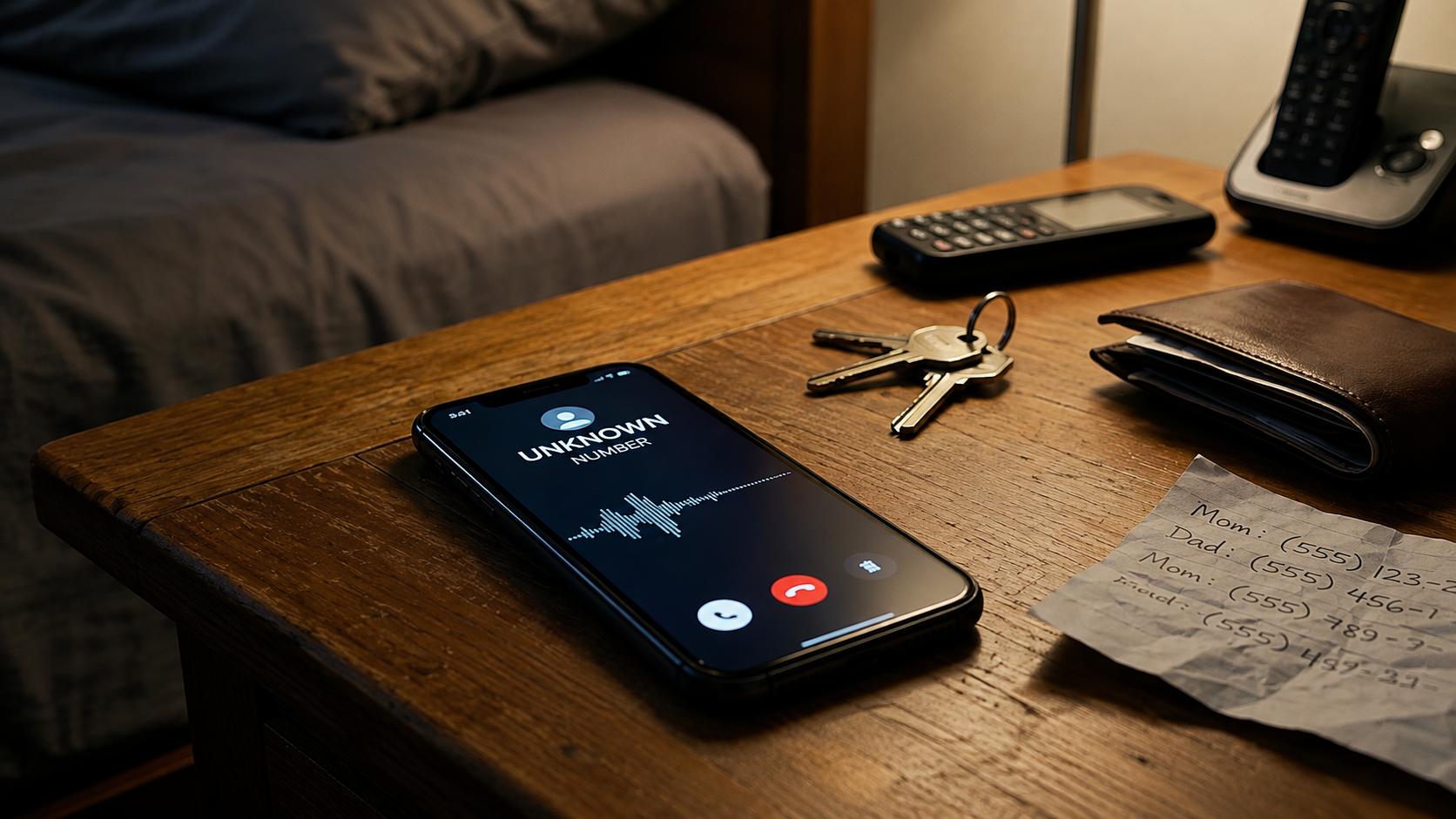
A voice that sounds like your child, grandchild, spouse, parent, or friend is no longer proof that the person on the phone is real.
That is the ugly operational truth.
Scammers do not need a Hollywood studio, a spy van, or some ridiculous villain bunker with blinking red lights. They need panic, stolen personal details, a payment demand, and enough audio to make your brain do the rest of the damage for them.
An AI voice cloning scam works because it attacks the one security system most families still trust: recognition. You hear a familiar voice screaming, crying, whispering, or begging, and your nervous system starts writing checks before your evidence brain even gets a chair at the table.
That is exactly the trap.
The scammer does not need you to believe forever. They only need you to believe long enough to send money.
TL;DR
- An AI voice cloning scam uses synthetic audio, caller ID spoofing, personal information, and panic to make a fake emergency sound real.
- The core risk is not the technology by itself. The real weapon is urgency: jail, hospital, kidnapping, arrest, accident, deportation, or “don’t tell anyone.”
- In the first fifteen minutes, hang up, call the person back using a trusted number, contact another family member, and use a pre-agreed family safe word.
- Rules, reporting systems, refund options, and scam definitions vary across the US, UK, Canada, Australia, and New Zealand. Do not assume one country’s protections apply everywhere.
- If money was already sent, report fast, preserve evidence, contact the payment provider or bank, and watch for fake recovery parasites trying to sell you miracle fixes.
What Is an AI Voice Cloning Scam?
An AI voice cloning scam is an impersonation fraud where criminals use artificial intelligence or synthetic audio tools to imitate someone’s voice and pressure the victim into sending money, sharing personal information, or taking another urgent action.
The most brutal version is the family emergency scam call.
The caller sounds like a loved one. They may say they were arrested, injured, kidnapped, trapped abroad, involved in a crash, or in trouble with police. Then another person may jump on the line pretending to be a lawyer, officer, bail agent, doctor, embassy worker, or government official.
Convenient little circus, isn’t it?
The demand usually comes fast:
- Send bail money.
- Pay a fine.
- Buy gift cards.
- Transfer money.
- Use a payment app.
- Send cryptocurrency.
- Keep it secret.
- Do it now.
That last part matters. “Do it now” is the scammer’s favorite little crowbar. They use it to pry open your fear before your common sense gets back from lunch.
The FTC says impersonation scams are consistently among the top frauds reported by consumers. In 2024, people reported nearly $3 billion in losses to impersonators, and the FTC’s Government and Business Impersonation Rule gave the agency more tools to fight scammers pretending to be agencies and businesses. The FBI’s IC3 annual report released in 2025, covering 2024 complaint data, also identified artificial intelligence as a fraud accelerant, including voice clones and believable videos depicting loved ones or public figures.
Translation: this is not science fiction anymore. It is a payment-pressure scam wearing your family’s voice like a stolen jacket.
The First Rule: A Familiar Voice Is Not Verification
Your brain treats a familiar voice like proof.
Scammers know that.
Voice cloning is dangerous because it turns emotional recognition into a weak security question. The scammer does not need perfect audio. They need enough similarity, enough background noise, enough crying, enough panic, and enough context to make you fill in the blanks.
That is why these calls often sound messy:
- The person is crying.
- The line is distorted.
- There is shouting in the background.
- Someone else takes over quickly.
- The caller says they cannot talk long.
- They claim police, kidnappers, doctors, or lawyers are listening.
- They beg you not to call anyone.
That noise is not a flaw. It is camouflage.
A calm voice can be examined. A screaming “Mom, help me” detonates inside the chest.
The scammer is not trying to win a forensic audio contest. They are trying to hijack the first sixty seconds of your fear response.
How the Family Emergency Scam Call Works
Most AI-driven family emergency scams follow a simple crime recipe. Not genius. Not elegant. Just dirty and effective.
1. They collect personal details
Scammers may scrape information from social media, data breaches, public records, obituaries, school posts, family photos, travel updates, or previous scam lists.
They look for:
- Family relationships
- Names and nicknames
- Travel locations
- Schools or workplaces
- Recent events
- Public videos or voice clips
- Elderly relatives who may be easier to isolate
- People who post too much because platforms turned privacy into a settings scavenger hunt
The information does not need to be complete. Scammers are very happy to let panic do the unpaid labor.
2. They create or fake the voice
Some scams may use actual AI voice cloning. Others use a voice actor, bad audio, a crying caller, or a fast handoff to a fake authority figure.
Do not get obsessed with proving whether the voice was “real AI.” That is useful later for reporting, but useless in the moment.
The immediate question is simpler:
Can I independently verify the person is actually in danger?
If not, no payment.
3. They build a fake emergency
Common scripts include:
- “I hit someone with my car.”
- “I’m in jail.”
- “I got arrested overseas.”
- “I need bail.”
- “I was in an accident.”
- “They took my phone.”
- “I owe a fine.”
- “I’m being held.”
- “Please don’t tell Mom/Dad.”
- “The lawyer will explain.”
Then the second scammer enters.
This person may claim to be:
- A police officer
- A lawyer
- A bail bonds agent
- A court clerk
- A doctor
- A government official
- A customs or immigration officer
- A kidnapper
- A bank fraud investigator
The handoff is designed to stop you from asking the “family member” real questions. Very convenient. Almost like the whole thing is a fraud script with shoes.
4. They demand payment through hard-to-reverse methods
The payment method is the scam’s fingerprint.
Watch for demands involving:
- Gift cards
- Cryptocurrency
- Wire transfers
- Bank transfers
- Payment apps
- Cash pickup
- Courier pickup
- Prepaid cards
- ATM withdrawals
- “Split the payment into smaller amounts”
- “Stay on the phone while you pay”
Scammers love payment methods that move quickly, provide limited recovery options, or bypass normal fraud checks. If the caller demands secrecy and speed, treat it like a burning evidence flag.
If you already sent a bank transfer, stop engaging with the caller and switch to recovery mode: contact your bank immediately and ask them to attempt a recall or freeze.
What to Do in the First Fifteen Minutes
This is the emergency procedure. Not a suggestion. Not “maybe later.” This is the part that stops the scammer from turning fear into a receipt.
1. Hang up
Yes, even if the voice sounds real.
Especially if the voice sounds real.
Scammers want continuous control. They want you on the phone, emotionally flooded, and too busy obeying to verify. Hanging up breaks the leash.
If they say, “Don’t hang up or something terrible will happen,” that is not evidence. That is manipulation wearing a cheap badge.
2. Call the person directly using a known number
Do not call back the number that called you.
Use:
- The person’s saved contact
- A family group chat
- A spouse, parent, sibling, roommate, friend, school, employer, or neighbor
- A verified official number from an official website if a hospital, jail, embassy, or agency is supposedly involved
If the loved one answers normally, the scam collapses like wet cardboard.
If the person does not answer, that still does not prove the emergency is real. Keep verifying through other trusted channels.
3. Ask the family safe word
A family safe word is a pre-agreed word or phrase that only trusted family members know.
It should be:
- Easy to remember
- Not posted online
- Not a pet name visible on social media
- Not a birthday, address, school name, or obvious family joke
- Changed if it may have been exposed
Example:
“Before I do anything, tell me the family safe word.”
If the caller dodges, cries harder, says there is no time, or hands the phone to the fake lawyer, you have your answer.
The scammer just failed the lock.
4. Ask verification questions that cannot be scraped easily
Use questions that are specific but not publicly available.
Good examples:
- “What did we call the broken chair in the kitchen?”
- “What did you give me last Christmas that made everyone laugh?”
- “What is the safe word?”
- “Which neighbor did we borrow the ladder from?”
- “What did you say when the dog knocked over the food bowl?”
Bad examples:
- Birthday
- Address
- School
- Pet name
- Mother’s maiden name
- Vacation location
- Anything visible on Facebook, Instagram, TikTok, LinkedIn, obituary pages, or family posts
If the caller says they are too distressed to answer, stop. Real emergencies do not require you to ignore verification and send crypto to a wallet like a panicked vending machine.
5. Do not pay while you are scared
Fear is not a payment authorization method.
Wait until you independently verify the emergency. If the demand involves bail, legal fees, hospital bills, government fines, tax problems, immigration trouble, or police action, use official numbers and verified channels.
Government agencies do not demand gift cards. Courts do not need Bitcoin. Police do not ask Grandma to stay on the phone while buying prepaid cards. That nonsense should be dragged into the sunlight and laughed out of the room.
The Family Verification Protocol
Set this up before the emergency. Do it today. It takes less time than arguing with a scammer pretending to be a bail agent.
| Protection Step | What To Do | Why It Works |
|---|---|---|
| Family safe word | Pick one private phrase for real emergencies | Blocks voice-only impersonation |
| Callback rule | Hang up and call the person back on a known number | Breaks scammer control |
| Second-contact rule | Verify with another trusted person before paying | Stops isolation |
| No-secret-payments rule | No family emergency payment happens in secrecy | Scammers need silence |
| Payment delay rule | Wait at least ten minutes before any money movement | Lets panic cool down |
| Official-number rule | Contact police, hospitals, courts, schools, or embassies using verified numbers | Avoids fake authority handoffs |
| Elder support rule | Older relatives call a trusted family contact before acting | Reduces targeted pressure |
The safe word does not need to be dramatic. This is not a spy movie. Pick something boring and private.
The power is not in the word. The power is in the rule: no verification, no payment.
Red Flags of an AI Voice Cloning or Imposter Emergency Scam
One red flag is enough to slow down. Three red flags means the scam is basically waving a tiny criminal flag in your face.
Watch for:
- The caller sounds like a loved one but refuses normal verification.
- They say not to tell anyone.
- They demand immediate payment.
- They claim a lawyer, officer, doctor, or official will explain everything.
- They pressure you to stay on the phone.
- They demand gift cards, crypto, wires, payment apps, or cash pickup.
- They say your loved one’s phone was taken, broken, or confiscated.
- They use fear words: jail, accident, warrant, kidnapping, deportation, bail, emergency.
- They claim caller ID proves who they are.
- They get angry when you ask questions.
- They say the situation will get worse if you verify.
- They ask you to lie to the bank, store clerk, or payment provider about why you are sending money.
That last one is a screaming siren.
If someone tells you to lie to your bank, the store cashier, or a payment platform, you are not dealing with a legitimate emergency. You are being coached through a fraud transaction by a criminal with the emotional maturity of a cockroach and the payment strategy of a sewer accountant.
Government Impersonation Fraud in 2026: Same Garbage, Better Costume
Government impersonation fraud is when scammers pretend to be from a government agency, regulator, police department, court, tax authority, immigration office, or law enforcement body.
The script usually sounds official. That is the point.
They may claim:
- You have a warrant.
- Your Social Security number or National Insurance record is compromised.
- Your bank account is linked to crime.
- Your child or grandchild has been arrested.
- Your passport, visa, tax record, or benefits are frozen.
- You must pay a fine immediately.
- You must move money to a “safe account.”
- You must not contact anyone because of a fake investigation.
The FTC’s Impersonation Rule in the United States targets government and business impersonation scams by giving the FTC additional enforcement tools against scammers pretending to be agencies or businesses. That does not mean every victim automatically gets money back. It means the conduct is squarely in the enforcement crosshairs.
Different countries have different agencies and complaint pathways:
| Country | Common Reporting Path | Practical Note |
|---|---|---|
| United States | FTC at ReportFraud.ftc.gov, FBI IC3 for internet-enabled fraud, local police when appropriate | Bank transfer, wire, card, payment app, and crypto recovery rules differ sharply |
| United Kingdom | Action Fraud or Police Scotland, bank or payment provider, relevant regulator or ombudsman route when applicable | APP scam reimbursement rules may apply to some bank transfer cases, but not every loss |
| Canada | Canadian Anti-Fraud Centre, local police, bank or payment provider | Recovery depends heavily on payment method and reporting speed |
| Australia | ReportCyber, Scamwatch, bank or payment provider | Fast reporting matters, especially for bank transfers and payment platforms |
| New Zealand | CERT NZ, local police, bank or payment provider, Financial Markets Authority (FMA) for investment or financial service impersonation concerns | Deepfake and impersonation warnings are especially relevant in financial promotions |
Do not let scammers weaponize official-sounding vocabulary. A real agency can be contacted through a verified public number. A real official does not need secrecy, gift cards, crypto, or your blind panic.
If You Already Sent Money
First, breathe. Then move.
Shame is useless here. Scammers design these attacks to create panic. Your job now is not to perform guilt in a corner. Your job is to build the file and report fast.
1. Contact the payment provider or bank immediately
Use the official number from the bank app, card, or official website.
Say clearly:
- You believe you were targeted by an imposter emergency scam.
- The caller may have used AI voice cloning or impersonation.
- The payment was induced by fraud.
- You need the transaction flagged, recalled, frozen, disputed, or investigated if possible.
Do not exaggerate. Do not invent details. Do not turn the report into a courtroom monologue. Give facts, times, amounts, recipient details, and screenshots.
If this involved online banking access, account takeover, or suspicious login activity, use the immediate containment steps in What To Do After Online Banking Fraud: Step-by-Step Guide and treat the account as compromised until proven otherwise.
2. Preserve evidence
Save:
- Caller number
- Voicemails
- Call logs
- Texts
- Emails
- Payment receipts
- Bank transfer confirmations
- Crypto wallet addresses
- Gift card numbers and receipts
- Screenshots
- Names used by the caller
- Claimed agency, lawyer, officer, hospital, or court
- Exact wording you remember
- Timeline of events
- Any social media post or public audio clip that may have been used
Evidence beats outrage. Outrage may be justified, but evidence moves complaints.
3. Report to official channels
Use the correct reporting path for your country. If the scam crossed borders, involved online communication, or used crypto, reporting may not recover the money, but it can help law enforcement identify patterns, mule accounts, wallet addresses, domains, and repeat scripts.
Also report impersonation pages, fake profiles, or scam accounts to the platform involved. Platform reporting can feel like throwing paperwork into a haunted mailbox, but it still creates a record.
4. Warn family members
Scammers may recycle the same script against relatives.
Tell the family:
- What number called
- What story was used
- What name they used
- What payment method they demanded
- What voice or relative they impersonated
- What safe word system you are using now
Do not hide the incident out of embarrassment. Silence is scammer fertilizer.
5. Watch for recovery scammers
After a loss, victims often get targeted again.
Fake recovery agents may claim they can:
- Trace crypto for a fee
- Hack the scammer
- Force a refund
- Recover funds through “special software”
- Contact the FBI, FTC, bank, or regulator on your behalf
- Guarantee results
- Unlock frozen funds after you pay a “tax” or “release fee”
No legitimate recovery path begins with a stranger in your inbox promising magic.
If someone guarantees recovery, they are not your rescuer. They are the second invoice.
What Banks and Payment Providers Actually See
In many AI voice cloning scam cases, the payment may look authorized from the institution’s side. That is the nasty procedural problem.
The victim may have:
- Logged in normally
- Passed authentication
- Initiated the transfer
- Confirmed the payment
- Ignored or misunderstood warnings
- Sent money to a mule account, crypto wallet, payment app, or wire recipient
That does not mean the victim was foolish. It means the scam was engineered to manipulate authorization.
But it does affect recovery.
Unauthorized access and authorized scam payments are not the same thing. A stolen login is different from a victim being deceived into sending money. Card chargebacks are different from bank transfers. Wire recalls are different from crypto transfers. Payment app disputes are different again.
This is where lazy advice becomes dangerous.
The real question is not simply, “Will the bank refund me?” The real question is:
- What country are you in?
- What payment method was used?
- Was the account accessed by the scammer?
- Did you authorize the payment under deception?
- How quickly did you report it?
- Did the bank provide warnings?
- Did the receiving account show mule-account indicators?
- Are scam reimbursement rules or voluntary codes relevant?
- Was the victim vulnerable?
- What evidence exists?
- Did the institution handle the complaint properly?
Some denials are valid. Some are lazy. Your job is to build the file well enough to tell the difference.
For official reporting and next steps, see ReportFraud.ftc.gov (FTC) and the FBI IC3 complaint portal. Keep expectations realistic. A strong complaint is not a magic wand. It is a documented argument.
The “Is My Loved One Actually in Danger?” Decision Tree
Use this when the call is happening or just happened.
If the caller says a loved one is in jail
- Hang up.
- Call the loved one directly.
- Call another trusted family member.
- Search for the court, police department, or jail number yourself.
- Do not use numbers provided by the caller.
- Do not pay bail through gift cards, crypto, payment apps, or random bank accounts.
If the caller says there was an accident
- Ask which hospital, police department, or ambulance service is involved.
- Hang up.
- Call the loved one directly.
- Call local hospitals or police using verified numbers if needed.
- Contact someone physically near the loved one.
If the caller claims kidnapping
- Stay calm enough to document.
- If you believe there is immediate danger, contact emergency services.
- Try to reach the alleged victim through another phone, message app, workplace, school, or nearby person.
- Do not send money before involving law enforcement.
- Preserve the caller’s number, a recording (if lawful in your jurisdiction), texts, payment demands, and timing.
If the caller claims to be government or police
- Ask for the agency, department, name, badge or reference number, and case number.
- Hang up.
- Find the agency’s official number yourself.
- Call and verify.
- Do not pay through unofficial methods.
- Do not move money to a “safe account.” That phrase belongs in the scammer hall of shame.
Common Mistakes That Make the Scam Work
These mistakes are human. They are understandable. They are also exactly what scammers are trying to trigger.
Mistake 1: Trusting caller ID
Caller ID can be spoofed. A number looking official or familiar proves almost nothing.
Caller ID is not a badge. It is a costume.
Mistake 2: Staying on the phone
The longer you stay on the call, the more control the scammer has.
They can interrupt, threaten, escalate, cry, transfer you to fake officials, and coach you through payment warnings.
Hang up. Verify separately.
Mistake 3: Asking public questions
If your verification question can be answered from social media, it is not verification. It is trivia.
Use a safe word or private family detail.
Mistake 4: Paying first and checking later
This is the scammer’s dream. Once money moves, the recovery path may be difficult, slow, limited, or impossible depending on the payment method.
Mistake 5: Keeping it secret
Secrecy protects the scammer, not your family.
The moment someone says “don’t tell anyone,” assume they are trying to isolate you from verification.
Mistake 6: Believing panic equals proof
Real emergencies create panic. Fake emergencies create panic too.
Panic only proves your body works. It does not prove the caller is real.
How to Set Up a Family Safe Word Without Making It Weird
Do it plainly.
Send a message to close family:
“We’re setting up a family emergency verification word because AI voice scams are targeting families. If anyone calls saying they’re in trouble and needs money, we ask for the safe word before taking action. No safe word, no payment.”
Then agree on the word over a private call or in person.
Good safe word rules:
- One word or short phrase
- Not posted online
- Not connected to obvious family data
- Easy for older relatives to remember
- Stored safely if needed
- Changed after any suspected exposure
- Used only for emergency verification
Also create a family rule:
No emergency payment happens until at least two trusted contacts verify it.
Scammers hate group verification. It drags their little panic theater into a room full of adults with phones, receipts, and questions. Terrible for business. Excellent for victims.
How to Talk to Elderly Relatives About Voice Cloning Scams
Do not lecture. Do not shame. Do not turn the conversation into a technology sermon.
Say this:
“Scammers can now make calls that sound like family. If you ever get a call saying I’m hurt, arrested, kidnapped, or need money urgently, hang up and call me back. If I do not answer, call these two people. Never send money because a voice told you to.”
Give them:
- A printed safe word card
- Trusted contact numbers
- Bank fraud phone number
- Local police non-emergency number
- A “do not pay under pressure” rule
- Permission to be rude to callers
That last part matters.
Many victims stay polite because they were raised to respect authority, answer questions, and help family. Scammers weaponize that decency.
Give your relatives permission to hang up.
Politeness is not a fraud control.
FAQ
Can scammers really clone a family member’s voice?
Yes. Scammers can use AI tools, synthetic audio, voice clips, or simple impersonation tactics to make a call sound like a loved one. The voice does not need to be perfect. Panic, crying, background noise, and urgency can make a rough imitation feel real.
What should I do first if I get a family emergency scam call?
Hang up and verify through a separate channel. Call the loved one using a trusted number, contact another family member, and ask for the family safe word. Do not stay on the line with the caller while making payments or checking information.
What is a family safe word?
A family safe word is a private word or phrase used to verify real emergencies. If someone calls claiming to be a loved one in distress, they should know the safe word. If they do not know it, dodge it, or say there is no time, treat the call as suspicious.
Can I get my money back after an AI voice cloning scam?
Maybe, but recovery is not guaranteed. It depends on the country, payment method, timing, evidence, whether the account was accessed without authorization, and how the bank or payment provider handles the report. Gift cards, crypto, cash, and some wires are especially difficult to recover.
Should I file a police report?
Yes, especially if money was sent, threats were made, kidnapping was claimed, government officials were impersonated, or personal information was exposed. A police report may not guarantee recovery, but it creates an official record and may support bank, insurer, regulator, or platform complaints.
Are government agencies allowed to demand immediate payment by phone?
Legitimate government agencies do not demand gift cards, cryptocurrency, payment app transfers, or secret emergency payments by phone. If someone claims to be from a government agency, hang up and contact the agency through an official number you find yourself.
What evidence should I keep?
Keep call logs, voicemails, texts, payment receipts, bank confirmations, crypto wallet addresses, gift card receipts, screenshots, names used, phone numbers, claimed agency details, and a written timeline. Evidence is the spine of the complaint. Without it, institutions have more room to shrug.
Can AI voice scams target younger people too?
Yes. Older adults are often targeted because scammers expect isolation, trust, or slower verification, but anyone can be hit. Parents, students, executives, immigrants, travelers, and people with public social media audio are all potential targets.
Legal and Financial Note
This article is for general educational information only and is not legal, financial, or professional advice. Scam refund rules vary by country, payment method, bank policy, evidence, timing, and case details. If you need advice about your specific situation, contact a qualified legal, financial, or consumer-rights professional in your jurisdiction.
Reality Check
AI did not invent the family emergency scam.
It just handed the scammer a better mask.
The old trick was panic. The new trick is panic with a familiar voice. Same sewer, cleaner microphone.
So build the rule before the call comes: hang up, verify separately, use the safe word, involve another trusted person, and never let a stranger turn fear into a payment instruction.
Because the voice on the phone may sound like family.
The demand for secrecy, speed, and money is the part that tells you who is really speaking.