The Regulatory Shift: What the CFPB’s Mass Enforcement Action Drop Means for Fraud Victim Rights
The CFPB’s enforcement pullback has changed the landscape for fraud victims, but consumer protections have not disappeared. Learn what dismissed enforcement actions mean for Zelle disputes, Regulation E claims, bank investigations, complaints, and fraud recovery rights.

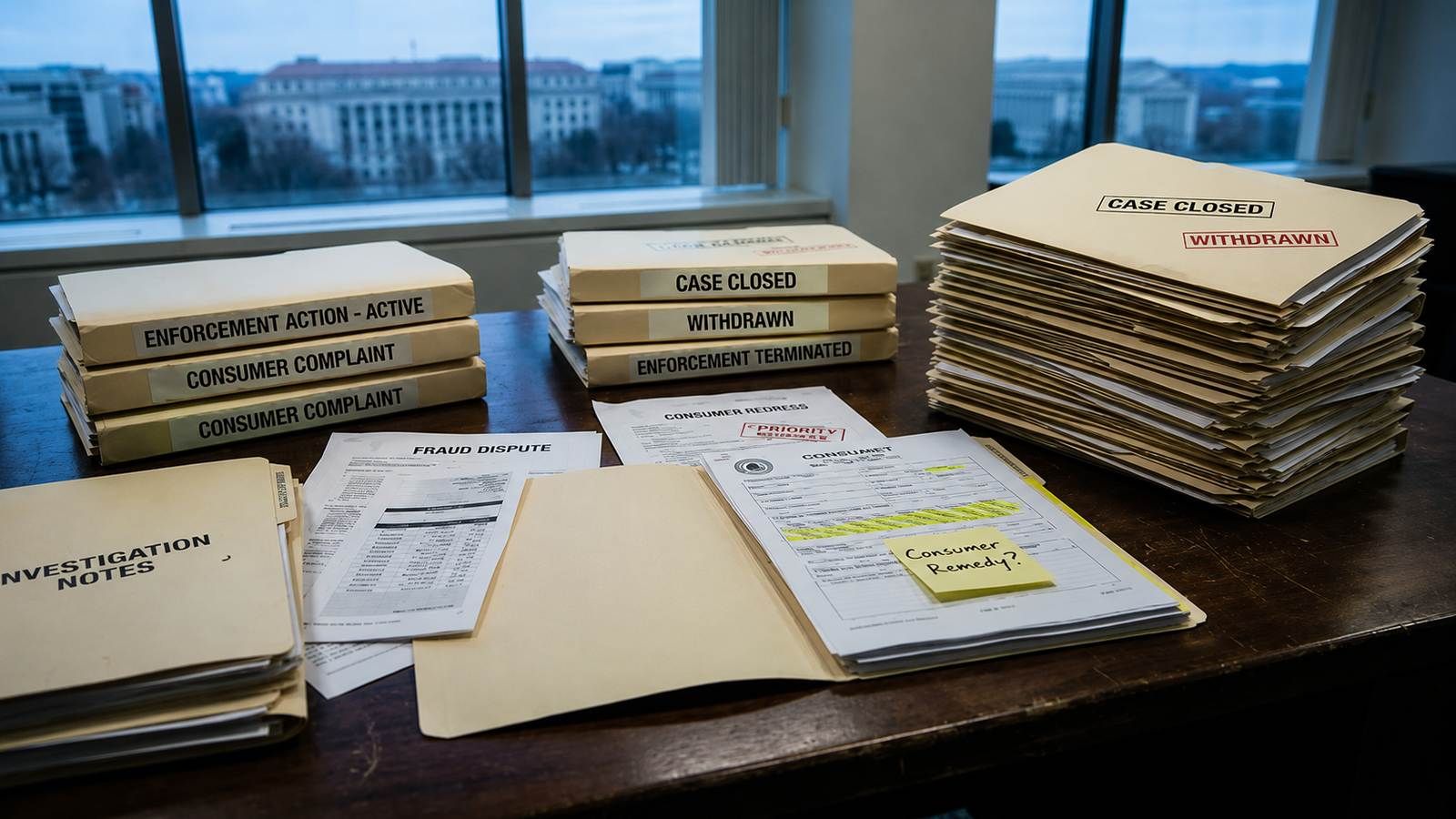
The federal watchdog did not erase your rights, but it did remove a very loud government hammer from several major fraud and fee cases. That matters.
As of 2026, the CFPB’s dropped enforcement actions mean U.S. consumers should not assume the Bureau is still aggressively litigating every landmark bank-fraud or payment-platform case from the last administration. The Zelle lawsuit against Early Warning Services, Bank of America, JPMorgan Chase, and Wells Fargo was dismissed with prejudice in March 2025. Capital One’s savings-interest lawsuit was dropped in February 2025. Navy Federal’s overdraft consent order was terminated in July 2025, including remaining redress obligations.
That does not mean banks can reject every fraud claim and laugh into a compliance spreadsheet. Regulation E, the Electronic Fund Transfer Act, state enforcement, private lawsuits, bank complaint processes, and written CFPB complaints still matter.
It means the battlefield changed.
TL;DR
- CFPB dropped enforcement actions in 2025 and 2026 changed the federal enforcement landscape, but they did not automatically cancel consumer rights under federal law.
- The core operational risk is that consumers may rely on old headlines about CFPB lawsuits while their bank dispute now depends more heavily on the facts, payment type, evidence, and applicable Regulation E analysis.
- Within the first fifteen minutes, save the denial letter, transaction record, scam messages, bank communications, login alerts, and the exact reason your bank gave for rejecting the fraud claim.
- This article covers the United States only. Bank transfer, Zelle, debit card, wire, and scam-payment rules can change depending on payment rail, timing, account type, and whether the transaction was unauthorized or fraudulently induced.
What Actually Happened To The CFPB Enforcement Cases?
The Consumer Financial Protection Bureau shifted its enforcement posture in 2025 toward cases involving “actual consumer fraud” with identifiable victims and measurable damages, while moving away from matters based on “novel legal theories” or areas the Bureau viewed as less clearly within its statutory authority.
Translation from regulator-speak: fewer experimental legal grenades, more narrow targeting.
That sounds neat on a policy slide. For victims, it creates a nasty practical problem. Some of the biggest public enforcement cases that consumers were watching as signals of institutional accountability were dropped, dismissed, or terminated.
Here are the key developments that matter for fraud victims and bank customers:
| Case or action | What happened | Why it matters to consumers |
|---|---|---|
| CFPB v. Early Warning Services, Bank of America, JPMorgan Chase, and Wells Fargo over Zelle | Filed December 20, 2024. Dismissed with prejudice in March 2025. | The CFPB is no longer pursuing that federal lawsuit over alleged Zelle fraud-control failures. Consumers cannot rely on that case as an active federal pressure point. |
| Capital One savings-interest lawsuit | Dropped February 27, 2025, according to Reuters reporting. | Shows the broader pattern was not limited to Zelle or payment fraud. |
| Navy Federal overdraft consent order | Terminated July 1, 2025, according to the Consumer Federation of America’s July 2026 tracking memo. | Remaining redress obligations were reportedly waived, which matters for consumers expecting CFPB-supervised refunds under that order. |
| CFPB enforcement strategy | 2025 lookback emphasized clear statutory authority and actual fraud with measurable damages. | The Bureau may still enforce consumer financial law, but the appetite for broad test-case litigation appears narrower. |
That is the regulatory shift. Not “consumer law is dead.” Not “banks are untouchable.” Not “every denial is legal now.”
Just a colder reality: the government may not be carrying the same enforcement bazooka into every fight.
The Zelle Lawsuit Was Dismissed, But That Does Not End Every Zelle Claim
The CFPB’s Zelle case accused Early Warning Services and three large banks of consumer-protection violations connected to fraud on the Zelle network. The Bureau’s own enforcement page states the lawsuit was voluntarily dismissed with prejudice in March 2025.
“With prejudice” is not casual legal confetti. It generally means that specific case is over and cannot simply be refiled in the same form by the same plaintiff.
For a consumer with a denied Zelle claim, that creates confusion.
Here is the clean answer: the dismissal of the CFPB’s Zelle lawsuit does not decide your individual dispute. It does not prove your bank handled your case correctly. It does not prove your bank handled your case incorrectly. It means one major federal enforcement case is gone.
Your case still turns on facts such as:
- Did someone access your account without permission?
- Did you authorize the transfer after being tricked?
- Was the payment sent through Zelle inside your bank app?
- Did the bank investigate under the correct rule?
- Did the bank give a specific denial reason or just toss you a lazy “you authorized it” postcard from the Department of Not Our Problem?
- Did you report quickly?
- Did you preserve evidence?
- Did the receiving account show mule-account indicators?
- Did the bank ignore alerts, prior fraud reports, or suspicious account behavior?
That distinction matters because U.S. consumer protection law treats different payment problems differently.
Unauthorized electronic transfers are not the same thing as authorized scam payments. A hacked account is not the same thing as a romance scam payment. A debit-card dispute is not the same thing as a wire recall. For the broader payment-scam framework, Dollar Vigil’s guide to Authorized Push Payment scam rules in 2026 explains why “authorized” does not always mean simple, fair, or refund-friendly.
A Zelle transfer is not automatically reimbursable just because a scammer wore a fake badge and spoke fluent panic.
Messy? Yes. Convenient for institutions? Also yes. But this is where the evidence file becomes the weapon.
Regulation E Still Matters, But It Is Not A Magic Refund Button
Regulation E implements the Electronic Fund Transfer Act and applies to many consumer electronic fund transfers. In plain English, it can matter when money moves electronically from a consumer account, including certain debit-card and bank-app transactions.
But Regulation E is not a refund vending machine. You do not insert outrage and receive money.
The strongest Regulation E disputes usually involve unauthorized electronic fund transfers, meaning the consumer did not authorize the transfer and did not benefit from it. That can include account takeover, stolen credentials, compromised devices, or transfers made by someone without permission.
Authorized scam payments are harder. If a consumer personally sends money after being deceived, the bank may argue the transfer was authorized, even if the consent was poisoned by a scammer’s lies. That is the ugly little trap scammers love. They do not always need to hack the bank. They hack the victim’s decision-making under pressure, then let the bank’s authorization rules do the dirty laundry.
That does not mean you should give up. It means your complaint must be built with precision.
A strong dispute should separate:
| Question | Why it matters |
|---|---|
| Was the transaction unauthorized, or was it authorized under deception? | This affects Regulation E analysis and bank liability arguments. |
| Was there account takeover? | Login records, device changes, password resets, and new recipient setup may matter. |
| Did the bank follow its investigation procedures? | A bad investigation can become its own complaint issue. |
| Did the denial letter explain the rule applied? | Vague denials are weak. They may be challengeable. |
| Was the receiving account reported, frozen, or traceable? | Recovery may depend on speed and receiving-bank cooperation. |
| Was the consumer vulnerable, impersonated, threatened, or misled by a fake institution? | Some bank policies and network rules may treat certain imposter scams differently. |
Evidence beats vibes. Always. If your file is thin, start with Dollar Vigil’s breakdown of why banks reject scam refund claims and what evidence actually changes their minds before you send another angry message into the void.
What The Navy Federal Order Termination Means
The Navy Federal overdraft action was not a Zelle scam case. It was about surprise overdraft fees. But its termination matters because it shows the broader CFPB retreat from certain existing enforcement outcomes.
According to the Consumer Federation of America’s July 2026 update, the CFPB terminated the Navy Federal consent order on July 1, 2025 and waived remaining redress obligations. The original order had required more than $80 million in consumer refunds.
For consumers, the lesson is brutal but useful: if your expected relief depends entirely on a federal consent order staying alive, administrative changes can affect what happens next.
That does not mean every fee dispute is dead. It means the route may change.
Instead of relying on a CFPB order to carry the refund process, a consumer may need to:
- Request the bank’s written explanation.
- Identify the exact fee, date, account disclosures, and account balance shown at authorization.
- Compare the bank’s explanation to the account agreement and applicable law.
- File a bank complaint through the institution’s formal complaint channel.
- File a CFPB complaint if the issue involves a covered consumer financial product or service.
- Consider state regulator complaints or legal advice if the amount and facts justify escalation.
Yes, that is more work. No, that is not fair. Fraud and fee disputes often become homework assignments for the person already harmed. The system loves giving victims a second unpaid job.
Can You Still File A CFPB Complaint After A Bank Denies A Fraud Claim?
Yes. You can still file a CFPB complaint if your bank denied a fraud claim involving a covered consumer financial product or service.
The CFPB complaint portal still exists. Banks and financial companies generally respond through that process. A CFPB complaint can create a written record, force a more formal response, and preserve the bank’s stated reason for denial.
But a CFPB complaint is not the same thing as the CFPB suing the bank for you.
That is the part consumers must understand. The complaint process can help with documentation and escalation. It may lead to review. It may produce a better explanation. It may even help resolve some cases. But it is not a private lawyer, not a court judgment, and not a guaranteed refund machine wearing a federal badge.
Use the CFPB complaint strategically.
Your complaint should include:
- The transaction date, amount, recipient, and payment rail.
- Whether the transfer was Zelle, debit card, ACH, wire, or another method.
- Whether you claim unauthorized access, scam-induced authorization, or both.
- The date you discovered the problem.
- The date you reported it.
- The bank’s denial reason.
- Any contradictions in the bank’s explanation.
- Screenshots of scam messages, fake bank texts, caller IDs, emails, app alerts, and account activity.
- A clear request: reinvestigation, written rule basis, provisional credit explanation, recipient-bank contact confirmation, or correction of an error.
Do not send a rage novel. Send a case file.
A complaint that says “they stole my money and the bank is useless” may be emotionally accurate, but it gives compliance staff too many escape hatches. A complaint that says “the bank classified this as authorized despite evidence of account takeover on X date, new recipient enrollment from an unrecognized device, and my report within Y hours” is harder to shovel into the denial pit.
What This Shift Means For Fraud Victim Rights
The CFPB’s dropped enforcement actions narrow the federal administrative pressure around certain major cases, but they do not erase private rights, state remedies, or institution-specific obligations.
The real impact is procedural.
Consumers may need to rely more on:
- The bank’s own investigation obligations.
- Regulation E arguments where the facts support them.
- State attorney general or state financial regulator complaints.
- Private legal claims in appropriate cases.
- Small claims court or arbitration where allowed and practical.
- Network rules or bank reimbursement policies for certain imposter scams.
- Written evidence showing the bank mishandled the dispute.
This is the boring, brutal truth: rights are only useful when they can be applied to a specific fact pattern.
A headline about the CFPB dropping a lawsuit will not decide your claim. Your claim will live or die on the payment type, timeline, evidence, applicable rules, and whether the institution’s handling was defensible.
That is annoying because it requires discipline. Scammers create chaos. Institutions often respond with scripts. Your job is to build a file clean enough that the script starts cracking.
The Decision Framework: What Should You Do After A Denial?
Use this framework before escalating. It keeps the case from turning into emotional fog, which is exactly where weak denials and fake recovery clowns thrive.
| If your situation is... | Your strongest next move |
|---|---|
| Someone accessed your account and sent money without permission | Build an unauthorized-transfer file under Regulation E. Include login alerts, device changes, password resets, and report timing. |
| You personally sent a Zelle payment after being tricked | Focus on scam evidence, impersonation, bank policy, recipient account details, and whether the bank properly investigated. |
| The bank gave only a vague denial | Demand the specific rule, facts reviewed, timeline, and reason the claim was rejected. |
| The bank ignored evidence | File a written appeal and attach only the strongest documents, not a junk drawer of screenshots. |
| The bank missed suspicious activity | Ask whether fraud controls, new-recipient warnings, account-takeover signals, or receiving-bank reports were reviewed. |
| You expected relief from a terminated CFPB order | Check whether any private, state, contractual, or bank-specific route remains. Do not assume federal redress is still coming. |
| Someone offers to “recover” your money for an upfront fee | Treat it like a second scam until proven otherwise. Recovery clowns love victims who just learned the system is complicated. |
What Not To Do
Do not weaken your own case with sloppy moves.
Avoid these mistakes:
- Do not describe every scam payment as “unauthorized” if you personally approved it. Say exactly what happened.
- Do not delete scam messages because they are embarrassing. Embarrassment is not evidence. Screenshots are.
- Do not rely on headlines about CFPB lawsuits as if they are active law.
- Do not assume a bank denial is final.
- Do not assume a bank denial is automatically illegal.
- Do not pay a “recovery expert” who guarantees a refund.
- Do not file five scattered complaints with five different stories.
- Do not threaten lawsuits in every sentence unless you are actually prepared to get legal advice and act.
- Do not wait weeks before reporting. Delay is where recovery chances go to rot. If you need the timing reality, Dollar Vigil’s bank fraud investigation timeline explains why the first day matters and why “under review” can become a bureaucratic swamp.
The goal is not to sound furious, even if you are. The goal is to sound impossible to ignore.
FAQ
Is The CFPB Still Suing Zelle For Bank Fraud?
No. The CFPB’s lawsuit against Early Warning Services, Bank of America, JPMorgan Chase, and Wells Fargo over Zelle was dismissed with prejudice in March 2025. That means the specific CFPB case is over. Your individual Zelle dispute may still have separate complaint, bank policy, Regulation E, state, or private legal angles depending on the facts.
Did The CFPB Dropping The Zelle Case Mean Zelle Scam Victims Have No Rights?
No. It means one federal enforcement case ended. It does not automatically decide individual claims. Victims may still dispute unauthorized transfers, challenge weak bank investigations, file CFPB complaints, contact state regulators, or seek legal advice where the amount and facts justify it.
What Happened To The Navy Federal Overdraft Refund?
The CFPB had ordered Navy Federal to provide more than $80 million in refunds related to surprise overdraft fees. According to the Consumer Federation of America’s July 2026 update, the CFPB terminated that order on July 1, 2025 and waived remaining redress obligations. Consumers with separate fee disputes may need to pursue bank complaints, regulator complaints, or legal advice based on their own account facts.
Why Did The CFPB Drop The Capital One Lawsuit?
Reuters reported that the CFPB dropped the Capital One lawsuit in February 2025 after previously accusing the bank of costing consumers more than $2 billion in lost interest. The dismissal fits a broader 2025 enforcement shift toward narrower priorities and away from cases the Bureau viewed as based on less favored or more novel theories.
Can Regulation E Still Help After A Zelle Scam?
Possibly, but the facts matter. Regulation E is stronger when the transfer was unauthorized, such as account takeover or stolen credentials. If the consumer personally authorized the payment after being deceived, the dispute becomes harder and may depend on bank policy, scam type, investigation quality, and other legal theories. Do not flatten the case into “Zelle scam equals refund.” That is not how the machinery works.
Should I File A CFPB Complaint If My Bank Denied My Fraud Claim?
Yes, if the dispute involves a covered consumer financial product or service and you have a clear, evidence-backed complaint. A CFPB complaint can force a formal response and create a written record. It does not guarantee reimbursement and does not replace legal advice.
Does The New CFPB Enforcement Direction Mean Banks Can Ignore Fraud?
No. Banks still have legal, contractual, regulatory, and operational obligations. But reduced federal enforcement pressure may make individual evidence, written appeals, state complaints, and private legal routes more important. In plain language: do not expect a regulator to do all the heavy lifting.
Legal Note
This article is for general educational information only and is not legal, financial, or professional advice. Scam refund rules vary by country, payment method, bank policy, evidence, timing, and case details. If you need advice about your specific situation, contact a qualified legal, financial, or consumer-rights professional in your jurisdiction.
Cold Truth
The CFPB’s mass enforcement retreat did not delete consumer protection law. But it did make the victim’s evidence file more important and the fantasy of easy federal rescue more dangerous.
If your bank denied your fraud claim, do not argue from hope. Argue from records, timelines, rules, contradictions, and documented procedural failures.
The scammers already used confusion as a weapon. Do not let the complaint process become their getaway car with nicer upholstery.
And if a fake recovery “expert” promises they can reverse everything for an upfront fee, congratulate them on inventing the world’s dumbest ATM: it only withdraws from victims and deposits into clown shoes.