Real-Time Transaction Risk Scoring in 2026: What Actually Works Under Fraud Pressure
Real-time transaction risk scoring is the engine behind modern fraud prevention. This guide explains how banks and fintech platforms analyze transactions instantly, assign risk scores, and stop fraudulent payments before money leaves the account.

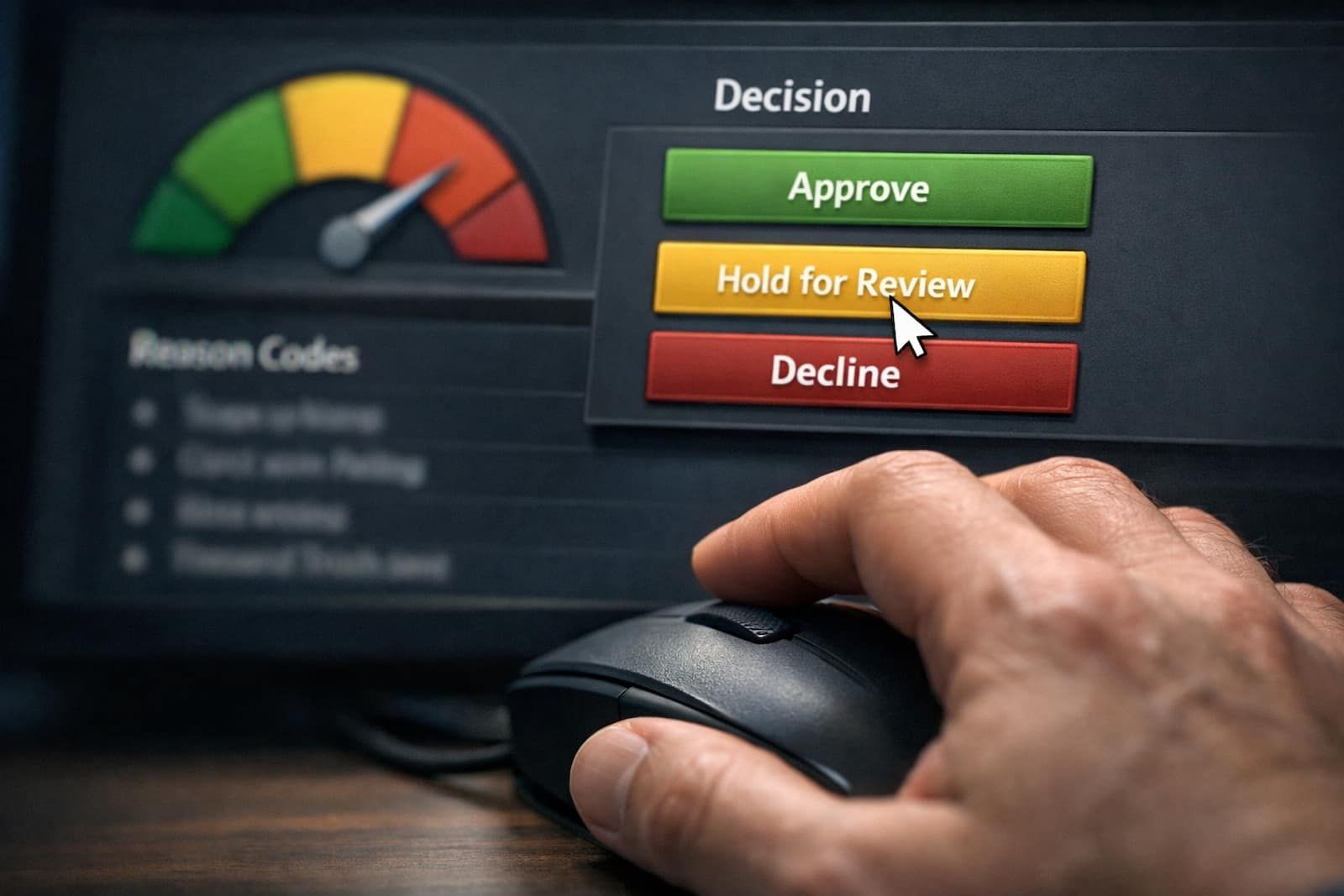
TL;DR
Real-time risk scoring is only useful if it survives four tests: it blocks measurable fraud, it keeps false positives affordable, it explains decisions in plain English, and it leaves an audit trail. Use threshold triggers, bias testing, and drift monitoring. Treat vendors like regulated suppliers, not magic.
Real-time transaction risk scoring in 2026 means scoring each payment or account action in milliseconds using device, behavior, and network signals, then triggering step-up verification, holds, or declines. What works reduces fraud while controlling false positives, produces audit trails, and stays defensible under regulatory pressure in the US, UK, Canada, Australia, and New Zealand.
In this 2026 review, treat real-time transaction risk scoring as a production decision system: it must be fast under load, calibrated to your loss and false-positive budget, and backed by reason codes and audit logs you can defend when fraud pressure spikes. In 2026, scammers design attacks to beat static rules and exploit weak model governance. This review gives a controlled way to choose and operate risk scoring without buying a black box you cannot defend.
Jurisdiction clarification: regulatory expectations differ by country and regulator, but auditability and fair, explainable decisioning are converging requirements.
Cross-border limitation note: if you operate across regions, a single global model can trigger local compliance issues unless you segment thresholds, features, and review policies by jurisdiction.
Evidence-first case file: what “good” looks like in the real world
A risk score is not a number that makes you safe. It is a decision trigger. A good system proves itself in three places:
- Loss outcomes: fewer confirmed fraud events and lower net loss per transaction.
- Customer harm outcomes: fewer wrongful declines, fewer locked accounts, fewer repeat verification loops.
- Governance outcomes: a clear reason code, an immutable audit trail, and measurable bias controls.
If a vendor cannot show you this with your data, your fraud problem becomes a procurement problem.
For broader context on how fraud tooling fits together, read the buyer-grade overview here: fraud detection software that fits day to day operations.
Real-time transaction risk scoring assigns a probability-based or tier-based risk rating to a payment or account action using live signals, then triggers controls such as step-up authentication, holds, velocity limits, review, or decline. The scoring must be fast, explainable, monitored for drift, and governed like a regulated decision system.
The entity map you need in your head
In practice, risk scoring is an ecosystem. These entities matter because they define what you can measure and what you can defend:
- Payment rails: card networks, ACH, wire, RTP, Faster Payments.
- Authentication: MFA, passkeys, one-time codes, 3DS, step-up.
- Device and identity: device fingerprinting, IP reputation, identity verification.
- Model governance: audit trails, explainability, bias testing, drift monitoring.
- Regulators and standards: CFPB (US), FTC (US), FCA (UK), FINTRAC (Canada), AUSTRAC (Australia), DIA (New Zealand), plus privacy frameworks.
Real-time risk scoring relies on identity and device signals, and it feeds decision logs that must satisfy regulator expectations for fair treatment and complaint handling.
How to evaluate real-time transaction risk scoring in 2026 (the non-negotiables)
You are not buying a dashboard. You are buying a decisioning engine that will affect money movement, account access, and disputes.
1) Latency and reliability under pressure
Ask for measurable proof, not marketing.
- P95 and P99 scoring latency under peak load.
- Uptime and failover behavior.
- What happens when the model service is down.
- Do you fail open.
- Do you fail closed.
- Do you fail to step-up only.
Hard Truth: a “perfect” model that times out is worse than a simple rule that executes every time.
2) Data inputs and how easy they are to poison
Scammers do not need to hack your systems. They need to shape your inputs.
- What features come from the device and network layer.
- What features are derived from your own transaction history.
- How the tool protects against:
- synthetic identities,
- emulator farms,
- proxy rotation,
- beneficiary manipulation,
- mule accounts.
3) Explainability that survives a complaint
If you cannot explain why you blocked or held a transaction, you will lose time, money, and trust.
Minimum outputs:
- Reason codes understandable by an analyst.
- “Top contributing signals” per decision.
- A case timeline view.
4) Review workflow and evidence capture
Real-time scoring is not only automation. It is triage.
You need:
- case management hooks,
- analyst notes,
- evidence attachments,
- consistent decision reasons.
If you publish guidance on open banking and API-connected fraud controls, tie scoring to those integrations and controls. This roundup is relevant background: open banking fraud API protections and governance.
DV Red Flag Matrix (original signal)
Use this matrix to test whether a vendor tool “sees” what scammers actually do. Score each red flag 0 to 2.
Scoring rule
- 0 = tool does not detect it reliably
- 1 = detects sometimes, high analyst effort
- 2 = detects reliably with clear reason codes
| Red flag | Example | Why it matters | Must-have detection |
|---|---|---|---|
| Payee switch in-session | Beneficiary name changes after “verify” step | Classic APP setup pattern | Session-level payee mutation alerts |
| Device continuity break | New device plus same cookie-like artifacts | Emulator and replay patterns | Device graph with anomaly labels |
| Velocity disguised as “normal” | Many small transactions just under threshold | Threshold evasion | Adaptive velocity and peer grouping |
| Account recovery abuse | Password reset then payout within 30 minutes | Takeover monetization window | Recovery-to-payout risk multipliers |
| Geographic impossibility | Login in UK, card present in US minutes later | Signal fusion test | Geo-time consistency checks |
Interpretation: if a vendor scores low here, it will push you into blunt controls like blanket holds and high friction.
Micro-scenario 1 (numbers, timeline): SME ecommerce chargeback spiral
Context: 10,000 orders per day. Average order value $80. Chargeback rate rises from 0.6 percent to 1.4 percent in 10 days.
- Day 1: bot test orders start, low-value.
- Day 4: fraud shifts to mid-value and mixed shipping addresses.
- Day 7: chargebacks hit, support tickets surge, payment processor warnings begin.
- Day 10: processor threatens reserve increase.
A real-time score tool that only uses transaction amount and IP reputation will miss this. You need:
- behavioral patterns,
- device reuse,
- address and identity consistency,
- network link analysis.
Operational example control:
- If the risk score crosses a defined band, step up to verification.
- If the score crosses the next band, hold and route to review with evidence capture.
Operational cost table (real math): the false positive bill
False positives are not “annoying.” They are a cost center.
Assume 10,000 transactions/day and an average gross margin of $12 per transaction.
- Decline rate due to fraud controls: 2.5 percent.
- Portion that are false positives: 60 percent.
- Support contact rate for wrongful declines: 20 percent.
- Support cost per contact: $6.
- Lost customer lifetime value estimate per wrongful decline: $25 (conservative, varies by business).
| Cost component | Calculation | Daily cost |
|---|---|---|
| Wrongful declines (count) | 10,000 × 2.5% × 60% = 150 | 150 incidents |
| Lost margin | 150 × $12 | $1,800 |
| Support tickets | 150 × 20% = 30 | 30 tickets |
| Support cost | 30 × $6 | $180 |
| Churn signal (proxy) | 150 × $25 | $3,750 |
| Total false positive cost | <strong>$5,730 per day</strong> |
Interpretation: a tool that reduces fraud but increases false positives can still lose money. Demand a joint metric: net loss avoided minus false positive cost.
Comparison table: what “tool class” you are actually buying
Not all “risk scoring” is the same product category.
| Tool class | Best at | Weak at | Evidence you must demand |
|---|---|---|---|
| Rules engine with scoring | Fast control deployment | Adaptive attacks, drift | Rule audit logs, simulation results |
| ML score with reason codes | Pattern detection at scale | Explainability without work | Reason stability, feature lineage, drift charts |
| Network consortium scoring | Shared fraud intel | Coverage gaps, transparency | Data sources, match rates, error analysis |
| Identity plus device graph scoring | Account takeover defense | Payment-only fraud | Device graph quality, false positive controls |
DV Decision Threshold Triggers (original signal)
You need explicit thresholds tied to actions. Not “use the score.”
Risk bands and actions (example)
- 0 to 29 (Low): allow.
- 30 to 59 (Medium): allow with passive friction.
- extra telemetry,
- silent step-up option ready.
- 60 to 79 (High): step-up required.
- stronger authentication,
- confirm payee,
- confirm device.
- 80 to 100 (Critical): hold or decline.
- route to review if funds are already pending.
If the transaction risk score is 80 or higher, then hold funds and require step-up verification before release, unless a verified safe-payee exception exists.
Decision design note: thresholds must differ by rail and use case. A card-not-present order is not the same as an instant transfer to a new beneficiary.
Micro-scenario 2 (numbers): APP-style beneficiary fraud under time pressure
Context: A customer receives a call impersonating bank fraud staff. They are instructed to “move funds to a safe account.” They initiate a $4,500 transfer to a new beneficiary, then another $3,200 within 15 minutes.
Your risk score tool must treat this as a pattern, not two independent events.
Minimum controls:
- new beneficiary risk multiplier,
- repeat payment within 30 minutes multiplier,
- device and session anomaly multiplier,
- confirm payee and destination account name check when available.
Prevention is different for individuals versus SMBs:
- Individuals need strong step-up and “safe payee” education.
- SMBs need dual approval workflows, payee whitelists, and daily limits by role.
For readers who want governance-specific risk in AI-driven fraud tooling, this is related and should be in your internal cluster: AI fraud model bias risks and SMB controls.
AI governance layer (required in 2026)
If your risk score is automated decisioning, treat it as regulated-grade even when no single law spells out your exact model. Regulators and complaint bodies care about harm, fairness, documentation, and repeatability.
Model explainability
You need:
- reason codes that map to signals,
- stable explanations across similar cases,
- analyst-accessible feature summaries.
Red flag: “The model is proprietary so we cannot explain decisions.”
Audit trails
Minimum:
- who changed thresholds,
- when features changed,
- what version scored each transaction,
- immutable decision logs,
- case notes and evidence attachments.
Bias testing
You cannot test “fairness” by hoping. You need a process.
- Define protected classes and sensitive proxies relevant to your region.
- Test for disproportionate impact in declines and holds.
- Test for disparate error rates across segments.
- Document mitigations and residual risk.
Drift monitoring
Drift is the quiet killer.
- Monitor score distributions weekly.
- Monitor approval and decline rates by channel.
- Track fraud catch rate and false positive rate by segment.
- Set alerts for sudden shifts.
Vendor contract clauses (non-negotiable)
Put these in procurement. Make them binding.
- Data retention and access rights for audit.
- Model versioning and change notices.
- Right to independent validation and red-team tests.
- SLA for explainability outputs and logs.
- Commitments on bias testing support and reporting.
- Incident response timeline and breach notification.
Regional regulatory pressure (high level, not legal advice)
- United States: CFPB complaint handling expectations and consumer harm scrutiny. FTC enforcement posture around unfair or deceptive practices.
- United Kingdom: FCA focus on consumer duty outcomes, operational resilience, and complaint handling.
- Canada: FINTRAC expectations around AML controls where relevant, plus privacy obligations for data handling.
- Australia: AUSTRAC compliance posture for regulated entities and strong expectations on systems and controls.
- New Zealand: DIA regulatory expectations for AML/CFT reporting entities and strong recordkeeping norms.
Regulatory citation placeholders (source names only): CFPB, FTC, FCA, FINTRAC, AUSTRAC, New Zealand Department of Internal Affairs (DIA).
Escalation framework: evidence-weight model (not panic)
When fraud spikes, do not improvise. Use evidence weights.
Evidence weights (example)
- Weight 3: confirmed fraud chargebacks, confirmed mule payout pattern, compromised credential proof.
- Weight 2: device farm indicators, beneficiary switch patterns, impossible travel, repeated recovery abuse.
- Weight 1: IP reputation only, new device only, single mild velocity change.
Escalation rule:
- If total evidence weight ≥ 5 in a channel, tighten thresholds and increase step-up.
- If weight ≥ 7, apply holds on high-risk bands and activate manual review surge plan.
This avoids “flip the big red switch” behavior that destroys conversion.
24-hour rapid action plan (evidence-first)
Use this when you suspect an active campaign.
- Freeze the narrative: define what you think is happening in one sentence.
- Pull the last 72 hours: approvals, declines, chargebacks, payouts, account recoveries.
- Identify the attack surface: which rail, which channel, which user journey step.
- Set temporary threshold triggers: tighten only where evidence weight is highest.
- Add one friction step: step-up verification for high band only.
- Protect payouts: holds on new beneficiaries above a set amount.
- Instrument logging: ensure reason codes and model versions are recorded.
- Create an analyst queue: prioritize by score band plus evidence weight.
- Customer communication: short, neutral notices with clear next steps.
- Post-mortem in 24 hours: what signals worked, what failed, what drifted.
Screenshot checklist (for evidence and audit):
- Transaction detail screen (amount, time, rail, payee).
- Device and session details (device ID, OS, browser, IP, geo).
- Authentication events (step-up used, failures).
- Risk score and reason codes.
- Analyst notes and final disposition.
- Customer contact log and complaint reference if applicable.
Litigation and liability exposure
Wrongful declines can create complaint risk. Wrongful holds can create regulatory scrutiny. Wrongful approvals can create loss, chargebacks, and partner penalties. The litigation exposure is not only “fraud happened.” It is “your controls were arbitrary, inconsistent, or not documented.” Your defense is a documented decision policy, an audit trail, and tested governance controls.
Recovery depends on timing, documentation, and bank or payment partner cooperation.
FAQ
Are real-time risk scores only for banks?
No. Any business that moves money, ships goods, or pays out credits can use risk scores. The controls must match the rail and the business model.
What is a “good” risk score range?
The number range does not matter. Calibration matters. You need thresholds tied to actions and measured outcomes.
How do I measure success without fooling myself?
Track net loss avoided, false positive cost, customer friction rate, and time to resolution. Compare against a baseline period and a controlled test group.
What causes most false positives in 2026?
Blunt device rules, poor identity linking, and models trained on biased or outdated data. Also, sudden threshold changes without re-calibration.
Can a vendor prove the model is not biased?
A vendor can support testing, but the operator owns governance. Demand bias testing outputs, documentation, and the ability to run independent validation.
What is drift monitoring in plain English?
It is watching for the model getting worse because fraud patterns and customer behavior change. You monitor distributions and error rates, then adjust.
Should I fail open or fail closed if scoring goes down?
It depends on your rail and risk. For high-risk payouts, fail closed or hold. For low-risk card authorizations, fail open with increased logging and post-transaction review.
Do I need separate thresholds by country?
Often yes. Different fraud baselines, different rails, different complaint expectations, and different data access rules.
How often should thresholds be updated?
Only when evidence supports it. In stable periods, review monthly. During attacks, adjust daily with a documented change log.
What is the fastest way to reduce losses without killing conversion?
Use high-band step-up and payout holds for new beneficiaries. Do not blanket-decline medium risk bands without evidence.
Disclaimer
This article is for educational purposes only. It does not provide legal, financial, or compliance advice. Requirements vary by jurisdiction and by the type of regulated entity. Validate controls and disclosures with qualified counsel and compliance professionals. No fraud control guarantees prevention. Outcomes depend on timing, documentation quality, and bank or payment partner cooperation.
If your fraud program is “trust the score,” your threat model is “hope.” Fraudsters love hope. It is the cheapest feature on your roadmap.
Do not buy a black box you cannot explain at 2 a.m. to a regulator, a payment partner, or your own finance team.