AI Fraud Model Bias Risks 2026: What SMBs Must Know
AI fraud tools can discriminate by data, not by intent. In 2026, SMBs need bias controls before a black box becomes a quiet profit leak.

TL;DR
In 2026, SMBs lose money when biased fraud models block real customers and miss real criminals. This guide shows bias patterns, business damage, and practical controls you can demand, test, and monitor.
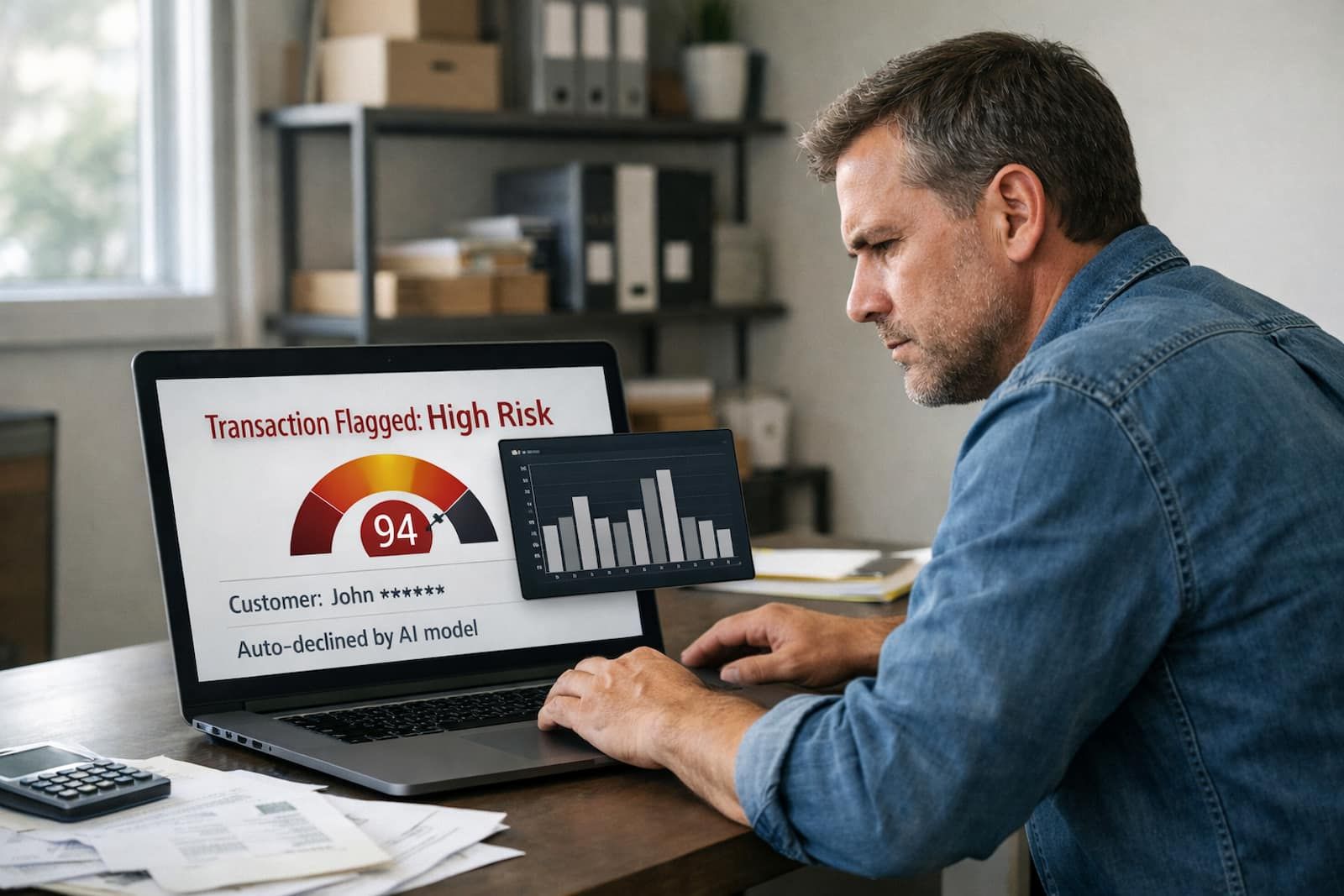
AI fraud model bias in 2026 is when a fraud system makes unfair, inaccurate decisions because of skewed data, proxy variables, or feedback loops. For SMBs, that means false declines, frozen payouts, blocked signups, and missed fraud. The fix is measurable controls: segment testing, reason codes, override rules, drift monitoring, and appeal workflows.
What you will learn: how model bias shows up in fraud scoring and decisioning, what it does to revenue and loss rates, what questions to ask vendors, what to monitor monthly, and what to do in the first 24 hours when the model starts behaving.
AI fraud detection and prevention models used by SMBs for payments, account access, onboarding, and transaction monitoring. We focus on bias risks, business impact, and mitigation controls. We do not drift into general AI ethics debates, hiring bias, or unrelated scam types.
Overview
Fraud models do not hate anyone. They do not have feelings. They have math, data, and incentives.
Bias shows up when the system makes systematically worse decisions for certain segments you actually do business with.
Regions.
Banks.
Devices.
Languages.
Customer types.
Here is the SMB problem in one line:
Your fraud model can be “accurate” and still be wrong enough to wreck your revenue and your loss rate at the same time.
A biased model is a two-sided gift to criminals:
- It blocks real buyers so you lose revenue.
- It misses specific fraud patterns so you pay losses.
How it works (where bias actually enters a fraud stack)
Bias is not only about protected classes. In fraud operations, it often shows up as unfairness across operational segments.
These are the places it hides in 2026:
- Identity and onboarding models: who gets approved, who gets flagged.
- Transaction scoring: who gets declined, who gets stepped up for verification.
- Account takeover detection: which login behavior is treated as “impossible” vs “normal.”
- Refund and dispute workflows: who gets auto-denied, who gets manual review.
- Marketplace and merchant risk models: which sellers get payout holds, which sellers get fast payouts.
The core bias mechanisms you must understand
You do not need to be a machine learning engineer. You do need to recognize the traps.
1) Skewed training data
If your “good customer” history is mostly one region, one payment method, or one device mix, the model treats new segments as suspicious.
2) Proxy variables
Even if you never collect sensitive attributes, you may be using proxies:
- Postcode patterns
- Device models common in certain regions
- Network and carrier signals
- Browser language
The model does not need the sensitive label. It just needs a pattern.
3) Label bias and feedback loops
If your team historically reviewed some segments more aggressively, your labels become biased.
Then the model learns that bias.
Then the model increases the biased reviews.
That is how “risk” becomes a self-fulfilling story.
4) Drift and seasonality
Fraud shifts fast.
Customer behavior shifts too.
If you do not monitor drift, the model starts hallucinating risk for normal behavior and missing the new attack.
Detection signs (how to spot bias before it becomes a profit leak)
Bias rarely arrives with a siren.
It arrives with charts that “feel off.”
Look for these signals:
- Approval rate drops for one region, bank, or device family while overall fraud stays flat.
- Manual review queues fill up with the same customer type, again and again.
- “High risk” flags cluster around language, carrier, IP ranges, or time zone.
- You see more support tickets like “I tried three cards and nothing worked.”
- Fraud shifts rails and your loss rate rises while chargebacks stay stable.
A 2023–2026 reality check
Fraud pressure keeps rising, and that pressure makes teams automate faster and audit less.
One public data point that should sober anyone up: the FTC reported consumers lost more than $10 billion to fraud in 2023. That is just what gets reported, categorized, and counted.
When pressure is high, vendors ship models fast.
When models ship fast, bias controls get skipped.
Micro-scenarios (realistic failure modes)
Micro-scenario 1: “The model saved us” until it didn’t
A US-based SaaS SMB sells a $39 subscription. The fraud tool flags a surge of “risky” signups and auto-blocks them.
Revenue drops 18% in two weeks.
Support tickets spike.
Real customers cannot pay.
The top driver is “new email domain + mobile device + non-standard time zone.”
In plain English: international customers and shift workers.
Scammer logic is simple. Attack where the model is trigger-happy. Let the business punish its own growth.
Micro-scenario 2: The UK marketplace trained on yesterday’s criminals
A UK marketplace uses a chargeback-driven label to train fraud decisions. Chargebacks drop. Everyone celebrates.
Three months later, fraud losses quietly rise through bank transfers and mule accounts that never generate chargebacks.
The model learned: “No chargeback equals safe.”
Criminals learned: “Use rails that do not create the labels.”
That is not intelligence. That is the model being trained on the shadow of the problem.
Myth vs reality
Myth: “Our vendor is big. Bias cannot be a problem.”
Reality: Scale can make bias worse. Bad patterns get repeated faster.
Myth: “If accuracy is high, we are safe.”
Reality: You can have high overall accuracy while harming specific segments. Averages are where accountability goes to die.
Myth: “Bias is a legal topic, not an SMB topic.”
Reality: Bias is a profit topic. False declines and missed fraud both cost money.
Myth: “More data fixes bias.”
Reality: More biased data produces more confident bias.
Prevention steps (controls SMBs can actually run)
This is the part that matters.
Controls.
Not vibes.
1) Measure outcomes by segment
If you cannot break performance down by region, device, payment method, and customer type, you are blind.
Minimum segment metrics:
- Approval rate
- False decline estimate (sampled)
- Fraud rate
- Loss rate
- Review rate and review outcomes
2) Require reason codes that are stable and specific
If a decline reason is “high risk,” that is not a reason.
That is a shrug.
3) Cap proxy influence
If language, time zone, or carrier signals dominate decisions, you will punish normal customers.
Put guardrails in place.
4) Add override rules with audit logs
Allowlists are not weakness.
Blind allowlists are weakness.
Overrides must be:
- Limited
- Logged
- Reviewable
5) Build a real appeal workflow
“Contact support” is not a workflow.
A workflow is:
- A path
- A timeline
- Evidence required
- A human decision
6) Monitor drift like it is a security control
Drift is not a data science problem.
For SMBs, drift is an outage that moves slower.
Prevention difference: individuals vs small businesses
Individuals can freeze credit, change passwords, and wait.
SMBs cannot.
SMBs have revenue flowing daily, disputes compounding, payouts depending on approvals, and trust that breaks once and stays broken.
That is why SMB bias controls must be operational, not academic.
What banks will not tell you directly
Banks and processors use automated risk systems too. Sometimes they are the model.
Here is what you will not hear in plain language:
- A hold can be triggered by your customers’ behavior, not yours.
- Appeals are often judged by policy, not by truth.
- “We cannot disclose our risk logic” is not the same as “our logic is correct.”
- If your business gets classified as high risk, your payout timing can change overnight.
So if your fraud tooling is biased and your bank’s risk systems are strict, you can get hit from both sides.
You are not paranoid.
You are paying attention.
Chargeback vs bank transfer
A chargeback is a card dispute process. It is regulated and network-driven. You can fight it. You can win or lose.
A bank transfer is often final once sent, especially for push payments. Recovery can be difficult, time-limited, and policy-driven.
Translation: your fraud model can “look good” on chargebacks while missing transfer fraud that never comes back as a neat dispute record.
The comparison table: bias risk vs damage vs control
| Bias risk pattern | What it looks like in SMB metrics | Damage | Control that works |
|---|---|---|---|
| Over-blocking new segments | Approval rate drops for certain regions or devices | Lost revenue, churn, bad reviews | Segment monitoring plus safe allowlists |
| Proxy-driven scoring | Declines tied to language, carrier, or IP ranges | Hidden unfairness, compliance exposure | Feature audit, cap proxy influence |
| Feedback loop from manual reviews | Same segment reviewed repeatedly | Ops load, biased labels, worse model | Sampling rules, label quality checks |
| Label blind spots | Fraud shifts to rails without disputes | Missed fraud, bigger losses | Multi-signal labeling beyond chargebacks |
| Model drift | Approval decay and rising false positives | Profit leak, customer frustration | Weekly drift alerts and change logs |
Urgency psychology (why “later” is a scammer’s favorite word)
Fraud teams love the idea of “we will fix it next sprint.”
Criminals love that even more.
Bias damage compounds quietly.
Every false decline is not one lost sale.
It is a lost future sale.
It is a support cost.
It is a negative review that scares the next buyer.
Meanwhile, missed fraud is not just one loss.
It trains criminals that your defenses are predictable.
⚖️Hard Truth: If your fraud tool cannot explain decisions, you are not using AI. You are renting a black box and hoping it likes you.
Read this twice
Scammers do not need to beat your model.
They just need to learn what your model hates.
If your system over-punishes certain behaviors, criminals will mimic the “safe” ones and push real customers into the penalty box.
What to do if affected (bias is live and harming you)
Screenshot checklist
When your model misbehaves, you need evidence fast.
- Approval rate by day with segment filters
- Decline reasons and top contributing features
- Fraud rate and loss rate by payment method
- Manual review queue size and outcomes
- Dispute rate trends (cards) and refund rates (non-card)
- Device and geo distribution changes
- New account vs returning account outcomes
24-hour rapid action summary
In the first 24 hours, do not debate philosophy. Stop the bleeding.
- Freeze any auto-block rule that is spiking false declines.
- Add temporary step-up verification instead of hard declines for affected segments.
- Pull a sample of declined-good customers and approved-bad customers.
- Identify the top 3 drivers behind wrong decisions.
- Put guardrails in place: caps on proxy features, allowlists for verified customers.
- Escalate to vendor support with evidence.
- Document what changed. Models drift. People forget.
What to demand from vendors in 2026
Ask for answers. Not vibes.
Minimum non-negotiables:
- Reason codes that stay consistent
- Segment performance reporting
- Appeal workflow with timelines
- Override rules with audit logs
- Drift monitoring alerts
- Human-in-the-loop sampling options
If a vendor refuses basic transparency, that is not “security.” That is convenience, and you pay for it.
For SMBs evaluating fraud tooling in general, use this buyer-focused reference on fraud detection software for small businesses.
If you remember only one thing
If the model cannot be measured by segment, it cannot be trusted in production.
FAQs
Is AI fraud model bias illegal in the US, UK, Canada, Australia, or New Zealand?
It can be, depending on how the decisions are used and which rules apply. Even when it is not clearly illegal, bias can still create customer harm and business risk. Treat it as a compliance and revenue issue, and document decisions.
How do I know if I am seeing bias or just a real fraud spike?
Check segments. If one segment collapses while fraud indicators do not rise evenly, bias is likely involved. Pull samples of declined-good and approved-bad cases. Do not rely on overall accuracy.
What are the most common “proxy variables” that cause bias in fraud systems?
Time zone, language, carrier, device model, IP ranges, postcode patterns, and onboarding friction signals can all act as proxies. The risk is when they dominate decisions instead of being capped and audited.
Can reason codes be misleading?
Yes. Some reason codes are marketing labels, not explanations. If the code does not map to a measurable driver you can validate, it is not operationally useful.
Does using a bigger vendor eliminate bias risk?
No. It can scale mistakes faster. What matters is transparency, segment reporting, drift monitoring, and the ability to appeal and override decisions with audit logs.
What is the fastest fix if false declines are hurting revenue today?
Shift from hard declines to step-up verification for the affected segment, temporarily cap proxy-driven features, and create a sampled review loop. Then push your vendor for evidence and a change log.
Should SMBs treat chargebacks as the main fraud label?
Not alone. Chargebacks are a useful signal for card fraud, but they miss fraud that happens on bank transfers, abuse, refunds, and mule activity. Use multiple signals so the model does not learn the wrong lesson.
Do I need a data science team to manage bias risk?
No. You need operational controls: segment dashboards, sampling rules, reason codes you can audit, drift alerts, and a documented appeal workflow.
Final Warning
If your model cannot explain why it blocked a real customer, it will not explain how it missed a real criminal.
If you cannot measure outcomes by segment, you are not managing fraud. You are guessing with confidence.
In 2026, scammers do not need genius. They need your model to be lazy.
Do not give them that gift.
Measure it. Challenge it. Lock it down.
For a broader recovery reality check after identity-related incidents, see this breakdown of https://dollarvigil.com/can-identity-theft-protection-help-with-tax-refund-fraud-recovery/.
Disclaimer: Educational only. Not legal or financial advice.