Fraud Forensic Accounting Firms: How to Choose the Right Specialist
A practical guide to deciding whether you need a forensic accountant, evaluating credentials and investigation capabilities, comparing specialists, and avoiding fake recovery providers.

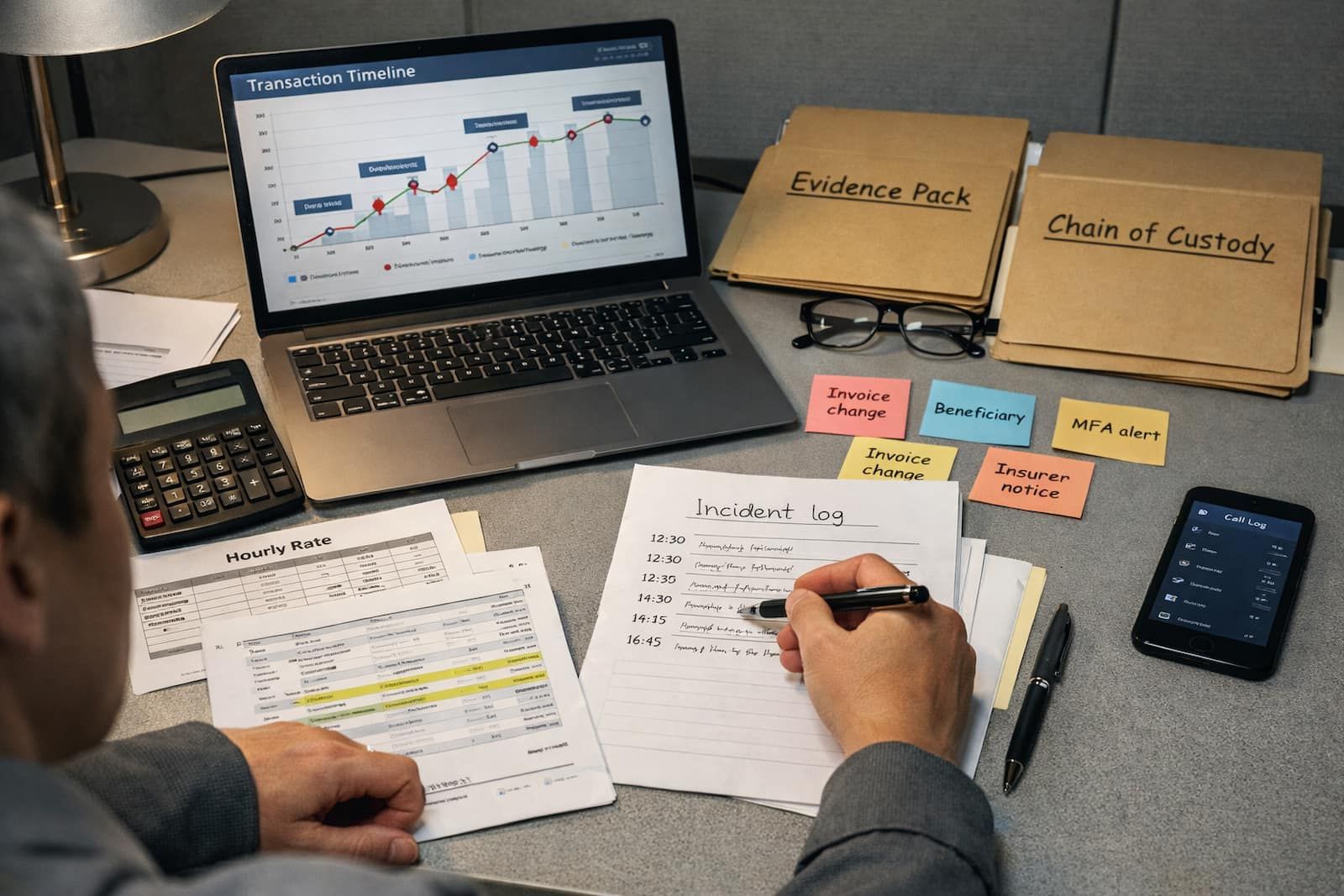
A forensic accountant examines financial records and transactions to reconstruct what happened, identify irregularities, trace financial activity, quantify losses, and support formal disputes or litigation. Hiring one may make sense when the evidence is complex, assets may be concealed, several entities or jurisdictions are involved, or a defensible financial analysis is required.
But a forensic accountant is not automatically the right answer for every fraud victim. If money has just left your account, contact the bank or payment provider immediately. A private investigation takes time; it cannot replace an urgent recall request, account security measures, official reporting, or legal advice.
The most important hiring question is not, “Which firm is best?” It is, “Does the assigned specialist have relevant experience, verifiable professional standing, appropriate jurisdictional capability, secure evidence-handling procedures, and a clearly defined scope for this case?”
What Does a Forensic Accountant Actually Do?
Forensic accounting combines financial analysis with investigative methods. The work focuses on financial records that may become relevant to a dispute, regulatory inquiry, insurance claim, internal investigation, or court proceeding.
Depending on the engagement, a forensic accountant may:
- Reconstruct transactions from bank statements, ledgers, invoices, emails, and accounting systems.
- Identify unusual payments, concealed transfers, accounting irregularities, or inconsistencies between records.
- Trace financial flows through multiple accounts, companies, or jurisdictions.
- Quantify losses, economic damages, diverted revenue, or misappropriated funds.
- Investigate suspected employee fraud, embezzlement, vendor fraud, or financial-statement manipulation.
- Assist legal counsel with financial analysis in shareholder, partnership, matrimonial, insolvency, or commercial disputes.
- Coordinate with digital-forensics, asset-tracing, legal, and investigative specialists.
- Prepare reports explaining the methods used, evidence examined, assumptions made, and conclusions reached.
- Provide expert analysis or testimony where the practitioner is appropriately qualified and the applicable rules permit it.
A useful forensic report does more than produce a pile of spreadsheets wearing a serious expression. It should explain what the records show, what they do not show, how the analysis was performed, and which limitations remain.
What a Forensic Accountant Cannot Do
A legitimate specialist should explain these limitations before taking your money.
A forensic accountant generally cannot:
- Guarantee that stolen money will be recovered.
- Arrest a suspect or exercise law-enforcement powers.
- Unilaterally compel a bank or payment provider to freeze an account.
- Guarantee that the person responsible will be identified.
- Guarantee that traced assets remain available or can legally be seized.
- Promise that litigation, reimbursement, or regulatory action will succeed.
- Guarantee that a report will be admitted as evidence.
Forensic accountants may prepare reports or expert evidence for litigation, but admissibility is not automatic. It depends on the jurisdiction, proceeding, expert’s qualifications, independence, evidence handling, methodology, and applicable court rules.
Tracing money and recovering it are also different jobs. An investigator may identify where funds appear to have moved without having the legal authority to freeze, seize, or return them. Those steps may require bank cooperation, law enforcement, court orders, or legal proceedings.
Anyone promising certain recovery before properly examining the evidence is not offering confidence. They are selling theater.
When Is Hiring a Forensic Accountant Worth Considering?
Hiring a forensic accountant may be worth discussing with legal counsel or another qualified adviser when financial records are complicated, disputed, incomplete, or likely to receive formal scrutiny.
Internal fraud or embezzlement
Specialist assistance may be useful when a business suspects payroll manipulation, vendor fraud, unauthorized payments, diverted revenue, expense abuse, skimming, or theft concealed within accounting records.
The investigation may need to establish how the scheme operated, who had access, which controls failed, how much was lost, and whether the misconduct remains active.
Hidden assets or disputed financial interests
Shareholder, partnership, matrimonial, insolvency, and estate disputes can involve allegations of concealed accounts, off-book income, unexplained transfers, manipulated valuations, or assets held through connected entities.
A forensic accountant may help reconcile conflicting records and identify financial questions that require further investigation. The legal significance of those findings should be assessed by qualified counsel.
Complex investment fraud
Specialist analysis could be useful when an alleged investment fraud involves several companies, investment vehicles, bank accounts, private funds, intermediaries, or jurisdictions.
A simple payment receipt may show that money was sent. It usually does not explain how the operation was structured, where funds subsequently moved, or whether reported investments and account balances were genuine.
Multi-entity or cross-border transactions
Tracing activity through multiple companies or countries can require expertise in different accounting records, corporate structures, currencies, financial systems, and legal processes.
Cross-border capability should never be assumed from a firm’s homepage. Ask which offices, specialists, external counsel, and investigative resources would actually work on the matter.
Litigation support and loss calculations
A forensic accountant may assist counsel by analyzing financial evidence, calculating economic losses, reviewing opposing analyses, or preparing an expert report.
If litigation is possible, involve legal counsel early enough to determine the appropriate scope, communication arrangements, and expert-evidence requirements. Hiring an investigator first and asking procedural questions later can create an expensive administrative bonfire.
When You May Not Need a Forensic Accounting Firm
Many individual scam victims do not need to begin with a private forensic investigation.
If a fraudulent or scam-induced payment was recently made, the first priority is usually to contact the bank, card issuer, cryptocurrency exchange, wire service, or payment platform. Ask about a recall, hold, account restriction, dispute, or recipient-bank notification appropriate to that payment method.
There is no universal 24-hour recovery rule. Recovery opportunities can decline as funds move, but the available procedures and timelines depend on the payment rail, institution, account status, jurisdiction, and case facts.
Dollar Vigil has separate guides explaining:
You may not need a forensic accounting firm at the beginning when:
- The records and affected transactions are relatively straightforward.
- The immediate need is securing accounts or requesting a payment recall.
- An established bank dispute or complaint process addresses the current problem.
- Official fraud reporting is the necessary next step.
- The proposed investigation would cost more than its likely practical value.
- There is no clear purpose for the investigation or intended use for its findings.
- The provider cannot explain how its work would improve the bank, insurance, legal, or evidentiary position.
There is no responsible universal loss threshold for hiring a forensic accountant. Consider the complexity of the records, potential recoverability, available evidence, investigation cost, intended use of the report, repeat business risk, and whether legal proceedings are realistically contemplated.
Before authorizing a broad investigation, ask whether a narrower initial review could determine whether further work is justified.
Which Type of Specialist Does Your Case Require?
Responsibilities can overlap, and complex cases may require more than one discipline.
| Specialist | Primary role | May be appropriate when |
|---|---|---|
| Forensic accountant | Reconstructs transactions, examines financial records, quantifies losses, and supports disputes or investigations | The central problem involves accounting records, financial flows, damages, or concealed transactions |
| Auditor | Evaluates financial statements, controls, and compliance against an audit framework | The purpose is financial-statement assurance or control testing rather than investigating a specific allegation |
| Private investigator | Conducts lawful background research, interviews, field inquiries, or other licensed investigative work | The case requires information about people, companies, witnesses, or activities outside the accounting records |
| Digital-forensics specialist | Preserves and analyzes devices, email, logs, servers, cloud accounts, and other digital evidence | Relevant evidence may exist on computers, phones, email systems, or compromised networks |
| Asset-tracing specialist | Investigates the ownership and movement of assets across accounts, entities, property, or cryptocurrency systems | Funds or assets may have been concealed, transferred through intermediaries, or moved across borders |
| Lawyer or legal counsel | Advises on rights, legal strategy, court procedures, disclosure, privilege, injunctions, and available remedies | Litigation, court orders, regulatory exposure, asset preservation, or legal deadlines are involved |
A forensic accountant can analyze transactions but may need a digital-forensics specialist to extract reliable data from a device. An asset tracer may identify a suspected asset, while a lawyer assesses what legal process could preserve or recover it.
Choose the team around the problem. Do not hire a hammer and then politely ask the evidence to become a nail.
Credentials and Professional Standing to Check
Credentials can indicate professional training, standing, or specialization. They do not prove that a practitioner is suitable for your investigation.
Relevant designations vary by country:
| Jurisdiction | Bodies and credentials to consider | What to verify |
|---|---|---|
| United States | State-issued CPA status; AICPA’s Certified in Financial Forensics (CFF); Association of Certified Fraud Examiners’ CFE | Active status, issuing body, relevant experience, disciplinary history, and whether the credential applies to the assigned practitioner |
| United Kingdom | ICAEW ACA or FCA; ACCA or FCCA | Membership status, practising authority where relevant, disciplinary information, forensic experience, and expert-evidence experience |
| Canada | CPA designation through the applicable Canadian accounting organization; forensic and investigative experience | Provincial standing, disciplinary record, relevant specialization, and case experience |
| Australia and New Zealand | CA ANZ membership and its Forensic Accounting Specialisation; CPA Australia membership | Current designation, specialist status where claimed, professional standing, and relevant jurisdictional experience |
The AICPA describes the CFF as a financial-forensics credential with eligibility, examination, experience, and continuing-development requirements. The ACFE explains that its CFE examination covers fraud schemes, investigations, legal issues, and fraud prevention.
In the United Kingdom, ICAEW provides a directory for checking ACA and FCA status, while ACCA maintains a member directory. CPA Canada publishes resources on forensic and investigative accounting. CA ANZ explains its Forensic Accounting Specialisation Program, and CPA Australia offers a member-verification service.
Do not assume that every legitimate forensic accountant must hold both an accounting qualification and a CFE, CFF, or similar fraud credential. Requirements vary by jurisdiction and engagement. Credentials are complementary evidence—not a universal two-badge entry ticket.
How to Evaluate a Fraud Forensic Accounting Firm
The following Dollar Vigil framework is a practical way to compare providers. It is not the only valid methodology.
1. Match the experience to the problem
Ask for experience with your type of matter—not merely “fraud.”
An employee-embezzlement investigation is different from a cryptocurrency tracing exercise. A matrimonial asset dispute is different from an insurance-loss calculation. A cross-border investment scheme is different from reconciling unauthorized company expenses.
Request anonymized examples or independently verifiable descriptions of comparable work where confidentiality permits.
2. Confirm jurisdictional capability
Identify where the transactions, parties, accounts, companies, and potential proceedings are located.
Ask:
- Which jurisdictions can the team cover directly?
- Will overseas offices or outside specialists be involved?
- Who coordinates the work?
- What limitations apply to obtaining records?
- How will additional jurisdictions affect scope, timing, and cost?
A global logo does not guarantee that the relevant specialist is available for your case.
3. Verify the assigned practitioners
Verify credentials through the issuing professional body whenever possible. Check the people who will perform and supervise the work, not only the impressive biography attached to the proposal.
Also investigate:
- Current professional standing.
- Disciplinary findings where public registers exist.
- Relevant forensic experience.
- Expert-witness experience if needed.
- Whether junior staff will perform most of the analysis.
- Whether subcontractors or external specialists will receive your data.
4. Examine evidence-handling procedures
Ask how the firm will receive, preserve, catalogue, analyze, and store records.
The answer should address:
- Original documents and working copies.
- Transaction exports and accounting-system data.
- Email, chat, and other digital records.
- Access controls.
- Audit trails and documentation.
- Changes made during processing or analysis.
- Transfer of evidence to counsel, insurers, authorities, or another expert.
If digital evidence is important, determine whether the firm has its own digital-forensics capability or will coordinate with a separate specialist.
5. Assess litigation and expert-evidence experience
If litigation may follow, ask whether the proposed lead has worked with counsel and prepared expert analyses for the relevant type of proceeding.
Do not ask only, “Will this be admissible?” No responsible provider can promise a court’s decision. Ask how the team will address independence, methodology, assumptions, evidence preservation, report requirements, and the rules identified by your lawyer.
6. Require a conflict check
The firm should determine whether existing or previous relationships create a conflict involving the opposing party, related companies, advisers, witnesses, or other relevant entities.
Complete this step before disclosing unnecessary sensitive information or paying a substantial retainer.
7. Define the scope and deliverables
The written scope should state:
- The questions the firm has been asked to investigate.
- Records it expects to examine.
- Work that is included and excluded.
- People responsible for the engagement.
- Expected phases or review points.
- Assumptions and dependencies.
- Deliverables, such as an oral briefing, transaction schedule, preliminary assessment, written report, or expert analysis.
- Circumstances that require approval for additional work.
“Investigate the fraud” is not a scope. It is an invitation for confusion to start billing by the hour.
8. Understand the fee structure
Ask how time, technology, external specialists, travel, data processing, and other expenses will be charged. Request estimates by phase where possible and establish who can approve work beyond the agreed scope.
A clear fee structure does not guarantee a cheap investigation. It does make it harder for cost ambiguity to hide in the furniture.
9. Review data security
Forensic investigations can involve bank statements, identity records, tax information, legal documents, employee data, confidential communications, and authentication records.
Ask where data will be stored, who can access it, how it will be transferred, whether subcontractors are involved, how long it will be retained, and how it will be destroyed or returned after the engagement.
10. Test the provider’s realism
A credible provider should be able to explain:
- What the investigation may establish.
- Which evidence is missing.
- What cannot be determined reliably.
- How long each phase may take.
- What depends on third parties.
- Why tracing does not guarantee recovery.
- When legal counsel, law enforcement, or another specialist may be needed.
Real investigators discuss limitations. Recovery scammers discuss miracles—and then send an invoice.
Examples of Forensic Accounting and Investigation Providers
Editorial disclosure: Dollar Vigil has no commercial relationship with the forensic accounting firms discussed in this guide. Inclusion does not constitute an endorsement or ranking. Providers are included as examples to help readers understand different types of forensic accounting and investigation services.
These examples are primarily associated with corporate, institutional, legal, or complex dispute work. Their inclusion does not mean they are suitable or cost-effective for an individual scam victim. Service availability and assigned teams can vary by country and office.
Kroll
Kroll says it provides financial investigations, forensic accounting, data analytics, litigation support, and asset-tracing and recovery investigations.
A prospective client should verify the specific office, assigned investigators, relevant jurisdictions, deliverables, conflicts, and whether the matter is proportionate to the likely cost.
FTI Consulting
FTI Consulting says its forensic accounting and fraud-investigation practice conducts investigations using forensic accounting, data analysis, and business-intelligence capabilities.
Readers should confirm the proposed team’s experience with the relevant fraud type, court system, industry, and financial records rather than relying on the firm’s general service description.
Deloitte
Deloitte advertises forensic and investigation services, while its member firms also publish services relating to disputes, financial analysis, investigations, and economic-loss quantification.
Deloitte operates through member firms, and particular services may not be available in every location or engagement. Verify the contracting entity, assigned practitioners, independence restrictions, scope, and jurisdictional coverage.
BDO
BDO describes a global forensics practice covering financial-reporting and fraud investigations, cross-border disputes, forensic technology, anti-money-laundering work, and investigative due diligence.
Prospective clients should verify which member firm would perform the work, the actual team’s case experience, any cross-border coordination arrangements, and the limits of the proposed investigation.
Alvarez & Marsal
Alvarez & Marsal publishes material on disputes, investigations, forensic accounting, and funds-tracing methodology.
Readers should independently confirm which services are available for their matter, who will conduct the work, how any tracing findings could be used, and whether legal or court action would be required to pursue identified assets.
These company pages establish what the providers say they offer. They do not establish that one firm is superior to another or appropriate for a particular reader.
What Affects the Cost of a Forensic Investigation?
There is no reliable universal hourly rate or minimum-loss threshold that applies to every forensic engagement.
Costs may be affected by:
- The amount and condition of the financial data.
- The number of accounts, companies, individuals, or transactions.
- Missing, inconsistent, or paper-only records.
- The number of years under investigation.
- The complexity of the alleged scheme.
- The number of jurisdictions involved.
- Currency conversions and cross-border research.
- Asset-tracing requirements.
- Cryptocurrency or blockchain analysis.
- Digital-forensics and electronic-discovery work.
- Specialist software and data processing.
- Interviews or field investigation.
- Reports, affidavits, schedules, and exhibits.
- Litigation support, meetings with counsel, depositions, or testimony.
- Travel, translations, court fees, and third-party specialists.
Obtain a written engagement letter that explains the scope, fee structure, excluded costs, billing frequency, staffing model, approval process for additional work, and expected deliverables.
For a complex matter, consider asking for a phased engagement. An initial assessment may establish what records exist, which questions can realistically be answered, and whether a wider investigation is proportionate.
Warning Signs of Fake Fraud-Recovery and Investigation Services
Recovery scammers target people who have already lost money. The pitch changes—investigator, law firm, regulator, hacker, blockchain expert—but the machinery underneath is the same: promise recovery, create urgency, demand money or credentials, and disappear.
The FTC warns that refund and recovery scammers may contact previous victims and request upfront payment in exchange for supposedly recovering lost money. The FBI has also warned about fictitious law firms targeting cryptocurrency scam victims, while New Zealand’s Financial Markets Authority has documented recovery scams using phishing tactics to obtain banking information.
Treat these signs as reasons to stop and verify:
- The provider guarantees recovery or promises a specific result.
- Someone contacts you unexpectedly after a previous scam.
- The caller claims your money has already been found.
- The provider claims to represent a regulator, law-enforcement agency, court, or law firm that you did not contact.
- You are pressured to pay immediately.
- Payment is demanded through cryptocurrency, gift cards, or a personal account.
- The provider requests your wallet seed phrase or private key.
- Someone asks for online-banking passwords, one-time passcodes, or unrestricted remote access.
- Credentials, addresses, staff identities, or company records cannot be independently verified.
- The provider refuses to issue written engagement terms.
- The explanation of how recovery will occur is vague, secret, or dependent on another advance payment.
- You are told to keep the service secret from your bank, lawyer, family, or authorities.
Never disclose a cryptocurrency wallet seed phrase or private key to an investigator. Anyone with that information may be able to control the wallet. Likewise, a legitimate professional should not need your online-banking password to review statements or transaction records.
Dollar Vigil Forensic Accounting Firm Evaluation Checklist
- [ ] Professional credentials independently verified
- [ ] Current professional standing checked
- [ ] Disciplinary records reviewed where available
- [ ] Relevant fraud or dispute experience confirmed
- [ ] Assigned team identified
- [ ] Jurisdictional capability confirmed
- [ ] Cross-border capability confirmed if required
- [ ] Asset-tracing capability confirmed if required
- [ ] Digital-forensics capability confirmed if required
- [ ] Evidence-handling procedures explained
- [ ] Litigation or expert-evidence experience checked if required
- [ ] Conflict-of-interest check completed
- [ ] Investigation scope provided in writing
- [ ] Fee structure and excluded costs explained
- [ ] Deliverables clearly defined
- [ ] Data-security and retention procedures explained
- [ ] Subcontractors and third-party access disclosed
- [ ] No guaranteed-recovery promises
- [ ] References or independently verifiable experience checked where appropriate
10 Questions to Ask Before Hiring a Forensic Accountant
- Which professional credentials and licences do the people assigned to my case hold, and where can I verify them?
- What experience does the proposed team have with this specific type of fraud, dispute, or financial record?
- Who will perform the day-to-day work, and will subcontractors or overseas offices be involved?
- Can the team work effectively in every relevant jurisdiction, and what limitations should I expect?
- How will you collect, preserve, document, transfer, and store financial and digital evidence?
- What written deliverables will I receive, and which questions will each deliverable address?
- How will fees, technology charges, third-party expenses, and work outside the original scope be approved and billed?
- What conflict checks will you perform before accepting the engagement?
- If litigation becomes necessary, what relevant expert-report or testimony experience does the proposed lead have?
- What can this investigation realistically establish, what can it not guarantee, and how will you protect my sensitive data?
Frequently Asked Questions
Can a forensic accountant recover stolen money?
A forensic accountant may trace financial activity and support recovery efforts, but cannot guarantee that money will be recovered. Recovery can depend on whether assets remain available, bank or exchange cooperation, legal authority, court orders, jurisdiction, evidence, and timing.
When should I consider hiring a forensic accountant?
Consider specialist assistance when financial records are complex, losses or damages must be quantified, assets may be hidden, multiple entities or countries are involved, internal fraud is suspected, or a financial analysis may be needed for litigation or a formal dispute.
How can I verify a forensic accountant?
Check credentials through the issuing professional body, confirm current membership or licensing status, review public disciplinary information where available, and verify the assigned practitioner’s relevant case and jurisdictional experience. Do not rely only on badges displayed on a website.
Does a forensic accountant need both an accounting and fraud credential?
Not universally. Requirements vary by jurisdiction and engagement. Accounting qualifications and credentials such as CFF or CFE can provide different evidence of training, but no single combination proves that a practitioner is right for every investigation.
How much does forensic accounting cost?
There is no universal price. Cost depends on data volume, complexity, staffing, duration, jurisdictions, asset tracing, digital forensics, reports, litigation support, testimony, and third-party expenses. Obtain a written scope and fee structure before authorizing work.
What is the clearest warning sign of a fake recovery firm?
A guaranteed-recovery promise is a major warning sign. Be equally cautious about unsolicited contact, claims that your money has already been located, unusual payment demands, unverifiable credentials, or requests for banking passwords, wallet seed phrases, and private keys.
Disclaimer
DISCLAIMER
This article is for general educational information only. It is not legal, financial, accounting, or professional advice, and it does not guarantee that money will be recovered. Scam refund rules and investigation options vary by country, payment method, bank policy, evidence, timing, and case details. If you need advice about your specific situation, contact a qualified legal, financial, accounting, or consumer-rights professional in your jurisdiction.
Sources and Official Resources
Professional bodies and credentials
- AICPA & CIMA — Certified in Financial Forensics credential
- Association of Certified Fraud Examiners — CFE eligibility and examination
- ICAEW — Find a Chartered Accountant
- ACCA — Find an ACCA member
- CPA Canada — Forensic and investigative accounting
- CA ANZ — Forensic Accounting Specialisation Program
- CPA Australia — Verify or find a CPA
Recovery-scam warnings
- Federal Trade Commission — Refund and Recovery Scams
- FBI Internet Crime Complaint Center — Fictitious Law Firms Targeting Cryptocurrency Scam Victims
- Financial Markets Authority New Zealand — Recovery Scams Using Phishing Tactics