BNPL Debt Traps: Understanding Your Legal Protections Under the FCA’s New Buy Now Pay Later Rules
Understand the FCA’s new UK Buy Now Pay Later rules, BNPL debt risks, affordability checks, consumer protections, credit-file disputes, Section 75 and complaint rights

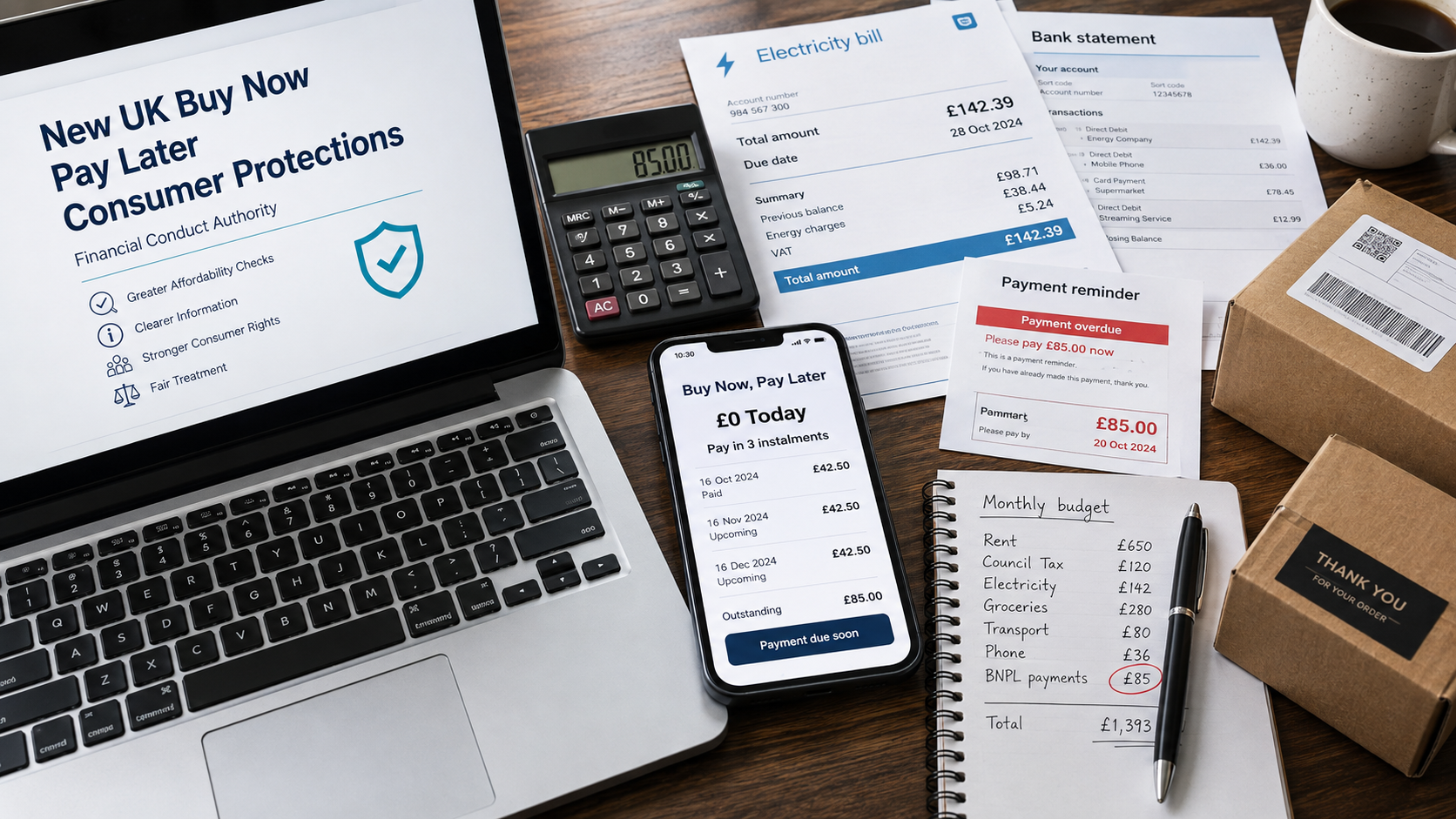
Buy Now Pay Later used to hide in the checkout lane like a harmless little convenience button. In the UK, that costume is finally being dragged under a regulatory light.
Since 15 July 2026, many Buy Now Pay Later products have come under Financial Conduct Authority regulation as Deferred Payment Credit, subject to product-specific exemptions and agreement details. That means regulated lenders will generally need to provide clearer information, assess affordability before lending, support borrowers in financial difficulty, and provide eligible complaint routes through the Financial Ombudsman Service when things go wrong. It does not mean every BNPL problem magically becomes refundable, every bad purchase gets Section 75 protection, or every credit-file error disappears because a regulator waved a clipboard.
The new rules help. They do not babysit your entire financial life. That part still needs evidence, fast action, and zero patience for corporate fog machines.
TL;DR
- The buy now pay later rules fca framework brought many Deferred Payment Credit products under FCA regulation from 15 July 2026 in the United Kingdom, subject to product-specific details and exemptions.
- The core risk is debt stacking: several “small” BNPL balances can quietly become a monthly repayment ambush with late fees, credit-file damage, and dispute chaos.
- If a BNPL account was opened fraudulently, contact the BNPL lender, secure your email and financial accounts, check your credit files, collect evidence, and begin disputing inaccurate credit reference data as soon as possible.
- UK protections depend on the product, lender, transaction date, agreement type, evidence, and whether the issue is fraud, affordability, goods not received, a merchant dispute, or financial difficulty.
- Section 75 protection is not something you should assume applies to every BNPL purchase. Check the agreement and payment structure before relying on it.
What Changed Under the FCA’s New BNPL Rules
The new regime has brought many Deferred Payment Credit products into FCA regulation. These are interest-free credit agreements commonly repaid in a small number of instalments over a short period, depending on the product and agreement structure. They are the products most people casually call Buy Now Pay Later.
The FCA says lenders offering regulated DPC agreements now need to meet rules designed to reduce consumer harm. The main protections are expected to include:
- clearer pre-contract information before you take the agreement;
- information about repayment amounts, dates, late fees, rights, and protections;
- proportionate affordability checks before lending;
- support for customers in financial difficulty;
- access to the Financial Ombudsman Service for eligible complaints.
That is the clean version.
The ugly version is this: BNPL grew partly because it made credit feel like shopping, not borrowing. Tiny instalments scattered across apps, retailers, and impulse purchases do not feel like debt until payday arrives and every little “manageable” payment lines up like a firing squad.
The FCA rules are meant to make that harder. Not impossible. Harder.
Deferred Payment Credit Is Still Credit, Not Checkout Fairy Dust
Deferred Payment Credit is credit used to finance the purchase of goods or services from a merchant. The lender pays the merchant or facilitates the purchase, and you repay the lender over a short period.
The danger is psychological. BNPL does not always feel like borrowing because the checkout screen does not smell like a loan application. It smells like convenience. Four payments. Zero interest. Cute interface. Pastel buttons. Financial chloroform.
But the operational reality is simple:
| What BNPL Looks Like | What BNPL Actually Is |
|---|---|
| “Split this into payments” | A credit agreement |
| “No interest” | Still a repayment obligation |
| “Small instalments” | Multiple liabilities if stacked |
| “Instant approval” | A lending decision |
| “Easy checkout” | A credit footprint that may affect your credit file |
| “Just return the item” | A merchant, lender, and credit-record dispute if it goes wrong |
The FCA rules do not ban BNPL. They force regulated lenders to treat it more like the credit product it always was, instead of pretending it was a shopping-cart garnish.
What BNPL Lenders Must Tell You Before You Borrow
Under the FCA’s consumer-facing explanation of the regime, regulated lenders generally need to give important information before you enter into a Deferred Payment Credit agreement.
That information should include:
- the amount you are borrowing;
- when repayments are due;
- how much each repayment will be;
- how much any late fee will be;
- the rights and protections attached to the agreement.
This matters because bad credit design thrives in the fog. If a lender buries the repayment schedule, late-fee consequences, or complaint route behind glittery checkout nonsense, the consumer is being asked to make a financial decision with half the dashboard covered.
Clear disclosure does not make borrowing safe by itself. It gives you a fighting chance to spot the trap before your bank account becomes a subscription service for yesterday’s impulse purchases.
Affordability Checks Are Now Part of the Game
The FCA says regulated BNPL lenders must carry out proportionate checks to assess whether customers can afford to repay before offering regulated BNPL.
That word “proportionate” matters. It does not necessarily mean every BNPL application becomes a full mortgage-style interrogation. It means the check should fit the risk, size, and circumstances of the borrowing.
For consumers, the practical point is this:
- lenders should not blindly approve regulated BNPL without considering affordability;
- repeated borrowing may matter;
- missed payments and financial difficulty should not be ignored like an inconvenient smell in the room;
- a complaint may be stronger if the lender approved credit despite clear signs the borrowing was unaffordable or poorly assessed.
But do not turn this into a fantasy refund machine. An affordability complaint is not automatically valid just because the repayment later became painful. The evidence matters.
Useful evidence may include:
- the date each BNPL agreement was opened;
- the lender’s disclosures at checkout;
- repayment schedule and late fees;
- your income and essential expenses at the time;
- existing BNPL balances or other debts;
- missed payments, declined payments, or warning signs visible to the lender;
- messages where you told the lender you were struggling;
- the lender’s response or lack of response.
Evidence beats rage. Rage may be justified, but evidence is what drags a complaint out of the swamp.
What to Do If BNPL Debt Is Already Stacking Up
If you are juggling multiple BNPL balances, the first job is not shame. Shame is useless. Shame is the little gremlin that tells people to ignore statements until the damage gets bored and leaves. It does not leave.
Do this instead.
1. Build a One-Page BNPL Debt Map
List every BNPL lender and every active agreement.
| Lender | Merchant | Amount Owed | Next Payment | Final Payment | Late Fee Risk | Status |
|---|---|---|---|---|---|---|
| BNPL provider | Retailer | £ | Date | Date | Yes/No | Current/Missed/Disputed |
This looks basic because basic works. The debt does not become less dangerous because it is hidden across six apps.
2. Prioritize Missed or Imminent Payments
Rank the agreements by:
- payments due in the next seven days;
- accounts already missed;
- accounts threatening late fees;
- accounts reported or likely to be reported to credit reference agencies;
- accounts linked to essential goods or services.
Do not randomly pay the loudest app. Pay based on damage control.
3. Contact the Lender Before the Account Gets Worse
If you cannot pay, contact the BNPL lender and say clearly:
- you are in financial difficulty;
- you need support options;
- you want fees, collections, and credit reporting explained;
- you want all communication in writing.
The FCA framework expects firms to support borrowers in financial difficulty. That does not mean they must wipe the balance because life got expensive and the checkout button was wearing a clown nose. It means they should handle difficulty fairly, explain options, and avoid treating support requests as a simple collections script.
4. Get Free Debt Help Before Paying a “Debt Fixer”
If the debt is already out of control, speak to a reputable free debt advice charity or qualified UK debt adviser. Do not pay some internet debt wizard who promises to “delete BNPL balances” using secret legal tricks they discovered between selling templates and posting fake testimonials.
Real debt help explains options. Fake debt help sells certainty.
Can You Dispute a BNPL Purchase?
Yes, you can dispute a BNPL purchase, but the route depends on the problem.
A BNPL dispute is not one single bucket. That is where people get hurt. They describe every problem as “fraud” or “refund,” and then the institution processes the wrong type of complaint while the clock keeps eating the file.
Use the right category.
| Problem | Likely Dispute Type | Who to Contact First |
|---|---|---|
| Item never arrived | Merchant dispute, then BNPL lender if unresolved | Merchant and BNPL lender |
| Item defective or not as described | Merchant dispute, consumer rights route, BNPL complaint if handling fails | Merchant |
| Refund issued by merchant but BNPL balance still shows | Payment allocation or account correction | BNPL lender |
| BNPL account opened without your permission | Identity theft or unauthorized credit account | BNPL lender and credit reference agencies |
| You cannot afford repayments | Financial difficulty support | BNPL lender |
| You were approved despite obvious unaffordability | Affordability complaint | BNPL lender |
| Credit file shows inaccurate BNPL data | Credit data dispute | BNPL lender and credit reference agencies |
The key is to write like an investigator, not a panic tornado. State what happened, what evidence proves it, what correction you want, and what deadline or complaint route applies.
Section 75 and BNPL: Do Not Assume You Are Covered
Section 75 of the Consumer Credit Act can make a credit provider jointly liable with a supplier for certain misrepresentation or breach of contract claims, usually where the cash price is over £100 and not more than £30,000. It usually depends on a qualifying regulated credit agreement and the required debtor-creditor-supplier relationship. But BNPL does not automatically behave like a normal credit card purchase.
The problem is the structure.
Some BNPL arrangements may not create the same debtor-creditor-supplier chain that Section 75 relies on. Some may involve different agreement types. Some may be regulated differently from traditional credit cards. Some purchase protection may come from lender policies, card chargeback rules, merchant obligations, or complaint handling rather than Section 75.
So the safe answer is this:
Do not assume Section 75 applies to your BNPL purchase. Check the agreement, the payment method, the lender’s terms, and the exact transaction structure.
That is not comforting. It is accurate. Comfort is cheap. Accuracy is useful.
If a BNPL lender, merchant, or card provider rejects your claim, ask for the reason in writing. You need to know whether the rejection is based on:
- no qualifying credit agreement;
- no debtor-creditor-supplier relationship;
- purchase value outside the relevant range;
- insufficient evidence of breach or misrepresentation;
- wrong complaint route;
- merchant refund still pending;
- lender policy rather than statutory protection.
A vague rejection is not the end. Sometimes it is valid. Sometimes it is corporate smoke in a cheap suit. Your job is to make them identify which one it is.
What If a BNPL Account Was Opened by an Identity Thief?
A fraudulent BNPL account is not “just a shopping problem.” It is identity theft wearing retail packaging.
Act fast.
First Fifteen Minutes
- Contact the BNPL lender immediately. Say the account or agreement was opened without your permission.
- Ask the lender to freeze collections and investigate. Request written confirmation.
- Change passwords on your email, banking, shopping, and phone accounts. If the thief controls your inbox, they control the paperwork trail.
- Check your credit reports with UK credit reference agencies. Look for unfamiliar searches, accounts, linked addresses, or BNPL entries.
- Dispute incorrect credit-file data. Contact both the lender and the credit reference agency.
- Report identity fraud through the appropriate UK reporting route. Keep the reference number.
- Save evidence. Emails, delivery addresses, device notices, lender messages, credit report entries, and merchant order details all matter.
Do not wait for the lender’s support inbox to develop a personality. Keep pushing for written confirmation that the account is disputed as fraud.
Evidence That Helps a Fraudulent BNPL Account Claim
| Evidence | Why It Matters |
|---|---|
| Credit report entry | Shows the account, search, date, lender, or linked address |
| Emails or texts you did not trigger | Shows account creation, orders, OTP abuse, or delivery notifications |
| Delivery address mismatch | May show goods were sent somewhere unrelated to you |
| Device or login alerts | Supports account takeover or unauthorized access |
| Police or fraud report reference | Creates a formal record |
| Correspondence with the BNPL lender | Proves reporting timeline and lender response |
| Proof of your real address | Helps challenge false linked addresses |
| Bank statements | May show no authorized payment or unusual linked activity |
A fraudulent account should be challenged as identity theft, not treated like a normal missed payment. If the lender keeps reporting it as your debt while the fraud dispute is live, demand written reasons and escalate if needed.
Credit Reporting Is the New BNPL Battlefield
The quiet danger of BNPL regulation is not only late fees. It is credit-file gravity.
BNPL credit reporting practices can vary by lender, agreement type, credit reference agency, and date. Do not assume every BNPL agreement is reported in the same way, but do check your credit files if you miss payments, return goods, dispute a balance, or suspect fraud.
The FCA’s Credit Information Market Study work focuses on improving the quality, coverage, and governance of credit information in the UK market. That matters because BNPL data can affect thin-file consumers, younger borrowers, renters, people with limited credit history, and anyone whose financial life is being judged by incomplete or messy data.
Credit reporting is supposed to help lenders understand risk. In practice, bad data can become a financial mugshot with the wrong face on it.
If BNPL information appears on your credit file, check:
- lender name;
- account opening date;
- repayment status;
- missed-payment markers;
- default markers;
- linked addresses;
- hard searches;
- closed accounts still showing active;
- balances that should have been updated after a return or refund;
- accounts you never opened.
If something is wrong, dispute it with both the credit reference agency and the BNPL lender. Do not rely on one side to fix the other side’s mess out of civic pride. That is how errors grow roots.
How to Challenge Wrong BNPL Credit-File Data
Use a clean dispute, not a rant. The file needs facts.
Send this structure to the BNPL lender and the credit reference agency:
I am disputing the BNPL account or credit-file entry listed below because it is inaccurate.
Lender: [Name]
Account/reference: [Reference]
Credit reference agency: [Agency]
Entry shown: [Missed payment/default/search/account/balance]
Why it is wrong: [Fraudulent account/refund not applied/account closed/payment made/not my address/not my agreement]
Evidence attached: [List documents]
Correction requested: [Remove entry/update balance/remove missed-payment marker/mark as disputed while investigated]
Please confirm in writing that the entry is under investigation and explain the outcome once reviewed.
Keep it boring. Boring is beautiful in disputes. Boring means the complaint handler cannot pretend they got lost in your emotions.
When to Escalate a BNPL Complaint
Escalate when the lender:
- ignores your complaint;
- refuses to explain its decision;
- keeps reporting disputed fraud as valid debt;
- fails to correct obvious credit-file errors;
- gives unclear affordability disclosures;
- does not explain late fees or repayment obligations;
- handles financial difficulty with script-reading nonsense;
- rejects a dispute without addressing your evidence.
For regulated BNPL agreements under the regime, eligible complaints can go to the Financial Ombudsman Service. The ombudsman does not exist to validate every angry email. It reviews complaints based on fairness, evidence, rules, and circumstances.
Your complaint gets stronger when you provide:
- timeline;
- agreement documents;
- screenshots;
- credit report entries;
- repayment history;
- affordability evidence;
- correspondence;
- fraud report references;
- merchant refund evidence;
- lender final response.
A weak complaint says, “This is unfair.”
A stronger complaint says, “Here is the agreement, here is the date, here is the disclosure gap, here is the affordability issue, here is the credit-file error, here is when I reported it, here is how the lender responded, and here is the correction I want.”
One is noise. The other is a file.
BNPL Myth Versus Reality
| Myth | Reality |
|---|---|
| “BNPL is not real debt because it is interest-free.” | Interest-free credit is still credit. Repayment failure can still cause fees, collection pressure, and credit-file damage. |
| “FCA regulation means every BNPL problem gets refunded.” | Regulation creates obligations and complaint rights. It does not guarantee refunds or erase valid debts. |
| “Affordability checks mean I cannot get into trouble.” | Checks reduce risk. They do not stop debt stacking, income shocks, impulse spending, or identity theft. |
| “Section 75 always protects BNPL purchases.” | Do not assume that. Protection depends on the agreement and transaction structure. |
| “If the credit file is wrong, the credit agency will fix everything.” | You usually need to dispute with both the credit reference agency and the lender that supplied the data. |
| “A fraudulent BNPL account is the lender’s problem.” | It is also your problem until the account is frozen, investigated, corrected, and removed from your credit file if inaccurate. |
What the FCA Rules Can and Cannot Do
The new rules can improve consumer protection by forcing regulated lenders to behave less like checkout magicians and more like credit providers.
They can help by requiring:
- better information before borrowing;
- affordability checks;
- support for borrowers in difficulty;
- complaint routes;
- stronger regulatory supervision.
They cannot:
- make every purchase dispute disappear;
- guarantee refunds;
- automatically apply Section 75 to every BNPL transaction;
- prevent all identity theft;
- instantly clean credit files;
- stop consumers from stacking multiple agreements across providers;
- replace debt advice, fraud reporting, or evidence gathering.
Regulation is a guardrail, not a force field. Anyone selling it as a force field is either confused or selling something.
Related Dollar Vigil Guides
- CFPB Enforcement Shift: What Fraud Victims Need to Know
- How to Spot and Report Deepfake Investment Scams in 2026
- Financially Motivated Sextortion: How Coercion Scams Target Teens and Seniors
FAQ
What are the FCA rules for Buy Now Pay Later in 2026?
Since 15 July 2026, many UK Buy Now Pay Later products have been regulated as Deferred Payment Credit. FCA-regulated lenders must provide clearer information, assess affordability proportionately, support customers in financial difficulty, and allow eligible complaints to be taken to the Financial Ombudsman Service.
Do BNPL companies have to check if I can afford the loan?
For regulated Deferred Payment Credit agreements, lenders must carry out proportionate affordability checks before lending. The depth of the check may depend on the product, amount, risk, and circumstances. If you believe a lender approved unaffordable borrowing despite clear warning signs, collect evidence and make a written complaint.
Can I dispute a BNPL purchase if the item never arrived?
Yes, but start by identifying the dispute type. If the item never arrived, contact the merchant and the BNPL lender. Keep order confirmations, tracking records, merchant messages, refund promises, and BNPL account statements. If the lender rejects the dispute, ask for written reasons and escalate if the agreement is covered by the relevant complaint route.
Does Section 75 apply to Buy Now Pay Later?
Do not assume Section 75 applies to every BNPL purchase. Section 75 depends on the credit arrangement, purchase value, and transaction structure. Some BNPL purchases may not fit the standard credit-card protection model. Check the agreement and get the lender’s position in writing if a claim is rejected.
What should I do if a BNPL account was opened in my name by an identity thief?
Contact the BNPL lender immediately, state that the account is fraudulent, ask for collections and reporting to be paused while investigated, check your credit files, dispute incorrect entries, secure your email and financial accounts, and report the identity fraud through the appropriate UK route. Keep every reference number and message.
Can BNPL affect my credit score?
BNPL data may affect your credit file depending on the lender, agreement, reporting practices, and repayment history. Missed payments, defaults, searches, or incorrect identity-fraud entries can cause damage if recorded. Check your credit reports and dispute inaccurate data quickly.
What if I cannot afford my BNPL repayments?
Contact the lender before the account deteriorates further. Explain that you are in financial difficulty and ask what support is available. Under the FCA framework, regulated lenders are expected to support customers in difficulty and, where appropriate, direct them to free debt advice. Also consider free UK debt advice if multiple BNPL balances are stacking up.
Can the Financial Ombudsman Service help with BNPL complaints?
For eligible regulated BNPL complaints, the Financial Ombudsman Service may review disputes after the lender has had the chance to respond. You will need evidence, timelines, correspondence, agreement details, and a clear explanation of what went wrong.
Disclaimer
This article is for general educational information only and is not legal, financial, debt, credit, or professional advice. BNPL rights, refund routes, credit-file disputes, affordability complaints, Section 75 protection, and ombudsman options depend on the country, agreement type, lender, transaction date, payment method, evidence, timing, and individual circumstances. FCA rules, exemptions, and guidance may change, so check current regulator guidance or speak to a qualified UK legal, debt-advice, financial, or consumer-rights professional before acting on a specific case.
Cold Truth
The FCA’s new BNPL rules make the UK market less lawless, but they do not turn checkout credit into harmless pocket change. BNPL is still debt. Fraudulent BNPL accounts are still identity theft. Credit-file errors are still financial shrapnel. And Section 75 is still not a magic spell you can throw at every split-payment disaster.
Use the new protections. Build the evidence file. Challenge bad data. Escalate lazy responses. And never let a pastel checkout button convince you that borrowing has stopped being borrowing.
The button may say “Pay later,” but the consequences are extremely punctual.