Zelle Scam Reimbursement Law 2026: What Banks Must Pay
Clear breakdown of the 2026 Zelle scam reimbursement law, what U.S. banks are legally required to refund, where consumer protections stop, and how victims can escalate denied claims under federal banking regulations.

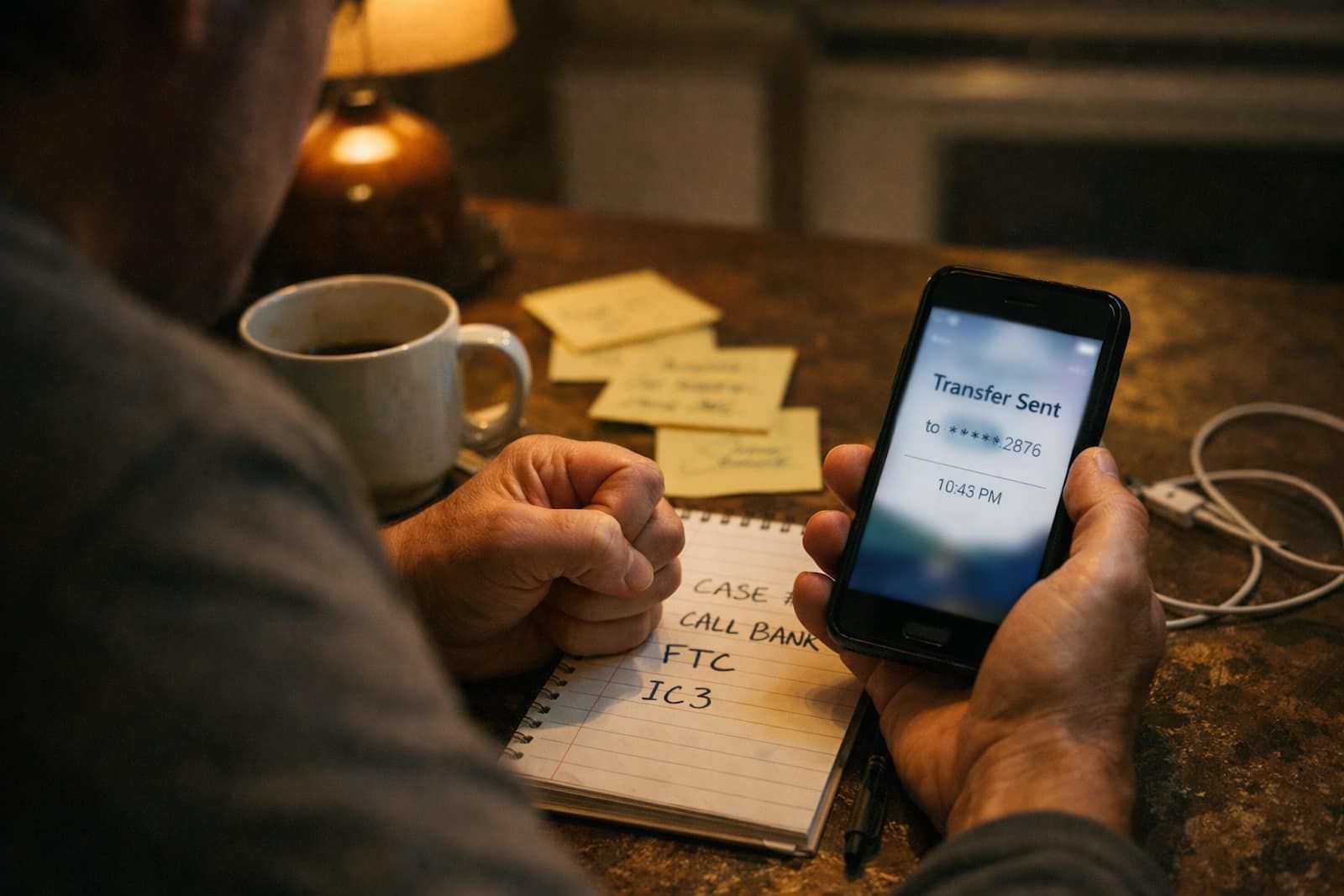
TL;DR
If you were tricked into sending Zelle money, refunds are not guaranteed, but some banks reimburse qualifying imposter scams. If your account was taken over, U.S. Reg E can require reimbursement for unauthorized transfers. Report immediately, lock accounts, file FTC and IC3 reports, and assume scammers will try a second bite.
In 2026, Zelle scam reimbursement is usually policy, not a guaranteed “law,” unless the transfer was unauthorized (account takeover), where U.S. Regulation E can require reimbursement. If you authorized the Zelle payment because a scammer manipulated you, many banks deny it, but some reimburse qualifying imposter scams. Speed, documentation, and transaction type decide the outcome.
Expectation vs Reality
Expectation: “My bank will reverse it because it’s obviously a scam.”
Reality: “You authorized it, so now we’re doing a feelings-based investigation with a 45-day timeline.”
“Zelle is instant.
Bank empathy is not.”
Introduction
Right after a Zelle scam, our brain does this cute little thing where it tries to bargain with physics.
“Maybe it’s pending.”
“Maybe it’ll bounce.”
“Maybe the bank will hit the magic ‘undo scam’ button.”
Here is the fact: Zelle is built to move money fast. Scammers love that. The second your money lands in a mule account, it can be gone again in minutes. Not because you did anything wrong. Because scammers designed the moment to make you act first and think later.
We are going to cut through the nonsense.
We are going to separate what’s legally recoverable from what a bank might refund if you raise enough hell.
And we are going to talk prevention like adults, not like a brochure.
What Actually Happened
A Zelle scam is a type of payment fraud where a scammer convinces a real person to send a real payment to the scammer’s account.
Not “hacked.” Not “glitched.” Not “oops.”
It is theater.
They impersonate your bank, your utility company, your boss, your kid, a seller, a buyer, a police officer, or God himself if they think it will work. They create urgency. They push you to act before you verify. Then they hand you the Zelle address like it is a harmless email.
And when the money is sent, they vanish like a coward with a burner phone.
Micro-scenario 1: “Bank Fraud Department” (imposter scam)
You get a call: “We detected fraud. We need you to move your money to a safe account.”
They read you your name. They know your bank. They sound calm. They sound official.
They tell you to “verify” by sending a Zelle payment to a “security account.”
That “security account” is a scammer’s mule. They are not protecting your money. They are stealing it with your hands.
Micro-scenario 2: “Marketplace deal” (goods not delivered)
You buy a laptop, tickets, a rental deposit, or a puppy. The scammer pushes Zelle because “it’s safer than cash.”
Yes. Safer.
For the scammer.
You send it. The listing disappears. The chat goes silent. Your money is now funding someone’s next scam script.
“They said ‘Zelle only.’
That was the warning label.
We just didn’t see it yet.”
Why This Issue Happens
Because scams hit the human nervous system, not the math part of the brain.
We freeze. We panic. We feel shame. We want to fix it quietly and fast. That is normal.
Scammers count on it.
They also count on a dirty truth: banks treat authorized payments differently than unauthorized transfers.
So the scammer’s job is to get you to do one thing.
Authorize it.
How scammers engineer urgency (the psychological wiring)
Urgency is the scammer’s crowbar.
They create a fake deadline, a fake consequence, and a fake authority. They keep you talking so you do not call anyone else. They use “security” language to make you feel smart for complying.
It is not smart. It is coerced.
And if you froze, that is not failure. That is the human brain getting jump-scared.
Scammers do not have better technology than you. They just have better audacity.
The Moment Money Leaves
Here is where we stop pretending.
Zelle (authorized scam)
Once you hit send, you gave an instruction to move money. Your bank may tell you it is “final.” Often, practically, it is.
Zelle moves money faster than your bank can admit it has a problem.
Zelle (unauthorized transfer from account takeover)
If someone logged into your account, added a recipient, and sent Zelle without your permission, that is not a scam payment. That is unauthorized electronic fund transfer.
In the United States, that triggers EFTA / Regulation E protections in many cases.
The words “I didn’t authorize this” matter more than “I was manipulated.” That is messed up. But it is how the rules are applied.
Credit card chargebacks vs bank transfers (why this hurts)
A credit card purchase can often be charged back because the card network is built for disputes.
A bank transfer, Zelle included, is built for settlement. It is closer to cash.
When you pay like cash, you get cash-level regret.
Quick comparison table: Zelle authorized vs unauthorized
| Type | What it means | Recovery odds | Legal protection | Why it matters |
|---|---|---|---|---|
| Zelle (authorized) | You sent the payment yourself after being tricked by a scammer | Low to mixed | No federal guarantee; depends on bank policy | Banks often treat it as "you approved it" unless their policy covers imposter scams |
| Zelle (unauthorized) | Someone took over your account and sent money without your permission | Medium to high (if reported quickly) | Regulation E may require reimbursement | Federal law protects unauthorized electronic transfers if timely reported |
What You Can Still Control (Step-by-Step Actions)
You cannot time travel. You can still build a paper trail, stop the second hit, and increase your odds.
First 24 hours: rapid action summary
- Call your bank’s fraud line now. Not tomorrow. Not after you “calm down.” Now.
- Say the words clearly: “I want to report fraud and request a reimbursement review.”
- If it was unauthorized: say “unauthorized electronic fund transfer.”
- Change banking passwords and email password. Turn on MFA.
- Freeze your credit if identity data was shared.
- File reports: FTC, IdentityTheft.gov (if identity theft), and FBI IC3.
- Document everything: screenshots, phone numbers, Zelle recipient info, chat logs.
A checklist you can screenshot
- Bank notified with a case number
- Zelle transaction ID saved
- Recipient phone/email saved
- Screenshots saved (and backed up)
- Email password changed
- Bank login password changed
- MFA turned on (authenticator app beats SMS)
- Credit freeze placed (US)
- IC3 report filed (US)
- FTC report filed (US)
- Police report filed if requested by bank
Decision Breakdown
- If you authorized it because of a scam:
- Ask for the bank’s Zelle scam reimbursement policy and appeal path.
- Ask whether the scam qualifies as an imposter scam category.
- Expect pushback. Escalate anyway.
- If you did not authorize it (account takeover):
- Report as unauthorized and request Reg E investigation timelines.
- Ask what provisional credit rules apply.
- If it was a purchase (goods or tickets):
- Treat it as near-cash. Focus on reports, evidence, and preventing future hits.
- If you shared SSN, ID, or banking info:
- Shift to identity-theft containment immediately.
What banks will not tell you directly
- They categorize first, empathize never. If it lands in “authorized,” you fight uphill.
- Speed is leverage. The earlier you report, the more likely funds can be frozen on the receiving side.
- Your wording changes the investigation. “Unauthorized” triggers a different legal posture than “I got scammed.”
- They can sometimes claw back money. They just cannot promise it, and they hate admitting it.
🧱Hard Truth: Zelle scam refunds are not a human-rights program. They are a mix of law (for unauthorized transfers) and policy (for authorized scams). Treat every hour like it costs money, because it does.
⚠️Read This Twice: If someone “from your bank” tells you to move money to “protect it,” it is a scam. Banks do not protect money by asking you to send it to strangers.
If You Remember Only One Thing: A real bank will tell you to secure your account. A fake bank tells you to send money.
“Scammers love ‘one last step.’
It’s always the step where you lose.”
What Banks, Federal Law, or US Regulations Say
In the United States, the big dividing line is unauthorized versus authorized.
Regulation E (EFTA) basics in scam language
Regulation E is the U.S. rule set under the Electronic Fund Transfer Act for many electronic transfers from consumer accounts.
If someone takes over your account and sends money without permission, banks often have legal obligations to investigate and, depending on the facts and timing, reimburse.
If you sent the money yourself because a scammer manipulated you, banks often argue it was authorized.
That is why scammers push you to press send.
Pressure on Zelle reimbursement (what changed)
Zelle’s operator has faced political and regulatory heat over scam losses, and reports have described reimbursement for certain imposter scams becoming more standardized across participating institutions starting in 2023.[1]
Also, states have started swinging. New York’s Attorney General sued the company behind Zelle in 2025, alleging the platform enabled widespread fraud and was marketed as “safe” while scammers ran wild.[2]
Data point you should not ignore
The FBI’s Internet Crime Complaint Center (IC3) reports huge fraud losses, and their published trend chart shows reported losses rising through 2024.[3]
That is not just numbers. That is rent money. That is payroll. That is people stuck in the shock phase.
Where to report (U.S.)
- FTC fraud reporting: FTC.gov[4]
- Identity theft recovery plan: IdentityTheft.gov[5]
- Cyber-enabled fraud intake: FBI IC3.gov[3]
Recovery Timeline
Here is the part nobody wants.
In the first 0–72 hours
- If the bank can freeze or recall funds, this is the window.
- Your job is speed, accuracy, and documentation.
You will be asked the same question five different ways. It is not to help you. It is to classify you.
3–10 business days
- You may get an initial denial.
- You may get a “we’re investigating” message.
- You may get requests for a police report or written statement.
Up to 45 days (and sometimes longer)
U.S. Reg E investigations can run on specific timelines depending on circumstances. Banks can extend investigations in certain cases.
Paperwork moves at the speed of molasses, but your money moved at the speed of light.
Reality-based expectations
- Unauthorized cases can have better outcomes.
- Authorized scam cases are inconsistent across banks.
- Partial refunds happen sometimes.
- No refund also happens. A lot.
Recovery Scams
After the first scam, the vultures circle.
You will get messages like:
- “We can recover your Zelle funds for a fee.”
- “We work with your bank.”
- “We’re cyber investigators.”
- “Pay a deposit to unlock the refund.”
That is not recovery.
That is the sequel.
Recovery scammers are just regular scammers wearing a fake badge and a cheap logo. Their business model is “kick someone while they are bleeding.”
Do not pay anyone to recover Zelle money. If they could recover it, they would not need your Venmo.
“They promised they can ‘trace the funds.’
Cool. Tell them to trace their dad first.”
Common Mistakes to Avoid
We do these because we are human and we are in shock.
- We wait because we are embarrassed. Shame is a scammer’s favorite free tool.
- We explain the story like a novel. Banks want timelines and facts. Give them timestamps.
- We keep talking to the scammer. “Maybe they’ll give it back” is a fantasy. Block them.
- We skip the reports. Filing FTC and IC3 reports creates a record. It also helps pattern tracking.
- We forget the second hit. Scammers come back with “refund processing” lies.
Detection and Prevention
No jokes here. This is the survival kit.
Detection signs (Zelle scam tells)
- Someone demands Zelle for “security,” “verification,” or “release.”
- A caller creates urgency and blocks you from hanging up.
- You are told not to tell anyone.
- The story includes “fraud department,” “warrant,” “shutoff,” or “final notice.”
- They push you to add a new recipient right now.
Prevention steps that actually work
- Call back using a trusted number. Never a number the caller gives you.
- Treat Zelle like cash. If you would not hand a stranger cash, do not Zelle them.
- Lock down account takeover risk: unique passwords, MFA, email security.
- Create a family rule: no money moves during a phone call. Ever.
- Small businesses: require dual approval for transfers and vendor payment changes.
Individuals vs small businesses (prevention strategy is not the same)
Individuals get hit by emotional manipulation and account takeover.
Small businesses get hit by process fraud: vendor impersonation, payroll diversion, invoice swaps, and “change of bank details” emails.
So individuals need verification rituals.
Small businesses need controls: separation of duties, call-back verification, and transfer limits.
FAQs
Can I get my money back if I got scammed on Zelle?
Sometimes, but it depends on whether the payment was treated as authorized. Many banks deny authorized scam payments, but some reimburse certain qualifying imposter scams under policy. If the transfer was unauthorized due to account takeover, U.S. Regulation E may require reimbursement after investigation.
What counts as an unauthorized Zelle transfer?
An unauthorized transfer is one you did not approve, such as when someone accesses your bank account and sends Zelle payments without permission. In the United States, unauthorized electronic fund transfers often trigger Regulation E protections. Report immediately and clearly state you did not authorize the transaction.
How fast do I need to report a Zelle scam?
As fast as possible. Minutes matter because scammer accounts can empty quickly. Report to your bank immediately, get a case number, and preserve evidence. For U.S. victims, file reports with the FTC and FBI IC3 as soon as you can. Faster reporting improves any chance of fund freezes.
Will my bank reimburse me for an authorized payment I regret?
Banks usually do not treat scam payments like “regret.” If you authorized the payment, many banks consider it final, unless a specific policy covers that scam type. Ask for the bank’s Zelle scam reimbursement policy, escalation path, and written denial reasons so you can appeal with documentation.
Should I file a police report for a Zelle scam?
If your bank asks for one, file it. Even if they do not, a police report can support documentation and timeline consistency. In the U.S., also file with FTC.gov and IC3.gov because those systems feed broader fraud intelligence and sometimes help identify mule networks and repeat actors.
Can scammers scam me again after the first Zelle scam?
Yes. Recovery scammers target victims aggressively after the first incident. They pretend to be investigators, bank partners, or “refund processors” and ask for fees or access. Do not pay anyone to recover Zelle funds. Communicate only through your bank’s official channels and law enforcement reporting sites.
TL;DR
Zelle scams win by forcing speed.
Refunds in 2026 hinge on one ugly split: unauthorized transfer rules versus authorized scam policies.
Report immediately.
Secure accounts.
File FTC and IC3 reports.
Assume a recovery scam will follow.
You did not “mess up.” You got targeted.
Conclusion
If you got hit by a Zelle scam, you are not stupid. You got ambushed by a system built for instant payments and exploited by lazy predators.
Your money may be gone.
Your ability to respond is not.
Move fast. Document everything. Cut scammers off at the knees.
Because the only thing worse than losing money to a scammer is letting the same clown take a second payment.
Related resources
After a Zelle scam, securing your identity and monitoring your accounts becomes critical. Learn more about credit monitoring vs identity theft protection after fraud
Disclaimer
This is fraud education, not legal advice. Banks will quote policy. Scammers will quote fantasies. If you need legal help, talk to a qualified attorney in your country. Do not pay random “recovery agents” from the internet. They are just scammers with extra steps.