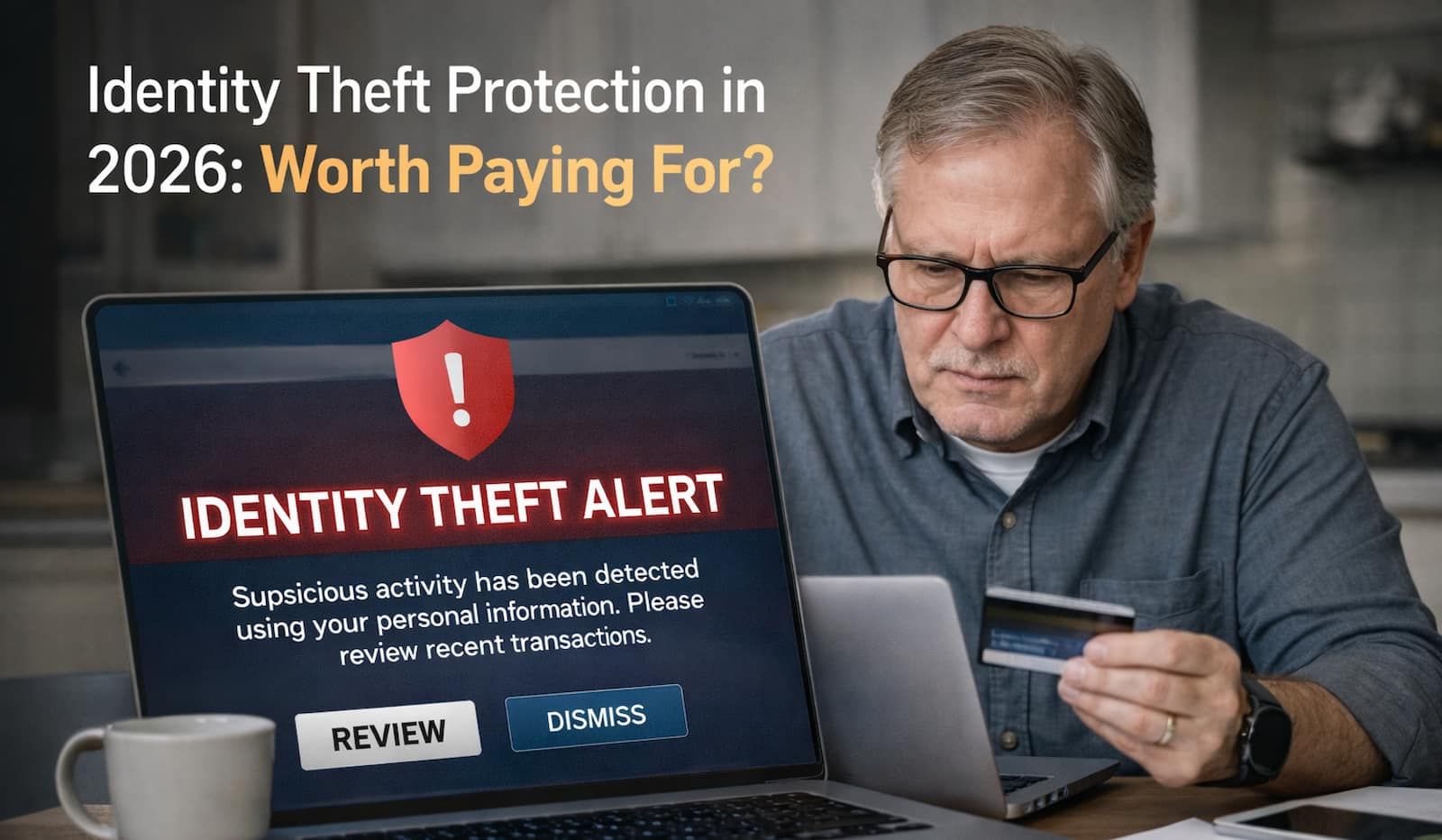
Identity Theft Protection in 2026: Worth Paying For?
2026 guide for US, UK, Canada, Australia, and New Zealand readers on whether identity theft protection is worth paying for. Covers what it actually includes, reimbursement limits, recovery support, credit freezes, and the steps that truly reduce fraud losses.

TL;DR
Identity theft protection is not a force field. In 2026 it can be worth paying for if you are high-risk, time-poor, or protecting a household or small business. If you already freeze credit, use strong authentication, and watch accounts, many subscriptions are expensive placebo.
Identity theft protection in 2026 is worth paying for if you have elevated risk (prior breach, high net worth, dependent family members, small business exposure) or you need hands-on restoration help. It can reduce damage and time, but it cannot undo bank transfers, gift cards, or crypto losses. Recovery speed depends on payment rails, policies, and law.
Introduction
You know the moment.
We are refreshing the bank app like it is a slot machine. We are whispering, “Please fail, please fail,” at a transaction that already posted. We are googling “can bank reverse transfer” at 2 a.m. like the internet is going to hand us a time machine.
Here is the clean fact: when money leaves through the wrong rail, it is gone. Not “maybe.” Gone.
So where does identity theft protection fit in, and when is it actually worth paying for in 2026?
If you are here after fraud and need the blunt post-hit breakdown, read this next: Credit monitoring vs identity theft protection in 2026: what helps after fraud.
Not when a scammer wants you calm. Not when an affiliate page wants your click. We are here to decide whether a subscription buys real protection, or just the comforting illusion of “someone’s watching” while the criminals do cardio in your accounts.
Expectation vs Reality
Expectation: “I pay $29.99/month and fraud bounces off me.”
Reality: “I pay $29.99/month and still have to freeze credit, change passwords, file reports, and fight paperwork like it is my second job.”
What Actually Happened
Identity theft protection is sold like a superhero cape. In real life, it is mostly three buckets:
- Monitoring: Alerts for credit file changes, dark web dumps, and sometimes bank account monitoring (limited, inconsistent, depends on integrations and region).
- Restoration help: A human (or a team) that helps you file forms, dispute accounts, draft letters, contact bureaus, and build a paper trail.
- Insurance: Usually coverage for certain out-of-pocket costs related to restoration. Not a blank check. Not “all losses.” Not “your money back.”
Scammers love this landscape because it is confusing on purpose. They also love pretending they are your bank, your credit bureau, the FTC, or “fraud support.”
Their script is always the same sad remix:
- “Your account is at risk.”
- “Move your money to protect it.”
- “We are sending a code. Read it to me.”
- “Do not tell anyone. This is sensitive.”
That last one is my favorite. Nothing says “legitimate organization” like demanding secrecy like a cartoon villain.
Micro-scenario #1 (how it unfolds):
You get a call spoofed as your bank in the United States. They “confirm fraud,” then push you to Zelle money to a “safe account.” You do it because panic makes smart people temporarily unplug their frontal cortex. The transfer is authorized. The money is gone. Your identity theft subscription did not “stop” it, because you pressed send.
Micro-scenario #2 (how it unfolds):
A UK consumer gets a text from “HMRC” about a tax refund. Click, enter details, then a new payee appears in online banking. A small transfer tests the waters. Then a bigger one hits. The identity protection service may alert after the fact. Great. The scammer already ate.
Why This Issue Happens
Because scammers do not beat security. They beat humans.
They weaponize:
- Urgency: “Right now or you lose everything.”
- Authority: bank logos, government language, “case numbers.”
- Isolation: “Do not talk to anyone.”
- Shame: “How did this happen?” (We feel it instantly.)
And when we panic, we freeze. That is not stupidity. That is biology doing the wrong thing at the worst time. Our brain goes into “survive the tiger” mode, except the tiger is a guy in a hoodie copy-pasting scripts from 2012.
“We did not ‘fall for it.’ We got hit with a professionally engineered lie at full speed.”
The Moment Money Leaves
This is where fantasies go to die.
Different payment types have different recovery odds. Not “fairness.” Not “who deserves it.” Just mechanics, policy, and law.
Payment type vs recovery chances
| Payment type | What “final” looks like | Typical recovery reality |
|---|---|---|
| Credit card | Chargeback system exists | Best odds if you report fast and it is unauthorized |
| Debit card | Bank account money leaves faster | Possible protections, but timing and investigation matter |
| ACH / bank transfer | Funds can settle quickly | Sometimes reversible early, often not once settled |
| Wire transfer | Designed to be final | Very hard to recover after release |
| Zelle and similar instant transfers | Authorized transfers are treated as authorized | Often unrecoverable if you sent it, even under pressure |
| Gift cards | Anonymous value transfer | Usually gone, fast |
| Crypto | Irreversible by design | Gone unless law enforcement intervenes quickly, which is rare |
Your bank does not have a secret “undo” button. If they did, scammers would be selling it on Etsy.
Chargebacks vs bank transfers
A chargeback is a dispute mechanism in card networks. It exists because card payments are built with consumer dispute rights and merchant accountability.
A bank transfer is money leaving your account directly. Once it clears, it is like handing cash to a stranger and then asking the universe for a receipt.
What You Can Still Control (Step-by-Step Actions)
No motivational nonsense. Just moves that reduce damage.
First 24 hours: rapid action summary
- Stop the bleeding: lock cards, change passwords, revoke access, log out of sessions.
- Freeze credit (US): freeze at all three bureaus, not “tomorrow,” now.
- Document everything: screenshots, transaction IDs, phone numbers, emails, chat logs.
- Report identity theft (US): use IdentityTheft.gov to generate a recovery plan and report.
- Report cyber-enabled fraud: file at FBI IC3.gov.
- Report fraud: report to the FTC at FTC.gov.
- Call the bank’s fraud department: from the number on the back of the card, not a number in a text.
- Tell your employer if work accounts were touched: especially if MFA or email was compromised.
- Create a clean email: if your main email is compromised, rebuild from a fresh address.
“If X, then Y” decision breakdown
- If you gave a scammer your bank login or MFA code, assume account takeover is underway. Reset credentials, revoke sessions, and contact the bank immediately.
- If you sent money via instant transfer, wire, gift cards, or crypto, treat it as likely unrecoverable and prioritize containment, reporting, and identity lockdown.
- If a new credit account was opened, freeze credit, dispute with bureaus, and file an identity theft report to support disputes.
- If your SSN was exposed (US), prioritize credit freeze, IRS protections, and account hardening. Identity theft protection may help with restoration, not prevention magic.
“Step one is boring. Step two is paperwork. Step three is rage. Welcome to the club.”
What Banks, Federal Law, or US Regulations Say
This is the part scammers hate because it ruins their “we are official” cosplay.
- The FTC is explicit about reporting identity theft and fraud. It also warns about impostors pretending to be the FTC.
- IdentityTheft.gov is the FTC’s official pathway to file an identity theft report and get a recovery plan in the United States.
- The FBI’s Internet Crime Complaint Center (IC3) is the central reporting hub for cyber-enabled crime, and its reporting helps pattern detection and investigations.
Data point (2024): IC3’s public reporting shows complaint-reported losses rising steeply over recent years, including $16.6 billion reported lost in 2024 (chart on IC3’s site).
What banks will not tell you directly
Banks and payment networks will say “we investigate.” Here is the less-advertised reality:
- If you authorized the transfer, many systems treat it as your decision, even if you were manipulated. Scammers build their entire business around this loophole.
- Speed matters more than your story. The earlier you report, the better your odds of stopping settlement or catching funds in transit.
- Policies are not laws. Sometimes you get reimbursed because the bank chooses to. Sometimes you do not because they choose not to.
- Documentation is leverage. A clean timeline, report numbers, and evidence make you harder to dismiss.
Detection and Prevention
This is the part that actually prevents fraud. Not vibes. Not “identity wellness.” Controls.
Detection (financial fraud early warning)
- Transaction alerts: enable push alerts for every card charge and every bank transfer.
- Account change alerts: new payee, new device, password change, new email, new phone number.
- Credit file locks: freeze credit in the US. In other markets, use the strongest available credit-file protections and alerts.
- Email monitoring: if email goes down, everything goes down. Secure the inbox like it is the vault key, because it is.
Prevention strategy (practical, not cute)
- MFA right: use authenticator apps or hardware keys when possible. SMS is better than nothing, but scammers love SIM swaps and social engineering.
- Password manager: unique passwords everywhere. Yes, everywhere.
- Device hygiene: keep OS updated. Remove unknown remote access tools. Scammers love “support apps.”
- Payment rail discipline: do not use instant transfers for strangers. Ever. If someone pressures you to “move money,” treat it as a confirmed scam.
Individuals vs small businesses (how prevention differs)
Individuals should focus on credit freezes, bank alerting, and account hardening.
Small businesses need all of that plus segregation of duties, approval workflows, vendor verification, and endpoint protection. Business fraud is not just “someone stole my card.” It is invoice fraud, payroll diversion, email compromise, and payment redirection. Criminals love businesses because the payments are bigger and the processes are sloppy.
“Scammers do not hack systems first. They hack your morning.”
Cost vs Benefit: When Identity Theft Protection Is Worth Paying For
Now we talk money. Because scammers love making victims pay twice. Once to the criminal, then again to a subscription that promises “peace of mind.”
Subscription pricing breakdown (what you are really paying for)
Pricing varies by provider and region, but the structure is predictable:
- Individual plans: usually monthly or annual.
- Family plans: higher cost, but can be cost-effective if it covers spouse, partner, and kids.
- Add-ons: credit bureau access, VPN, “dark web” monitoring, device security tools.
Here is the blunt truth: you are not paying for “prevention.” You are paying for monitoring + restoration labor + limited insurance.
So the value test is simple:
- Do you want alerts you could set up yourself?
- Do you want a professional paper-chaser when you are exhausted?
- Do you qualify for the insurance coverage, and does it cover the losses you actually fear?
Who actually needs it
Identity theft protection can be worth paying for if:
- You have already been breached and your data is circulating.
- You have high exposure: public-facing work, business ownership, frequent travel, frequent online purchasing.
- You are protecting kids or older relatives. Family plans can be rational here because minors and seniors are targets.
- You are time-poor and want restoration support to fight on your behalf.
- You are running a small business where identity compromise can turn into vendor payment diversion.
Who does not need it
Skip it if:
- You will not do the basics anyway. A subscription will not fix “password reuse + no alerts + no freezes.”
- You already freeze credit, monitor accounts, and have strong MFA. In that case, many plans are expensive redundancy.
- You think insurance means “they refund stolen money.” It usually does not.
Real-World Scenarios Where It Fails
Identity theft protection fails in predictable ways. Not because victims did anything wrong, but because the product is boxed in by reality.
- It cannot stop an authorized transfer. If a scammer manipulates you into sending money, the system sees “authorized.” That is the scammer’s whole plan.
- Monitoring is not omniscience. Some alerts are delayed. Some banks do not integrate. Some signals trigger after damage.
- Insurance is narrow. It often covers restoration costs, not your full losses.
- It does not replace your judgment. It cannot stop you from reading a code to a stranger who called you.
Insurance Fine Print (The Part You Pay For And Then Argue About)
Insurance is where marketing goes to cosplay as certainty.
Read for:
- What is covered: out-of-pocket restoration costs, legal fees in limited contexts, lost wages sometimes.
- What is not covered: many direct financial losses from transfers you initiated, business losses, “I was tricked” losses, consequential damages.
- Proof requirements: police reports, affidavits, documented timelines.
- Caps and sub-limits: the headline number is not the check you get.
This is not to scare you. It is to stop you from buying fantasies.
Tax Implications (Because Fraud Also Tries To Ruin Your Paperwork)
Fraud can become a tax problem in two ways:
- Tax identity theft: someone files using your information. You get a “surprise” from the tax authority, not a gift.
- Deductions and losses: rules vary, and many personal theft losses are not simply deductible like people assume.
Do not let scammers sell you “tax help” as part of a panic bundle. Use official pathways and reputable professionals when needed.
Family Plan vs Individual (And Why Kids Get Targeted)
Family plans can make sense when they cover:
- A partner or spouse.
- Children, including credit monitoring where available.
- Elder family members.
Why kids? Because a clean identity is a blank credit file. Criminals love blank files. It is like fresh snow for fraud footprints.
If you have kids: consider credit monitoring or freezes where available. Not because kids are careless. Because predators are relentless.
Business Use Cases (Small Business Owners, Yes, You Too)
Identity theft protection for business owners can be worth it when it is paired with real controls:
- Vendor change verification: confirm bank detail changes by calling a known number.
- Dual approval for payouts: no single person should be able to change payee details and send money.
- Email security: protect admin mailboxes. Use strong MFA. Lock down forwarding rules.
- Fraud detection: alerts on new payees, new devices, and high-value transfers.
Because invoice fraud does not care about your feelings. It cares about your accounts payable workflow.
🧱Hard Truth: If a scammer got you to authorize the payment, most “protection” products cannot reverse physics. Your best defense is prevention discipline and fast reporting.
⚠️Read This Twice: Any “support” person telling you to move money to protect it is the scam. That is not fraud prevention. That is fraud acceleration.
If You Remember Only One Thing: Freeze credit, lock the inbox, and treat payment urgency as a threat.
Recovery Timeline
No sugarcoating. Here is the typical tempo.
- 0–24 hours: stop bleeding, report, lock accounts, freeze credit, document evidence.
- 2–14 days: disputes, affidavits, new cards, new account numbers, password resets across everything.
- 2–8 weeks: bureau disputes, account cleanup, possible reimbursement decisions, endless “please upload this document” loops.
- 2–6 months: long tail fallout, collections notices, re-opened disputes, administrative cleanup.
Dry humor, as required: The paperwork is not a process. It is a lifestyle.
Recovery Scams
Now for the parasites that feed on the original crime.
Recovery scammers show up right after fraud because they know we are scared and desperate. They promise:
- “We can trace your crypto.”
- “We have a special contact at the bank.”
- “Pay a fee to unlock your funds.”
- “We are government recovery agents.”
They are lying. They are not “helpers.” They are scavengers.
If someone asks you to pay to get your stolen money back, especially via gift cards, crypto, or transfer, they are not recovering your funds. They are continuing the robbery with better branding.
“Recovery scammer: ‘Pay me and I will fix it.’
Translation: ‘I noticed you are bleeding. Mind if I juggle knives near you?’”
Common Mistakes to Avoid
We do these because panic is loud. Not because we are “bad at security.”
- We keep talking to the scammer because we want closure. Scammers do not do closure. They do extraction.
- We trust inbound calls because the number looks real. Caller ID is a costume shop.
- We delay reporting because we feel embarrassed. Shame is a scammer’s favorite lockpick.
- We scatter evidence across texts, notes, and memory. Build one timeline. One folder. One story.
- We pay a “recovery” fee because we want hope. Hope is good. Paying strangers for hope is how fraud gets sequels.
FAQs
Is identity theft protection the same as credit monitoring?
No. Credit monitoring is mainly alerts about credit file changes. Identity theft protection usually bundles monitoring plus restoration support and limited insurance. Neither is a guarantee against scams. They are tools. Your strongest prevention is credit freezes, account alerts, and refusing urgent money moves to “safe accounts.”
Does identity theft protection get stolen money back?
Usually not. It can help you fight disputes and handle paperwork, but it cannot reverse most authorized transfers, crypto, gift cards, or wires. Reimbursement depends on payment method, timing, bank policy, and applicable consumer protections. Buy it for help and speed, not for miracles.
Is a family plan worth it in 2026?
It can be, especially if it covers children and older relatives and includes restoration support. Families are targeted because attackers can pivot across multiple identities. If your household has multiple credit files and devices, a family plan may be cheaper than separate plans. But still do the basics: freezes and alerts.
What is the fastest first step after suspected identity theft in the US?
Freeze credit and lock the inbox. Then file an identity theft report at IdentityTheft.gov and a complaint at IC3 if it is cyber-enabled fraud. A clean paper trail improves dispute outcomes and reduces repeat attacks. Speed beats perfect wording. Report first, refine later.
Can small businesses use identity theft protection effectively?
Yes, but only as a supplement. Small businesses should prioritize prevention controls: vendor verification, dual approvals, strong MFA for email, and transfer alerts. Identity protection may help with owner identity misuse and restoration tasks, but it will not fix invoice fraud if your workflow is built like an open door.
Identity theft protection in 2026 is not a shield. It is a paid support system.
Pay for it if you need:
- Restoration help
- Household coverage
- Extra monitoring and faster containment
Do not pay for it expecting:
- Instant refunds
- Reversal of authorized transfers
- A life without paperwork
Conclusion
If you are reading this after fraud, the anger is valid. The shame is not. Scammers engineer panic on purpose, then blame victims for reacting like humans.
Money may be lost. Time will be wasted. That part is cruel and real.
But your awareness is still yours. Your next move is still yours. And once you harden your accounts and your habits, scammers do not get to hit you twice.
Scammers live on panic. We live on proof, locks, and a zero-bullshit “no.”
Disclaimer
This is education, not legal or tax advice. Fraud is messy, rules vary by country and bank, and scammers do not care about your jurisdiction. Use official reporting channels, document everything, and if you need professional help, hire a real one, not a “recovery wizard” in your DMs.